Sunday, July 31, 2011

Let your kids cry

Last summer, we traveled to Park City, Utah for a family reunion. The return flight from Salt Lake City was overbooked. We volunteered to be bumped (in exchange for $900 in airline vouchers!). The next flight didn't leave until the following day, so we spent the day in downtown SLC.

All of this doesn't really matter, except as the backdrop for the rest of the story. Eric wanted to see one of his college roommates who worked downtown. "Back in 10 minutes!" he told me. I had Dio (1 year old) and Zari (3 1/2). We waited...and waited...for him to return.

Finally we took a bathroom break in the basement of the Joseph Smith Memorial Building. Something upset Zari, and she refused to move. I had to pull her up the entire flight of stairs (while carrying Dio and being newly pregnant with Inga). Her tantrum continued unabated. I dragged her outside to a nearby park. I still couldn't get her to calm down. I probably could have, if I hadn't also had Dio to take care of and if I hadn't been frustrated by a missing husband. I was fed up with her behavior.

So I just left her there.

I sat down with Dio about thirty feet away. Zari continued throwing a tantrum. I played with Dio and kept an eye on her. Some of the other park-goers threw questioning glances at me. "Yes, she's mine," I would shrug and smile.

I've occasionally wondered if I should have done more to calm Zari down. I did get some nasty looks from other park-goers (as well as people telling me how calmly I was handling the situation!). But I read an article today that confirmed what I believe--that your children need to be allowed to feel sad, frustrated, angry, or disappointed. In How to Land Your Kid in Therapy, clinical psychologist Lori Gottlieb urges parents to back off. By being overly attuned to our children, by working so hard to ensure they are always happy and successful, we're actually doing them harm. In her practice, she encountered growing numbers of young adults who felt depressed, adrift, and unhappy, despite loving, engaged parents:
They truly did seem to have caring and loving parents, parents who gave them the freedom to “find themselves” and the encouragement to do anything they wanted in life. Parents who had driven carpools, and helped with homework each night, and intervened when there was a bully at school or a birthday invitation not received, and had gotten them tutors when they struggled in math, and music lessons when they expressed an interest in guitar (but let them quit when they lost that interest), and talked through their feelings when they broke the rules, instead of punishing them (“logical consequences” always stood in for punishment). In short, these were parents who had always been “attuned,” as we therapists like to say, and had made sure to guide my patients through any and all trials and tribulations of childhood. As an overwhelmed parent myself, I’d sit in session and secretly wonder how these fabulous parents had done it all.

Until, one day, another question occurred to me: Was it possible these parents had done too much?....

“Happiness as a byproduct of living your life is a great thing,” Barry Schwartz, a professor of social theory at Swarthmore College, told me. “But happiness as a goal is a recipe for disaster.” It’s precisely this goal, though, that many modern parents focus on obsessively—only to see it backfire. Observing this phenomenon, my colleagues and I began to wonder: Could it be that by protecting our kids from unhappiness as children, we’re depriving them of happiness as adults?

Paul Bohn, a psychiatrist at UCLA who came to speak at my clinic, says the answer may be yes. Based on what he sees in his practice, Bohn believes many parents will do anything to avoid having their kids experience even mild discomfort, anxiety, or disappointment—“anything less than pleasant,” as he puts it—with the result that when, as adults, they experience the normal frustrations of life, they think something must be terribly wrong.
When your child throws a tantrum, scrapes a knee, or fights over a toy and loses, give her some time to cry and feel entirely frustrated with the unfairness of the universe. It won't kill her. In fact, it will do her some good.

And next time you see a parent with a tantruming child, doing nothing about it, give her a sympathetic smile. It might be me.

Thanks to cjane for the heads-up.
Read more ...

Friday, July 29, 2011

Changing topics

I solemnly swear not to write about breech...for a while!

I've been a single parent this week while Eric has been on a research trip in Alberta. Dio puked at 3 am this morning and now I am coming down with something. It's been hot, hot hot. High 90s last week, mid-90s this week and 90+% humidity. We keep our house between 80-85 degrees, so it's not much cooler inside.

Zari is soaked and happy

Do any of you dress your kids in hand-me-downs from the other gender? Dio is wearing a perfectly nice pair of Zari's pink flowery leather sandals. I don't care, he doesn't care, so we're all good.
Read more ...

Thursday, July 28, 2011

Reply-turned-post: is banning breech at home reasonable?

Over at Academic OB/GYN, Nick Fogelson reprinted a letter from Oregon direct-entry midwife Jonie Dawning. Recently Oregon considered (but ultimately decided against) forbidding licensed midwives from attending breeches at home. Jonie Dawning testified in favor of this ban.

My original comment:
In a hypothetical scenario where every community had access to vaginal breech birth in a hospital, I might be more inclined to find Jonie’s proposal reasonable. But in our present situation, banning breech at home = forced cesarean for almost all women. This topic is particularly relevant to me, since I just organized a vaginal breech training workshop with a Canadian OB who has done 300-400 vaginal breeches and a Canadian midwife who has trained in a German clinic that does mostly upright (hands & knees) breeches. I was disappointed but not overly surprised that all participants were out-of-hospital providers. Unless some radical changes occur to bring vaginal breech birth back into the hospital setting, I think the future of breech birth will be at home. Interestingly the midwife we brought down was more hesitant about breech in a home setting (she has done them in both home and hospital in the past, but now only does breeches in hospital, in part to help train residents and OBs in the dying art) than the OB was.
Dr. Fogelson replied:
So should the practice be continued at home even though there is no skilled provider present? Does attending a course give one adequate experience to provide breech birth?

I think the political issue of breech birth availability should not be addressed by providing the service in a suboptimal environment. I feel the same about VBAC.
And I wrote this:
A skilled provider is obviously optimal in whatever setting a breech birth happens. I’m just saying that there are women who would rather have a chance at a vaginal birth even in less than optimal conditions (i.e., with someone who hasn’t done a large number of vaginal breech births), rather than be forced into surgery.

I don’t think anyone was expecting this workshop to be the only training they needed to safely attend a breech. You’ve got to start somewhere, though, and simulation training with an experienced OB and midwife is a good place to start. Many of the participants had attended surprise breeches at some point in their careers and wanted more training for when/if that happened again.

I would love to see vaginal breech birth become common again in a hospital setting. But I don’t think that banning it in a home setting is the right approach. (This will further drive breech birth underground, as women either go unassisted or hire unlicensed midwives to be able to have a vaginal birth.) I’d rather find a solution that expands, rather than contracts, choices and that doesn’t limit women’s autonomy.
Come join the discussion--especially if you've had a breech baby (at home, in hospital, by c-section or vaginally).
Read more ...

Tuesday, July 26, 2011

Urgent--searching for vaginal breech providers in Nova Scotia

I was just contacted by a couple from Halifax expecting their first baby, due August 2nd. The baby is frank breech and they have been unable to find a doctor willing to do a vaginal breech birth. If anyone knows a provider in Nova Scotia willing to attend a primip frank breech, please let me know ASAP!
Read more ...

Sunday, July 24, 2011

Vintage beauty

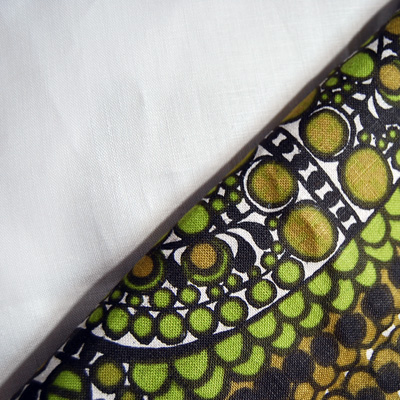
Several months ago, I bought four yards of 18" wide vintage hand-printed Norwegian linen. It was very retro, and I wasn't sure what to do with it.

Then my sister bought me several linens for my slings, and I was inspired to pair the print with a solid cream linen. 
The end result has a decorative panel (also functions as a pocket) of the vintage print on the tail.
By the way, I'm open again for business at Second Womb Slings. I have lots of gorgeous new linens and silks, and more batiks to be added for my infant scale slings.
Read more ...

Thursday, July 21, 2011

All about the breech workshop

What a whirlwind weekend...

It began Friday evening with a discussion session. Participants were able to ask questions of Peter and Betty-Anne, as well as share their own experiences with breech birth as either care providers or mothers of breech babies. The conference co-organizer, Penny Lane, opened the session with the stories of her three breech babies. It's an epic story, one that I hope to tell at a later date in more detail. (I might even turn it into a book, it's that fascinating.)

Saturday's workshop was with Dr. J. Peter O'Neill. He began with two hours of instruction and advice about vaginal breech birth. He reviewed the literature, including knowledge gained from the Hannah term breech trial and more recent European studies. He explained the Canadian breech guidelines and how they were created. Finally, he explained the mechanism of breech birth and the various maneuvers to free trapped legs, arms, and heads. Then it was time to do simulations. He and Betty-Anne had each brought a simulation mannequin, complete with a snap-on vulva and snap-on abdomen. You can imagine the wisecracks coming from a room full of birth attendants. ("Hey Rixa, your vulva's hanging out!")

The participants were all writing or typing furiously, trying to catch all of Peter's instruction and commentary. He was a fabulous instructor, and we all came away feeling confident in the skills he had taught us. He has attended about 8,000 births and between 300-400 vaginal breech births. He teaches vaginal breech, among other skills, for the Canadian ALARM courses taught to physicians, midwives, and nurses. A few highlights that I can remember from his workshop:
  • Trust your training and your instincts. Don't blame yourself for "missing" a breech prenatally--it's highly likely you didn't miss it, as babies can flip very late in pregnancy. 
  • Do vaginal breech births with a best friend--in other words, with someone who won't hesitate to tell you when you're not making wise decisions, when you're letting your emotions or your relationship with your client get in the way of the larger clinical picture. 
  • Try to keep your hands off the baby unless absolutely necessary. The more a breech baby is manipulated as it is being born, the more likely it is to do the "What the F#@!" startle reflex (Peter's words), throwing its hands up and its head back.
  • Peter did breech simulations with the mannequins on their backs, not because he feels that is the best or safest way, but because 90% of his patients choose epidurals and are largely unable to move from that position. He emphasized that the women he attends are free to choose any position they desire during labor and birth, whether for cephalic or breech presentations.
  • Pay attention to the language you use. For example, he never uses "maternal exhaustion" in his records. Instead, he writes "inadequate progress despite maximum maternal effort." He feels this keeps women from feeling like they failed if labor just did not progress, and it emphasizes the extraordinary effort that all labors entail. 
  • Don't fall into the trap of extrapolating from cephalic to breech births. What might be fine for a head-down labor might not be for a breech. He wants to see a breech labor begin spontaneously and progress steadily; in general, the time from 5-10 cms should not take much longer than 7 hours. Start-and-stop labors in a breech are a sign for caution and an indication that a vaginal birth might not be the best decision. Deciding to move to cesarean is not a failure. If certain signs suggest trouble, the decision to abandon a vaginal birth is a wise one. 
I have to say that I was beyond thrilled with Peter's workshop. He was approachable, generous, and willing to engage in an open exchange of ideas and experiences. Anyone who can keep a straight face with a room full of midwives talking about placentophagy has got my vote! I think we were all wishing we had him as a physician in our own communities.

Saturday evening was a lecture on upright breech birth by Betty-Anne Daviss. She took an anthropological approach to breech birth and reviewed the history of breech birth and maneuvers. We had booked the room for two hours, but she ended up speaking for just over an hour. We were all exhausted, and to be honest as much as I would have liked to learn more, I was glad to go back to my (not-so-posh) dorm room and rest. Several of us gathered in a lounge, snacked on cookies and Chipotle Grill wraps, and talked late into the night about birth (of course!).

Sunday's workshop was on upright breech birth with Betty-Anne. She spent the morning overviewing the various breech studies and trends in breech birth throughout the US, Canada, and Europe. I enjoyed learning about how she ended up at Dr. Frank Louwen's clinic in Frankfurt, Germany. She is part of his reserach team gathering data on upright (hands & knees) breech births. They are close to submitting their data for publication. I can't wait to read their findings. Preliminary data that Dr. Louwen presented two years ago in Ottawa showed that the upright position leads to fewer feto-maternal complications, fewer abnormal heart rate tracings during pushing stage (due to less cord compression), and lower morbidity.

Betty-Anne also explained in detail the mechanism of upright breech birth. Using a flexible pelvis and cloth doll, she explained step-by-step how a breech baby descends and turns through the maternal pelvis. At that point Gail Tully (of Spinning Babies) jumped up and started illustrating what Betty-Anne was explaining. By the end of the day, we had all sorts of lovely drawings from Gail. I hope she will reproduce them!

The afternoon was spent doing simulated hands & knees breech births with Betty-Anne and Gail. A few things I learned specific to hands & knees positioning:
  • The baby normally presents at the vaginal outlet with the butt transverse and one butt cheek rumping first, rather than facing directly forward.
  • Once the baby has been born to the umbilicus, you should see a line of "cleavage" on the baby's chest. This indicates that the arms are NOT trapped and in a good position to be born. If you don't see this fold of skin, this indicates that one or both hands are behind the head. AT this point the baby's body should be turned and the baby should be facing you straight on. If the baby remains turned sideways, this again is a bad sign, indicating an inability to descend and rotate properly due to trapped arms.
  • "Frank's nudge" (also called the Louwen maneuver) is used once the arms are born and the head is still inside the mother. Often the baby will emerge on its own. But if the head is not born relatively soon--let's say within the next contraction--this maneuver will help the head be born. First ascertain that the baby's head is facing directly forward, rather than turned to the side. If needed, turn the baby's head to face directly posterior (right towards you, since you are looking at the mother's behind as she is on her hands & knees). Use your thumbs or first two fingers and press on the baby's shoulders towards the mother's pubic bone. (Do not press on or near the clavicles, as they are prone to breaking.) This maneuver causes the back of the baby's head to press against the pubic bone and flex forward, freeing the head.

Attending the breech skills workshop this past weekend reinforced the need for open, honest, and respectful collaboration between home and hospital based providers. Dr. O'Neill's approach to helping women was simple: do what is right for mothers and babies, without regard to political or liability concerns. If a home birth transfer occurs while he's at work, he prepares whatever the situation requires (for example, he would prepare the OR and scrub in for an urgent transport). Then he greets the woman with this simple phrase: "What can I do to help?"
Read more ...

Wednesday, July 20, 2011

Home Birth Summit update

Guess who was invited to the upcoming Home Birth Consensus Summit? Me!

I am really excited to participate in this event. I am also curious to see how things play out. There's been a lot of grumbling about who was chosen and how. With a limited number of slots for each stakeholder, inevitably most of those interested (and qualified) will not be able to attend. Because of that, some have already dismissed the summit as inherently flawed. I'm not going to pass judgment on the summit, though, before it even happens.

If you have a perspective you'd like to add, please comment at the open forum for the home birth summit.
Read more ...

Sunday, July 17, 2011

New breech maneuvers

I learned several new vaginal breech maneuvers this weekend from Dr. J. Peter O'Neill, including

the Vanna White Maneuver
("Don't put this on YouTube," he'd say with a graceful sweep of his arm)

the Getting Off a Horse Maneuver

the Pringle Chip Maneuver

Learning breech birth has never been so much fun. More details forthcoming, but I wanted to say that Dr. O'Neill was a phenomenal teacher, physician, and person. I've found a new Dr. Wonderful*. If you live in Kingston, Ontario, you are lucky to have access to him.

* Other Dr. Wonderfuls include Andrew Kotaska, Robert Biter, and family practice physician "doctorjen". 
.
Read more ...

Wednesday, July 13, 2011

Lecture on upright breech birth

Please distribute widely! Click on the image to download the PDF flyer. Text-only version below.
Upright Breech Birth: 
What We Can Learn From the Germans
Lecture by Betty-Anne Daviss

Saturday, July 16, 7pm
Pharmacy Building, Room 150
Butler University

Betty-Anne Daviss has undergone extensive training in Germany in
upright breech birth. A professor at Carleton University, Daviss has
30 years of experience as a midwife in Canada.

What is upright breech birth?
A decade ago, German obstetrician Frank Louwen began doing vaginal
breech births with women in an upright (hands and knees) position. The
results were compelling—fewer fetomaternal complications, less
umbilical cord compression during the pushing stage, and reduced need
for maneuvers, leading to lower maternal and perinatal morbidity. His
Frankfurt clinic has delivered approximately 1,000 vaginal breeches in
the past decade, 90% of which were in the upright position.
Read more ...

Saturday, July 09, 2011

Wedding reception

My older sister, whose wedding we attended this May in DC, had a wedding reception at my parents' house yesterday. It was a lovely evening in our backyard. I was able to take a few pictures before my camera died.
Zari looking angelic
my sister and her husband
flowers from the garden
tables, chairs and linens were borrowed
each of us got a set of apothecary jars to take home
individual mango-lime cheesecakes
cool drinks for a warm evening
walking violin serenade

My mom, as usual, outdid herself. My sister joked that "this was mom's party, to which I was invited." My mom planned the decorations, food, and music. She cooked half of the food and had friends help make the rest. She even wrote some of the arrangements that her string quartet and violin students played.

The evening's menu:
Finger foods
  • Avocado & goat cheese crostini
  • Double tomato bruschetta
  • Filipino lumpia with sweet chili sauce
  • Pesto ravioli on skewers
  • Edamame
  • Chicken satay with peanut sauce
  • Baguettes and cheeses
  • Fresh fruits and vegetables
  • Bacon-wrapped dates stuffed with Gorgonzola
  • Endives stuffed with hummus and balela
  • Swedish meatballs
Drinks
  • Lemon/lime infused sparkling water
  • Raspberry/strawberry infused sparkling lemonade
Desserts
  • Mango-lime cheesecake
  • Blueberry-lemon cheesecake
  • Sachertorte
Read more ...

Tuesday, July 05, 2011

Bathroom renovation: final pictures

We finished renovating our master bathroom, just in time to move. It looked like this before we started and like this in the middle of renovations. We started this project when I was 6 months pregnant.

I took pictures the day before our renters (a new tenure-track professor and her husband) moved in. I love the antique vanity & mirror we found. My dad helped me refinish the wood and cut holes into the marble for the sink and faucet. We also put bun feet on the vanity to bring it up to the right height.
I had an antique silver chandelier that I had found in our house in Iowa City and had moved it with me a few times, thinking "some day I will find a use for this." (I usually don't do this, but the light fixture was really cool and I couldn't justify getting rid of it.) I used two of the five arms to make these vanity lights. I think the little shelves below the lights were for candles, back before electricity.
I miss our tub and our fancy shower...but I am sure our renters will enjoy them!
Read more ...

Sunday, July 03, 2011

Bright Star diapers

I love the huge variety of cloth diapers available to parents nowadays: prefolds, flatfolds, All-In-Ones, All-In-Twos, pockets, and wool covers. You can wrap your baby in bamboo and hemp, cotton and wool, even in silk! Cloth diapers are stylish as well as functional. I know a lot of parents who love their cute cloth diapers so much that they rarely put pants or skirts on their babies.

I had the opportunity to test-drive a Bright Star Ultimate Trim Fit All in One Diaper, thanks to Abby Flores of Itsy Bitsy Bums. Mine came in Horizon, a pale sky blue.
 

So what is a Bright Star diaper?
The maker of Fishnoodles diapers has created a new diaper line called Bright Star. The diapers are advertised as All-In-Ones, but actually I'd call them a hybrid diaper. It combines the elements of an AIO and a coaker/cover system. The inside soaker pad snaps into the diaper at the back. You normally leave it snapped in during washing and drying, but you can remove it for additional cleaning.

The outer part of the diaper is made of PUL and lined with a thin layer of fabric. I tried re-using the cover with a new soaker, but the inner layer of fabric does get damp enough after one use that you have to change both parts each time (which makes it more of an AIO).

The soaker pad is cleverly engineered with 7 total layers. However, it dries quickly because the layers are serged together in groups of two and only joined where they snap into the outer diaper. I like this combination of high water retention and efficient washing & drying.
Photo taken right after washing & drying...soaker is spread out to show layers
The diaper uses a side-snap closure (the front snaps over the wings). There are four sets of double snaps on each side, giving each diaper a good range of sizes.

What are Bright Star diapers made of?
The outer layer is PUL, like most modern cloth diapers. The soaker is made of bamboo and organic cotton fleece.

I love the range of colors and patterns! I'm drooling over the limited edition prints...Skully, Black Butterfly, Aloha, and Dalmatians are some of my favorites.

How do the diapers fit?
Bright Star diapers come in 3 sizes: 0, 1, and 2. Dio (2 years old, about 25 lbs) fits very comfortably into the second set of buttons on a size 2 (24-32 lbs). He probably could still fit into the last set of snaps in a size 1 (12-28 lbs). In fact, you could probably diaper your baby almost entirely in size 1s, as long as you had something else for the first few weeks.

Bright Star diapers have a very trim, smooth fit. The front goes under the belly, while the back rises to keep the diaper snugly on the waist. The back waistline of the diaper is serged, rather than bound or turned, making it even trimmer.

I've washed and worn my Bright Star diaper 20+ times. It has held up well, no staining or pilling or fraying. The only complaint I have is that the outer diaper scrunches up after it's first washed (totally normal for a diaper bound with elastic). When you lay the soaker on top of the diaper, the soaker overlaps the crotch sides. You have to put your hand on the soaker and tug the four corners with the other hand until all the soaker edges are tucked in. Not a huge deal, but definitely a design element I'd suggest changing.

For a super-detailed review of the Bright Star diaper, and a comparison to the retired Fishnoodles diaper, visit Bitsy Buzz.
$21.50 for solids, $22.50 for prints. Volume discounts available.
Read more ...

Saturday, July 02, 2011

4 months old!

Inga is already 4 months old! We drove back from Canada last weekend, surviving the 3-day trek home despite a bad coolant leak and antsy kids. Now we're unpacking boxes of books, making war on poison ivy (it's showing up all over the grass...eek!), and enjoying having my sister, her husband, and her 4-month old baby stay with us while they look for a house.

Pictures coming soon--today was super fun but too busy for pictures. Farmer's market, assembling bookshelves, helping our friends with their landscaping and then cooling off in their pool, and moving our swingset from our old house to our new house.

Stay tuned for a review of Bright Star diapers!
Read more ...

Thursday, June 23, 2011

Autonomy, Information, and Power

I find myself increasingly drawn to the principle of autonomy. It has been adopted by law or by custom in most Western countries. If patient autonomy were fully adopted and enforced, it could bring about substantial changes in maternity care. (More about this at tonight's talk.) We have a long way to go to reach true autonomy in both key areas: informed consent and the right to refuse treatment.

In a recent post on the surgical consent process, Dr. Nick Fogelson proposes that communicating risk by listing any and all possible risks in precise statistical fashion might not be the best form of informed consent. He comments that our current method of informed consent is
a bit like asking your neighbor bring your son home from school, and having her say “we may get hit by another car, I might run a red light, we may run out of gas on a train track, there might be a meteor that hits the car and kills us all…. but don’t worry I am a good driver and your son will be fine.”

The fundamental reason we do these consents is that we believe that in some way they will protect us in a lawsuit if something bad happens. For example, let’s say somehow I transect a ureter in my patient’s hysterectomy, I can say “See – I said this was a risk of the surgery… it wasn’t my fault!”

But isn’t that a bit ridiculous? Is telling somebody that something bad could happen actually a defense if that bad thing does happen? In some cases a problem is truly random, such as the development of a pelvic abscess after a hysterectomy, but in other cases it is not. There is almost no situation in which I could cause a ureteral injury and have it not be a surgical error. If it happens, I did it – and it was a mistake. Ureters are damaged in about 1% of hysterectomies, but its not like they magically get injured in 1% of cases. In 1% of cases the surgeon makes an error....

The trouble with the standard consent process is that it doesn’t deal with the real issue; errors do occur, and physicians cannot be perfect. By naming error-driven events as statistical occurrences, the process supports an expectation that surgeons will never make errors, and thus the corollary that any surgical error is a de facto breach of physician’s fiduciary duty.
Dr. Michael Klein recently co-authored several studies on attitudes of maternity care providers. He found that pregnant woman rarely have complete or accurate information on common birth procedures.
It should be noted that regardless of the type of care provider, many women reported inadequate knowledge of common procedures....When combined with evidence on the nature of obstetrical power and control, and research showing that many providers are not evidence-based in their views, (3) this suggests that even a woman with strong values and beliefs could find it challenging to assert her choices in the professionally controlled process of birth. Women, especially first time mothers, who do not have evidence-based knowledge, are likely to be particularly sensitive to negative attitudes toward birth procedures and processes, from providers and other sources.
A recent editorial by Jackie Tillett in the Journal of Perinatal and Neonatal Nursing, Politics, Power, and Birth,   explores power interactions between childbearing women and their care providers. She comments:
The power relationships between women and their healthcare providers limit the choices that women may have and may even constrain the discussion of choices. If the healthcare provider believes that choices should be limited to those the provider feels comfortable providing, other choices may not enter into the dialogue.

Ideally, decision making regarding labor and birth will begin during prenatal care. The antepartum period is a time of exploration and questioning for many women. Care providers can facilitate this learning with adequate time during appointments, concern for a woman's misgivings, and encouragement. Informed consent may and should initiate a discussion of risks and benefits of procedures and routines.

However, even though informed consent implies an understanding and agreement with a plan of care, too often a woman is influenced by her perception of the healthcare provider as an unbiased expert. This is true of her perceptions of physicians, midwives, and nurses.
Later in the article, she addresses the language of allowance and how it limits autonomy:
The politics and power relationships of the labor and birth process may be seen to revolve around the word "allow." To allow is to make possible through a specific action or lack of action, or to consent to or give permission. The concept of allowance gives the power to the healthcare provider, whether physician, midwife, or nurse and makes the laboring woman dependent upon this allowance. Allowance removes some aspects of choice and consent from the woman and makes her dependent upon the actions and beliefs of the healthcare provider. To define the services one offers to pregnant women using the phrases "I allow" or "I don't allow" transfers all control to the provider.
Remember that autonomy = informed consent + right to refuse. With both of those key factors weak or missing in our current obstetric climate, autonomy exists in name only. It's time to turn rhetoric into reality. Or in Dr. Klein's words: "It is going to take a revolution driven by women to change this, as practitioners are not going to change very soon. To the barricades!"
Read more ...

Tuesday, June 21, 2011

Come to BirthTalk this Thursday!

I will be giving a talk this Thursday evening in Moncton, NB as part of the BirthTalk series hosted by Natalie Arsenault. My presentation is called "Childbirth activism: where we have come from and where we are going?" I will review the various childbirth movements of the 20th and 21st century and share my thoughts on the future of birth activism.

For more details, please contact Natalie. I hope to see you there!

Now here's the back story of how I met Natalie...I was at the downtown Moncton Farmer's Market about 10 days ago and saw a stall with beautiful batik and handwoven cotton slings. Aha! I thought. I have got to talk to her! She makes slings! Yes, I am kind of dorky that way. So I headed over with Inga (in a sling of course) and said hello. We chatted for a while about slings. Then it turned to birth stuff, at which point she gave me her card and asked if I'd be around for her monthly meetings, called BirthTalk. I went to the gathering last week and enjoyed myself quite a bit. She invited me to give a presentation this week. I don't have access to most of my materials, so it will be informal but still interesting and thought-provoking.
Read more ...

Open forum for the Home Birth Summit

Several blog readers expressed concerns or comments about the upcoming Home Birth Consensus Summit, to be held this fall. This post is an open forum for your comments/concerns/questions. I will make sure your input reaches Geradine Simkins.

If you were able to attend the summit, what would you say? What are the biggest obstacles you have experienced to home birth in general? In your own community? What would make it safer, more accessible, etc?

Speak up!
Read more ...

Saturday, June 18, 2011

Baby gear, circa early-to-mid-1800s

While we were visiting the Keillor House in Dorchester, NB, we saw several fascinating baby items. We always talk about life being simpler "back then." But even 150-200 years ago, there was plenty of baby gear for parents to accumulate.

When I was little, my parents used a Johnny Jump-Up. I have memories of kicking my baby brother while he was sitting in it. These apparently aren't new. Here's a "Jolly Jumper" from the 19th century. It is suspended from the ceiling by a rope.
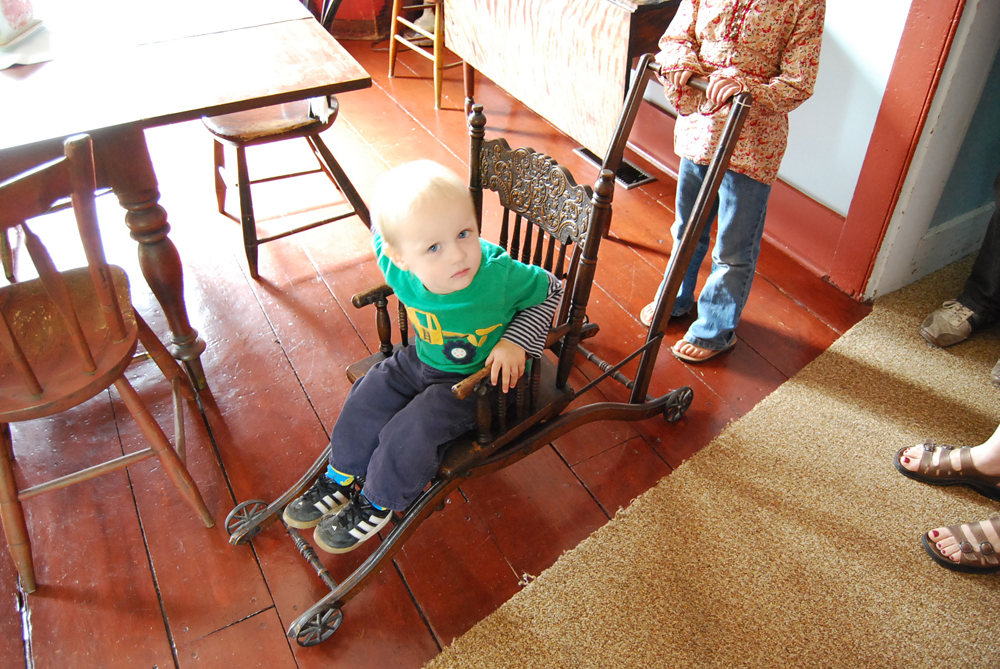
I loved this multi-function chair. Now it's a high chair...
Now it's a stroller!
Finally, here's a little child-sized potty (missing the bowl underneath)
Read more ...

Monday, June 13, 2011

When they need it, where they want it

A recent press release from the SOGC (Society of Obstetricians & Gynaecologists of Canada) shows support for women's autonomy in childbearing. In honor of the International Day of the Midwife, the SOGC released this document (PDF). Dr. Lalonde upholds pregnant women's autonomy in where and how to give birth:
“The SOGC acknowledges that it is the mother’s decision to decide where she would like to give birth,” stated Dr. André Lalonde, executive vice-president of the SOGC. “Most babies are born without serious complications. As ob/gyns, our specialized training allows us to address the unique requirements of high-risk situations. What matters is that all professions acknowledge each other’s competencies and work together to provide mother and baby with the quality care they need, when they need it, where they want it.”
Read more ...

Sunday, June 12, 2011

What is autonomy?

My earlier question asking if autonomy is just for the natural birth crowd got sidetracked into arguments about the safety of home birth. Yawn. (Is anyone else ready to move on from these worn-out debates?)

Anyway, let's talk about what autonomy is and what it means in a healthcare context. From Wikipedia (emphasis mine):
Autonomy (Ancient Greek: αὐτονομία autonomia from αὐτόνομος autonomos from αὐτο- auto- "self" + νόμος nomos, "law" "one who gives oneself their own law") is a concept found in moral, political, and bioethical philosophy. Within these contexts, it refers to the capacity of a rational individual to make an informed, un-coerced decision. In moral and political philosophy, autonomy is often used as the basis for determining moral responsibility for one's actions. One of the best known philosophical theories of autonomy was developed by Kant. In medicine, respect for the autonomy of patients is an important goal as deontology, though it can conflict with a competing ethical principle, namely beneficence. Autonomy is also used to refer to the self-government of the people.
Let's take a look at the Patients' Bill of Rights adopted by the Association of American Physicians and Surgeons (emphasis mine):
All patients should be guaranteed the following freedoms:
To seek consultation with the physician(s) of their choice;
To contract with their physician(s) on mutually agreeable terms;
To be treated confidentially, with access to their records limited to those involved in their care or designated by the patient;
To use their own resources to purchase the care of their choice;
To refuse medical treatment even if it is recommended by their physician(s);
To be informed about their medical condition, the risks and benefits of treatment and appropriate alternatives;

To refuse third-party interference in their medical care, and to be confident that their actions in seeking or declining medical care will not result in third-party-imposed penalties for patients or physicians;
To receive full disclosure of their insurance plan in plain language...

In a healthcare context, autonomy means being informed about the full range of risks, benefits, and alternatives of a proposed treatment (informed consent), and having the ability to accept or reject the treatment (right to refuse). Or for you math geeks:
autonomy = informed consent + right to refuse
While patients have the right to refuse treatment, they do not necessarily have the right to demand medically unnecessary treatments. For example, if your leg is injured and your physician recommends amputation, you have the right to refuse. However, you do not have the right to demand an amputation of a healthy limb. 

In maternity care, the right to refuse and inability to demand are not always consistently applied. Women are often not allowed to refuse certain treatments, such as repeat cesarean section or IV therapy. On the other hand, many women are able to demand medically unnecessary treatments, such as elective primary cesarean or elective induction. This inconsistent application of autonomy and patients' rights has emerged from cultural beliefs in the inherent risk of labor and inherent safety of medical intervention and from concerns about litigation and liability. 

So I ask again: is the desire for autonomy really a frivolous, selfish concern at best, and a potentially dangerous doctrine at worst, as implied by more than one commenter? 
Read more ...

Saturday, June 11, 2011

Home Birth Summit

I've been hearing buzz about a Home Birth Summit coming some time this fall. I recently received a message from Geradine Simkins via a midwifery list I belong to with more details about the summit participants. This might assuage some concerns, such as the ones articulated at The Trial of Labor, about who is attending and how they were chosen.

Below is the letter from Geradine Simkins, president of MANA.

~~~~~

Dear Friends,

I’d like to address some of the comments about the upcoming Homebirth Summit. First of all, this is an idea that has been brewing for at least two years, some might say for two decades. No one really “owns” the idea of putting together a gathering of multiple stakeholders to have a frank and productive conversation about how to best support and care for women who chose homebirth. But after lots of conversation—the decisive one being at the ACNM Homebirth Section meeting two years ago—we decided to pursue this “project” in earnest.

Many of you may be familiar with the type of process we chose. It is not unlike what Childbirth Connection chose to use when they initiated the process for creating their seminal work, “Transforming Maternity Care: A Blueprint for Action”. They convened a Vision Team of experts in the fields of maternity care and health systems, worked in specific stakeholder groups, and developed concrete solutions to some of the most pressing issues facing the U.S. maternity care system. The result is a group of actionable strategies to improve maternity care quality and value.

It was not a conference; it was an invited work team. The Homebirth Summit will also not be a conference. Here are some details about the process and the participants:


  • In order to get representatives to the table who are in any way involved with homebirth, 72-80 delegates have been identified to be evenly balanced across 9 stakeholder groups (listed below).
  • The invitation selection process has been an iterative process with many rounds of vetting, internally and externally.
  • Short lists were created by subcommittees chaired by those who knew those stakeholders.
  • Each subcommittee of the MULTIDISCIPLINARY planning group went through a detailed vetting and weighing process and considered the balance of perspectives, ethnicities, gender, age, geography, and other factors.
  • After serious consideration, we hired consultants from Future Search because of their success with consensus building among groups with very disparate (and often conflicting) ideas, values and principles.
  • We are using Future Search Methodology, which prioritizes including participants who had authority, information, expertise, need, and resources.
  • We also prioritized those who were likely to respect the process by fully engaging in the Future Search methodology and open-minded dialogue.
  • The stakeholders are NOT ANY ORGANIZATION but rather are individuals who are defined as belonging in these nine stakeholder groups:
    • Consumers (from a variety of perspectives)
    • Consumer advocates (doulas, childbirth educators, childbirth and women’s healthcare activist)
    • Home Birth midwives (CPM, CNM, LM, Amish, traditional, whatever)
    • Obstetricians and OB family practice
    • Collaborating MCH providers (nursing: L&D, neonatal, pediatrics; CNMs who provide backup)
    • Health insurers and liability insurers
    • Health policy, legislators, legal, ethics
    • Research and education: Public Health, epidemiology
    • Health models, systems, administrators


In this way, the WHOLE SYSTEM is at the table. Otherwise, we will not be able to seriously come to consensus.

The point is not to debate the “right or wrongness” of homebirth, or even the safety. The goal is to establish what the whole system can do to support those who choose homebirth, and provide the care, safety net, consultation, collaboration and referral necessary to make homebirth the safest and most positive experience for all involved—moms, babies, families, communities, health care workers, hospital personnel, administrators, payors, and so on.

We have been meticulous and intentional about our process. Nonetheless, not everyone will agree with our process. With only 72-81 spots to make this a functional process, not everyone will be happy with those that are selected, and specifically, if they were not selected.

I would ask you to consider that we are working very hard and with the firm intention of making the process, the event and the outcome as optimal for mothers and infants as possible, and for the benefit of midwives serving homebirth clients.

In solidarity,
Geradine

--
Geradine Simkins, CNM, MSN
President & Interim Executive Director
Midwives Alliance of North America
president@mana.org
executivedirector@mana.org
geradines@gmail.com
275 Cemetery Rd.
Maple City, MI 49664
231.228.5857
Read more ...
Related Posts Plugin for WordPress, Blogger...