The kids are packing for a 4-day camping trip. We've got tents, backpacks, sleeping bags, mattress pads, suitcases, clothes, pillows...mostly in order. It will be quiet with just me, Eric, and Zari.
I wanted to drive up with the kids, but there will not be any space in the care since Eric is also bringing a few others in the car.
The waves were huge today. I snuck away with Ivy and Inga and had a great time playing. I couldn't stay long because I had another meeting, but at least I got out.
Eric's computer turned itself on at 4 am, so I was woken up thinking it was sunrise...only to find out it was the rainbow lights of his keyboard and mouse. I didn't sleep much after that and I've been exhausted all day. I also feel like I'm coming down with something. Zari had a brief day of fever/chills/body aches a few days back, so it's not entirely surprising.
There was a big party at Cavigal for players and families: potluck dinner and big soccer game. Everyone one went except for me (I wasn't feeling great, plus it was one of my long fasting days so I wouldn't have eaten anything). I did go out on a walk this evening, shorter than usual due to the heat.
Ivy managed to get a ball kicked into her face, so she's complaining of a sore jaw and a split lip on top of her shark fight face :(
I did a few small home renovation things today getting ready for our departure. Sigh...I just want to stay.
Our friends visiting in Le Chateau made us a 4th of July dinner, French style: "hot dogs" (merguez sausages in baguettes with harissa mayonnaise, pecorino cheese, arugula, & roasted zucchini) and apple pie (a variation on a tarte Tatin). Super delicious!
After dinner, I went with Ivy and Inga to jump off the rocks at the point. They're about 2 meters high--high enough to be fun, but not high enough to be dangerous.
We were getting ready to swim back. Ivy and Inga were in the water swimming around. Ivy went under the water and ran face-first into a rock. She came up with blood streaming down her face. I jumped off the rocks and swam over to her. Nothing life threatening but plenty of blood everywhere.
We swam back to shore, and some nice lifeguards at the private beach/restaurant patched her up. She has tons of scrapes and a gash across the bridge of her nose.
She is telling people that she had a fight with a shark.
Besides the toe kicks--who knows when we'll get to them?--the kitchen is done!
I tried taking pictures with my good camera, but I couldn't get a good enough angle. So here are some phone pictures.
You can also see my office area on the far right. It's the first time in almost 11 years that I've had a desk in this apartment. Before, I was working at the kitchen table or on the couch.
I went swimming first thing this morning and decided that it's my favorite time to swim. It's a lot cooler because the rocks on the beach haven't heated up yet, and the water is glassy smooth.
One more day of school left for Ivy and Inga (but they haven't had proper classes for a few weeks now).
I was captioning videos and one of the computer-generated captions made me laugh: it wrote "atomic wrenches" instead of "tummy crunches."
I roused Zari at 8 am so we could start running by 8:30. We did 5k and then jumped into the sea. Ahhh! It was hot and I was losing steam by the end of the run.
I got 10 outlets wired this evening, so our countertop installation is finally done! I'll try to take some pictures tomorrow.
Eric made poke bowls for dinner and the kids LOVED it! We had: red rice, avocadoes, mangoes, marinated raw salmon, marinated shrimp, and edamame.
Oh, we had to go to the Prefecture today to pick up the kids' DCEMs. It was relatively quick (only 50 minutes' wait in line). We won't have to go back for several years and I am so thrilled! That place is so depressing.
After months and months, we finally got all of the counters and backsplashes installed in the kitchen. (Long story--I sent the correct measurements and the quartz fabricator entered them in wrong, sent me the sink in the wrong place, and then made me buy a new countertop because I had signed off on the estimate.)
We had a long wait for the new countertop piece, which I finally installed a few weeks ago. And then finally today I mobilized the Freeze team to get the 3 backsplash pieces put in. The silicone in joints needs to cure for a day, and then we can use everything.
The last two things left for this kitchen renovation are rewiring the 5 double outlets in the backsplash and installing the toe kicks.
What else? I did lots of video editing and captioning today. I enjoyed breaking a 42-hr fast at noon today. I started with scrambled eggs, chipotle sauce, and tomatoes; Comté cheese; and vegetable purée with crème fraîche. And lots of dark chocolate!
I snuck away for a quick 30 minute swim late this afternoon. Everyone else stayed a lot later, but I had a meeting. Eric approves of the paddleboard because it keeps the kids out on the water for much longer than they would usually stay.
Dio bought a 1-month gym pass so he can work out with his friends.
Zari, I, and a friend of mine went running this morning at 8:30--much better than 10 am! Zari and I jumped in the sea at the end, which makes the hot, sweaty run worth it.
I got 3 proposals sent off for the 2026 ACOG conference. Whew!
Ivy went to her friends' dance recital and is apparently eating out afterwards. It will be her second dinner.
Zari went with my friend and her nephew to see the new FI film. It was fun but predictable.
Several us went for a late afternoon swim and treasure hunt. Europe is in a heat wave, and we have it relatively easy--just 1-2 degrees higher than normal temperatures. Today was 33 or 34 C (91-93 F). We had no AC for many years, but I am very thankful to have it. We keep the house at a comfortable 26C (78.8 F), just enough to cut the heat and humidity. The bedrooms are turned off during the day and vice-versa with the living room at night. I actually get a bit cold even at 26, since I am sitting where the air blows on me.
My friend, who I've known since we lived in the same building since our freshman year in college, is a specialist on water. Yes, she even wrote a book about it! Anyway, today we had a water tasting. She bought 7 types of mineral water, 3 flat and 4 sparkling. Who knew water had so many flavors?
Vittel and Badoit got thumbs up, Hépar and Rozana thumbs down, although they have specific medicinal uses if you're low on, say, cacium or magnesium.
I did my usual walk at a somewhat moderate pace, to Cimiez and back. I used my spray bottle a lot on the way home to stay cool.
Eric and Dio had a parents vs. kids friendly match, with the parents winning 10-3.
Our friends made us a huge couscous lunch--delicious!
I went running at 10 am and was quickly regretting my life choices--way too hot! I went on an abbreviated run and vowed to start much earlier next time.
Eric and I were gone all day at a soccer tournament. They've had way too many this year.
In the afternoon, we made 4 batches of homemade pasta dough. A few weeks ago, I was at a thrift store and found a pasta machine from the 1970s--the exact same brand and box and everything as I had growing up! I had to buy it. I have so many memories of using the pasta machine when I was little. This was our first time trying it out.
We also made a big batch of homemade pesto with sundried tomatoes with basil grown in my hydroponic countertop garden. The one thing I miss, living here in France, is gardening. My little hydroponic system fills that gap just a little bit.
After dinner, it was time to swim. Zari came along, plus my friend and her nephew. The sea was as flat and calm as a lake and super clear.
We rinsed off, came home, and then walked up to the Chateau for the fête du Château, sponsored by the PCF (French Communist Party). It was the first time I've ever been up there at night, since it normally closes in the evening. There was music, food, and of course tons of booths about various PCF causes (transportation, housing, Palestine, etc.).
Also a photo from yesterday of Ivy sleeping on a row of chairs, post-sleepover.
Ivy had a sleepover with her best friend who lives just a block down the road. They woke up early to see our Canadian friends off on their way back to Vancouver after a year in Nice. Then they went back to sleep.
I had a random night where I was up most of the night. My body was like, "nah, no sleeping for you! I'm just going to have you lie in bed super bored and wired and think about the plot of the book you just read."
More friends arrived in Le Chateau and they'll be here until the day before we leave.
We've been busy with life and some really good friends moving back to Canada 😭
I've been thinking about getting a paddleboard for years...and I finally did it. I got one on clearance and the kids are loving it. I figured it was a great way to get everyone outside more. Money well spent. Inflating it is its own workout, and we still haven't been able to get anywhere near the recommended 15 PSI.
A good day...starting with sprint intervals early enough that it wasn't too hot. Ivy was awarded a prize for being an "élève méritant" and got a 15 Euro gift certificate to the local bookstore. We went to the ceremony (couldn't really hear anything, but oh well!). Through some miscommunication, Inga also thought she was supposed to come and get the same award, but it turned out not to be the case. She was quite disappointed.
Inga's team won a game tonight 11-2, with Inga scoring 2 goals. Dio had a practice that went really well. He's moving up to the higher-level team next year, which is exciting!
The music went on much later than in recent years...still crazy loud and noisy around 3 am. I couldn't get to sleep until things quieted down. Oh well...it's just once a year.
I got my normal walk in this morning--a bit more sedately due to the heat. We relaxed in the afternoon and watched and episode of X Files. Inga went directly to a waterpark, with giant inflatables on the ocean, after church so she and Eric were gone until mid-afternoon. It was with her soccer team so Eric talked with the parents while the kids played.
They're upset because after Inga cinched the victory that brought her team out of district and into regional level, her coach decided to keep them in the district level. His main reasons? It's a long more driving and he doesn't want them to drive really far and then lose and feel demoralized. The parents are quite upset because it was a huge deal to move up a division and the coach turned the opportunity down. Eric feels like it's sexism in action to turn down this opportunity for the girls. If it happened to a boy's team, it would be headline news and everyone in the club would be supporting them.
Welcome to France.
What else? Most of us had a nice swim this afternoon, then dinner (Eric's turn: salad, leftover rice, and duck breasts cooked with shallots, balsamic vinegar, & honey). Then more X Files.
I love that all of France celebrates the summer solstice with a huge music party. I hate that much of it is doof-doof electronic music. It was quite nice around here until 10 pm; acoustic, jazz, classic rock & roll. Then the doof-doof started. Ugh.
I met with a friend who having her entire apartment redone and talked through her electrical plans. It's quite the shock to see what the estimate is to have her electricity totally redone. Granted, it's in a huge apartment (huge for France, small for the US). That is why I could never pay someone to do something when I know I could do it myself and save like 20x the cost!
Ivy had a tournament all day in Antibes. The rest of us had a relaxed morning. I started them off with several wakeups (teenagers!) and French toast. We watched an episode of X Files after lunch, took some short naps, and then went swimming. Eric joined us at the beach after the tournament. The first two games they lost, but the last two they won.
More X Files after dinner. We just started it this week and the kids are enjoying the early 90s vibe, complete with cheesy music and effects.
Even though I didn't feel like it, I went running this morning. I'm glad I did. And the water was so gorgeous that I jumped in at the end to cool off.
Lots of sitting down the rest of the day. I also had a podcast interview with Dr. Stu and Triumphant Birth Podcast about our twin home birth paper.
After dinner I went to my friend's apartment that she's having renovated. The crew just started demolition last week and all the small dividing walls are gone and there is rubble everywhere. Ahhh, reminds me of old times in the communist apartment. I'm happy I don't need to do that again for a while!
Zari may have failed one of her catch-up exams from 1st semester (law class). She's not too worried about it because she only has to get a certain average overall to get credit for the missed first semester.
Eric caught two fish today: barracuda and marbré. Dinner tomorrow!
Whatever ailment it was last night, it was gone by morning. It took me a while to get to sleep. After I woke up the kids at 7, I went back to bed for a little nap.
I was sedentary today--unusual for me--except for a late afternoon swim. The water was gorgeously clear and calm. It's like swimming in a crystal. Zari found several treasures: a glow-in-the-dark fishing lure, a big hair clip, a little napkin, and some garbage.
Eric and I had dinner with BWB instructor Whitney Rose Pinger and her husband; they're staying at The Chateau tonight before heading back to the States. We're already planning a 2026 breech retreat. Can't wait!
A few pictures from this past week's breech training
Something is disagreeing with my stomach and I've been holding very still the past two hours on the verge of puking. No fun! I hope it subsides enough to let me get to sleep.
What else from today? Eric went spearfishing and almost caught a big fish. I went to the beach after dinner with Ivy. It was overcast and windy so I opted out of swimming and just chatted with my friend while the kids played.
Inga's soccer team won 15-0 with Inga scoring 4 of the goals. Eric is very excited about the new girls coming on next year (many of whom are trying out right now) and thinks they'll have an amazing team.
I tend to wake up early this time of year because it gets light out early. Despite having shutters, some light comes through and bing! I'm up. So today was 6 am for me. I definitely didn't sleep enough but there was no going back to bed, knowing I'd have to wake kids up at 7.
I did sprint intervals fairly early this morning, and I'm glad I did.
What else? Dio is doing a 2-week internship with me (required by his school). I'm putting him to work moving our website over to a different host.
I was tied up all week with our huge Train the Trainer event, which took every possible waking moment and many sleeping moments. I'm still recovering and let's just say that I have not yet conquered my email inbox but I'm getting closer!
It was an amazing week, both invigorating and exhausting in the best possible ways. We now have 12 new BWB instructors who will be going all over the world, from South Africa to Australia to all over the EU. I'm excited to see our presence grow and develop locally.
Meanwhile Eric has been crazy busy with back-to-back soccer tournaments. I've hardly seen him the past 7 days.
Ivy had her much-awaited "boum" last night (rainbow-themed dance party) and it was a huge success. It was hosted by a friend who brought together 2 groups of girls from 2 different schools who didn't know each other and now they are all great friends.
Anyway it's time for bed and hopefully I can find some pictures of what happened this past week.
Our Train the Trainer week is about to start! I've been working nearly nonstop to get everything ready. It's a relief to have it start so I can do it instead of prepare for doing it :)
I met up with several instructors/attendees this afternoon, from the US, Australia, and South Africa. We went to the beach, along with Eric and Zari, after discussing a few training items. It felt amazing to swim. The waves were big today, with that classic fluorescent blue water near the shore and dark blue further out.
And of course, guess what I was doing at 10:30 pm? Installing a kitchen faucet and soap dispenser. We finally got our 2nd countertop piece 2 days ago, and I knew that if I didn't install the faucet and dispenser now...we'd be without water for a week! I didn't have time to get the backsplashes installed; that will have to wait until the TTT week is done.
Tomorrow is a school holiday, so everyone else is going to have a beach day at Hyeres with a few other families.
We went to the drone & fireworks show last night, which was INSANE. I have never seen so many people in one place, ever. The entire beach, standing room only. The entire Promenade des Anglais + parallel streets and sidewalks, standing room only.
I caught a bit of the end of the drone show on camera.
Eric, Ivy, and Inga have been gone all day at Ivy's tournament. Inga stayed at the nearby campground to play with her friends. Eric had to come back to Nice for a book signing and then drive back...so he'll have been driving for 4+ hours today!
I've been preparing for the big Train the Trainer event next week. So many things to put together. Today we did an A/V test of our setup for livestreaming to those who cannot attend live. We (me and my assistant) bought loads of snacks. We need to get fresh fruits/veggies and juice/sparkly water tomorrow.
I had to load up on gloves and lube for the simulators. I hope the brand of lube I bought is one of the good kinds! You never know what will work on these simulators. Some are amazing and some are sticky and worthless...and I have LOADS of it now.
Our ongoing inside joke about buying 14 scoops of ice cream came to fruition yet again. It's my brother's last night here in Nice before he has to be a real adult again and work for a living. We got lots of funny looks as the workers were adding scoop after scoop.
Pictures from last Saturday when we carried the huge carpet home...
ps, any handsome* French** men*** looking to meet my brother? He's single! Every year we are determined to find him a "sexy French boyfriend."
* Somewhat subjective
** I suppose English-speaking is ok, too. And he also speaks fluent Russian!
*** Sorry ladies, this one is non-negotiable!
Dio has a fitness program from his US soccer coach, so I volunteered to do the exercises along with him. Zari joined in, too. Today was 30 second sprint intervals, with 30 seconds of rest between. We did 5 reps, rested 3 minutes, then did 2 more reps.
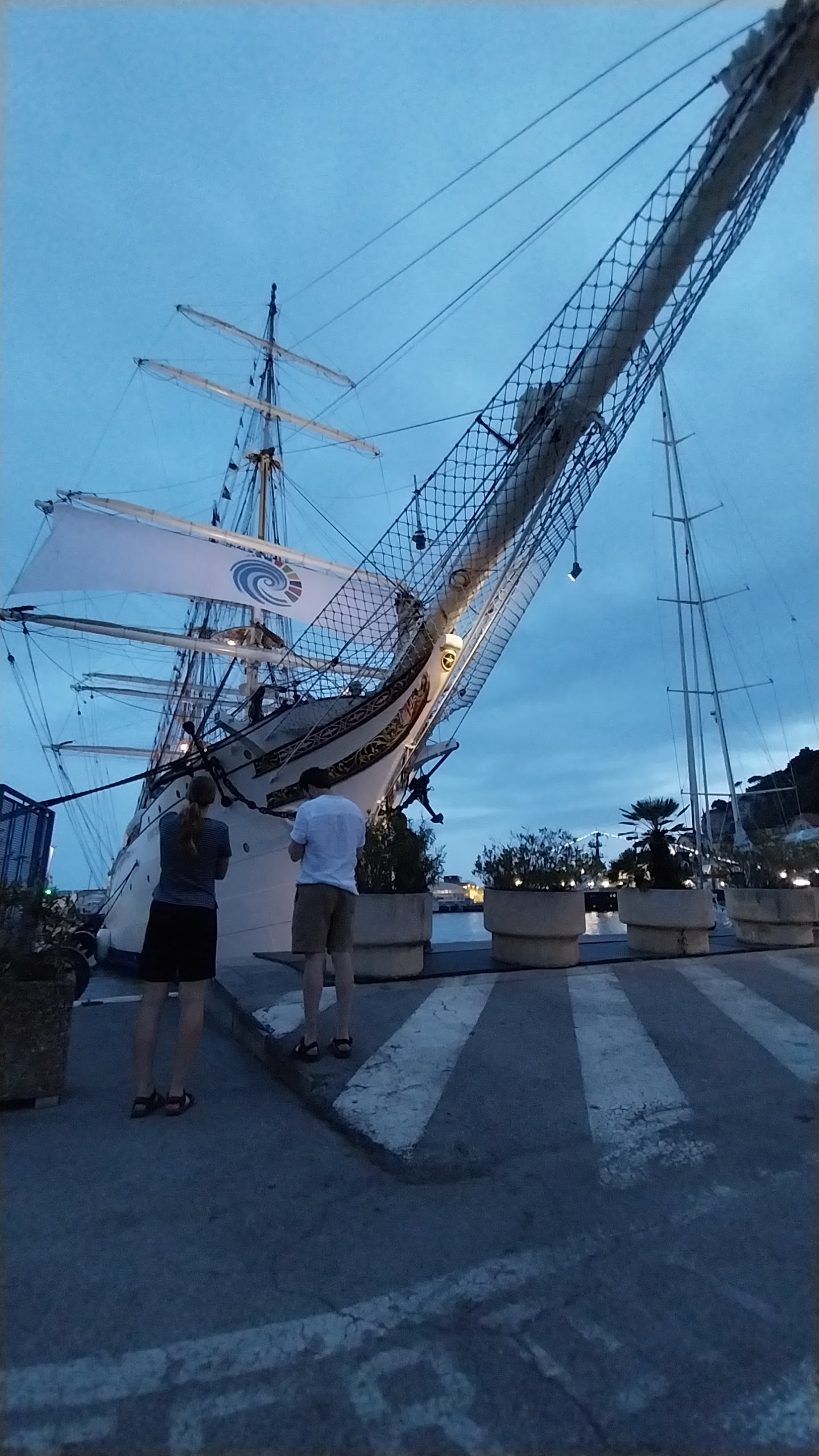
On our evening walk around the port, we enjoyed looking at several sailing ships and catamarans that have moored here for the UN ocean summit.
Inga had her regional game today--they lost the first game 3-1 and won the second one 1-0. It's a one-off event with a specially selected team of the top few players from each club. Eric is worried he got a speeding ticket on the way home. His phone told him the speed limit was 130 and right after that, he passed a speed trap and saw a 110 sign.
My brother spent the day at Cap d'Antibes, and Eric and Zari joined him mid-day. Eric was hoping to catch some fish...but no luck.
I had a busy work day preparing for the Train the Trainer event here next week.
What else to report? Not a whole lot. I found a little Syrian side table to serve as a TV console for Le Catamaran, plus a 16-piece cafe set (espresso cups & plates) for 5 Euros. We officially removed our winter comforters. It seems like warm weather came much later this year. I've only started opening the windows consistently this past week.
When we went on a walk this evening, there were big changes at the Port (site of the huge UN conference on the ocean starting this weekend). All of the yachts along 1 side had been removed for an art installation: polar bears sitting isolated on their tiny icebergs.
Ivy finally finished her book nook, which she started at Christmas. It's so intricate. The picture doesn't show the top and back, which have all sorts of little rooms and retractable windows.
2 more to go...
My brother treated me and Eric out to lunch at L'eau de Vie. Soooo good!
The day after a 4-day soccer tournament, Inga's team had the most important game of their season: a game that would decide if they were moving up into the regional division. They were playing against Grasse. They lost to Grasse 2-0 last week, which meant they had to defeat Grasse by at least 3 points in order to move up a level (and Grasse would move thus be downgraded). So each team was highly motivated to win, or in Grasse's case, to not lose by a 3-point margin).
It was a nail-biter. Inga was put in defense at the beginning and there was not much action. Sometime during the first half, the coach finally put her back in forward. She soon did a beautiful assist and another striker scored the first goal!
The second half arrives. Within 5 minutes, Inga scores a beautiful goal, running past all the defenders and putting it in easily. I was already there with Eric and my brother, but the other kids were en route. I was so sad they missed it, and I didn't film it either!
Inga's team continued to dominate the field and, after the whole family arrived, she scored again! This time I caught it, although with some jumping around :)
Inga had several other shots on goal that she missed, but still the game ended 3-0, meaning Cavigal is moving up divisions. We were all so thrilled. Eric feels vindicated for all of his advocacy trying to keep Inga as an attacking player.
What else happened today? I had my usual walk to Cimiez and back in the morning. Eric had one of his Wabash students over for dinner (he's been doing a study abroad since December in Aix). We also went on a post-dinner walk.
We are all tired and sore after 2 days of hiking! We took it easy in the morning. I didn't want the kids to sit around on devices all day, so I had them pull out their book nooks. Zari and Ivy have made good progress on their overly-elaborate kits.
My brother and I went consignment store shopping to look for fun household items and furniture. I found a huge wool rug for Le Chateau (we had an old ratty rug in the living room as a placeholder). Plus a few small items, like a Peugeot salt grinder and a little mother-of-pearl bowl for holding coins and other little items.
Then we had to carry this huge, heavy carpet 1.2 km home! We were very sweaty by time we got home.
Next up: quick swim with Ivy, Zari, and my brother. Dio had a date with a girl from his class (they got pizza and hung out at the beach) so he didn't come swimming.
Inga and Eric got in after dinner. Everyone is watching the Champion's League final.
That is how many steps we took, how many vertical meters we climbed, and how many kilometers we hiked. We did the Tour de la tête de Chien, which we've done several times before but always in the winter. The entire descent is sunny and south-facing, and the radiant heat from the rocks and cliff faces was intense! It was definitely a challenge to get myself up, given the sun and heat and thirst (we underestimated how much water we'd need).
Ivy was struggling. She was tired from her tournament the day before, and she was either whining, pulling on me, hyperventilating, or crying the whole way up. I kept her going because I knew she could do it. Once we were at the top, we found a cool, dark tunnel and had a lunch break. That perked everyone up.
There's a spectacular view of Monaco from the top.
The descent was a bit more direct and much more shaded, so we had zero issues with Ivy.
The hike took us 3 hrs 13 minutes, including lots of breaks.
Once we got home mid-afternoon, we took a bit of downtime to recuperate. Then I went with my brother for a swim (amazing!) and Zari joined us a bit later.
We made a "what's in the fridge?" dinner of hamburgers, green beans, escargots, and French fries.
We all took an evening walk after the sun had gone down. Because we clearly hadn't walked enough today!
Ivy left early this morning for a tournament. I dropped her off at Cavigal and then came home and woke Zari up to go hiking with me and my brother. I got Dio up right before we left at 9:30. It was a lovely hike, a bit over 6 miles and just under 3 hours including plenty of breaks for lunch and enjoying the views. We've done this one many times over the years.
I got quite a bit more written and several new graphics designed for my video analysis publication.
Inga's first tournament day went well. They tied their first two games 0-0 and 1-1, with Inga scoring the one goal and finally playing forward. I think they played another game and honestly I can't remember the results because I'm also trying to track Ivy's tournament (they went all the way to the finals, tied, and lost via penalty kick). Ivy came home very upset and still won't talk about everything. When she is down, she is VERY down.
Dio spent the afternoon at the beach with his friends and came home happy, a bit sunburned, and 10 Euros (of mine) lighter because they bought juice and Magnum ice cream bars.
I went for another walk after dinner (potstickers, edamame, Italian salad, and tiramisu). I really hope we all sleep well tonight. I didn't get that much last night but that was my fault for staying up reading and then having to wake up at 7 am.
Zari had her last official exam for this semester's classes. Now she has to study for "les rattrapages" for first semester. Once she was done with her test, we went for a run-swim.
My brother and I went out to eat--his treat--at Fine Gueule. Very delicious. It's a bit more pricey, but they have a daily 2-course menu for just 21.50. Today was gazpacho and a veal cutlet with lemon confit, spinach, and mashed potatoes. The gazpacho was superb.
Eric and Inga left this afternoon for a huge tournament in Béziers. They'll be staying 3 nights in a campground in little cabins. There's a pool and waterslide and it's supposed to be 33C! I hope they can stay cool enough during the games. We've had a cool spring and it's just started to heat up a tiny bit. We aren't used to hot weather yet!
We had a post-dinner walk with those who were around, then I made tiramisu for tomorrow.
School is off for the next 2 days due to the brevet (middle school exams) so we have hiking and other excursions planned.
Yesterday Zari, my brother, and I went running and jumped into the ocean at the end. Bliss! Zari was hesitant at first but I think we've converted her.
My brother took several of the kids clothes shopping for both himself and them. He came home with several linen shirts and a linen suit jacket. He's in love with the way European men dress so he's coming home with lots of nice things to wear. Zari and Dio both were gifted a shirt and Inga got a t-shirt and a pair of shorts. They are so lucky to have an uncle who loves to spend time with them and spoil them.
I took a break from work to swim with my brother, Zari, and Eric this afternoon. Despite being very tired, I've been sleeping poorly because I have so much work and it never ends. I like what I do, don't get me wrong, but I have not been able to find ways to limit my working hours to something reasonable.
I went to Dio's soccer tournament; we had to be out the door before 8:30 am and it was scheduled to go until 8:30 pm! We arrived and there was a huge mis-organization and the fields were being used by another group. This delayed the start of the tournament over an hour, and throughout the day the delay just got worse.
I watched the first two games (joined by my brother) and then we went home since there was a several hour break. Eric showed up for the last few games, 4 initially and 1 since they made it to the quarterfinals.
We watched the Monaco Grand Prix in our apartment, greatly aided by my brother, who knows a lot about cars and racing. Otherwise we'd have just been watching the cars go around 78 times without thinking anything else interesting was going on.
It's amazing to see the 2.2 second pit stops.
Then my brother and I cooked a delicious meal: homemade socca, potatoes roasted in duck fat, and kebabs made with lamb, chicken, and lots of vegetables, in a rosemary-garlic marinade.
I've been working on scatterplots and linear regression lines this evening and my brain is ready to turn off 🙂
Ivy and Eric were gone all day at a tournament, which didn't go well. Eric came back super frustrated and is still ranting about the girls' bad behavior (not Ivy, but several of her teammates).
I let the other kids sleep in quite late, then made them French toast. We watched Ocean's 11 in the early afternoon. I was feeling cooped up, so afterwards Zari and I went on a walk around the port.
My brother went to the Formula 1 race in Monaco. Today was the qualifying races, but still super fun. He got back late this evening and invited the kids to meet him on the beach for pizza. I came with Dio and Inga. Then we stopped for crepes and waffles (well, I was fasting so I passed mine on to someone else).
Dio has a tournament tomorrow. I'll go with him in the morning and switch off with Eric in the afternoon.
I also got several more sections written for the video analysis publication. It's coming along!
I went running with Zari and my brother this morning. It's so much more fun to run with people!
Over the past two days I've written about 20 pages (including tables and illustrations) of a research article, our breech birth video analysis project. I have the methods and results sections nearly done.
I took a break in the afternoon for a quick swim with Eric, Ivy, and my brother.
Busy soccer weekend. Ivy has a tournament tomorrow and Dio has one on Sunday. My brother will be in Monaco at the F1 qualifying races tomorrow.
My kids are remembering that if they go do something with my brother--maybe it's going on a walk, maybe it's taking out the garbage and recycling--they often accidentally run into ice cream stores. How does that happen???
I went on a walk with him in the morning, and then he and Zari went running. Lots of writing today (research articles) and some meetings. We got treated to a meal that my brother cooked: lamb in garlic and rosemary, potatoes roasted in duck fat, and green beans with garlic and olive oil. Dessert was from Paul via TooGoodToGo.
Ivy came home not feeling well, and she missed soccer practice. Uh oh.
My brother is en route and arrives tomorrow morning! We are looking forward to lots of adventures and treats and maybe even "quatorze boules de glace" (an ongoing inside joke about buying ice cream at Fenocchio's).
We have some family friends staying the night in Le Chateau before my brother arrives, and they invited me and Eric out to dinner. Eric had soccer, so lucky Ivy got to be the 4th person.
I had my last eye exercise appointment, doing a "final exam" and comparing the results with when I first started. Everything is within normal physiological limits now, so the exercise classes worked! I asked the practitioner why and how he got into that orthoptics and he used to work in wine making! But with the downturn of wineries about 15-20 years ago, he started looking for a second career and chose this one.
Inga's back at school and back to normal. Phew. She forgot to bring her signed note, though, and I got an email from the school. Even if you phone in their absence, you still have to fill out a form in their "carnet de correspondence."
Zari has another big test tomorrow, as does Dio. He's been memorizing history facts about the American revolution and I hear him reciting things to himself about the "Boston Tea Party" but pronounced the French way.
Ivy's rainbow dress arrived today (used via Vinted) and it was way better than in the pictures. She's so excited for the "Boum arc-en-ciel"! She's been making loads of bracelets and necklaces and earrings to accessorize.
I have finished my "eye exercise" class and have the final evaluation tomorrow. He'll retest everything and compared to the beginning, but he's pretty sure I won't need any more sessions.
We didn't have huge decorations or anything fancy. Somehow 51st birthdays don't get the attention that 50th birthdays do! But we did have a birthday dinner (homemade chicken pot pie) and 6 different pastries from Lac for a birthday cake. And we watched an episode of Andor together after dinner.
I went to Dio's soccer game this morning. He scored the first goal, a penalty kick (which I missed; I was still en route) and they won 5-0. They had a "goûter" afterwards where the coaches gave little thank-you speeches.
Eric and I got out this afternoon for a walk, plus I had my normal walk up to Cimiez. So I'm well over 13k steps even though I only walked to Cimiez one-way instead of round-trip.
I'm sewing several sets of stirrups for our obstetric simulators. Here are the scraps from cutting out the pieces. The fabric is left over from Covid, when we were sewing and wearing masks. (Remember having to wear masks outdoors? Yeah, that was a crazy time.)
Inga wanted to do an escape room for her birthday. More than 2 months after, we finally had time to do one! This was a WWI-themed game, in the trenches of Verdun. It was more like an escape compound, with multiple rooms and doors. (My German great-grandpa fought in Verdun and wrote about it in his auto-biography. I remember him describing it as a "hell.")
Inga is looking much improved and has an appetite again. She still looks quite pale and has dark circles under her eyes.
We went to the beach this morning intending to swim, but there was a strong wind and it was too chilly to go in the water. Inga and Dio went back home after about 10 minutes. Eric went spearfishing so he was in for a good while and he came back with an octopus and 2 fish. The rest of us stayed a bit longer.
Inga is STILL sick! I tried to get her to go to school, but she absolutely did not feel well enough. I hope she's well enough to go out tomorrow--we have a free day with no soccer games, so we were thinking of spending some time at the beach and then going to an escape game (a very late birthday activity for Inga).
I went running (sprint intervals) and got loads of breech things done. Zari's exam went well.
I got a monitor for my work station. I can finally see things in great detail! It's so nice for photo and video editing. It only took me 10 1/2 years to get a proper desk and work area here...
Inga didn't feel well enough to go to school, but it was the first day with out a fever since Saturday! I think she'll be back tomorrow. She's still really pale and lethargic.
I got another publication submitted today! (Technically, one of my co-authors submitted it...but it still counts!) We submitted to the BJOG, British Journal of Obstetrics & Gynecology.
What else? Zari's test went pretty well, although she realized in retrospect she should have spent more time on anatomy and morphology and less on phylogeny. She has an ecological economics test tomorrow.
Inga woke up with a fever--again! Poor girl. Day 5 of illness and not looking any better. I felt well enough to run this morning, but I've been feeling progressively worse all day. Body aches, general malaise, maybe even a fever coming on. Bleh.
AND...this afternoon...Inga started hollering for me from the bathroom. I was in the middle of helping Dio with a timed online quiz, but she was insistent so I went to investigate. Of all the days for it to happen, her period started for the first time. Between dealing with blood clots, washing out underwear and pants, showing her pads, and giving her a hot water bottle for terrible cramps, it's been quite the day. She got lots of sympathy from her siblings.
We'll have a Red Party like we did for Zari, once she's feeling better. Red Party = a party where everything is red. Think pomegranate seeds, beets, red bell peppers, red velvet cake, cranberry juice...
I need to go shopping for period underwear. I constantly extol the virtues of menstrual cups but Inga wants to first get used to just dealing with periods for a few months.
Zari has a huge biology test tomorrow. The class is called the Diversity of Life (Diversité du Vivant), or phylogeny and genetic classification. Inga and Ivy have been helping her study.
Dio was studying a huge list of French vocabulary and their synonyms earlier today, also with siblings' help. Much silliness and laughter ensued.
Inga is still sick and no better today, maybe even worse. She has barely eaten except for juice and applesauce.
I'm mostly better but not well enough to run yet. Maybe tomorrow?
Ivy and a group of friends had an outing today to a taco shop and a movie. I love that we can send her on the tram and they can go off anywhere in the city by themselves. French taco stores are definitely *not* what you'd think. Nothing Mexican in these tacos at all! Ivy's had French fries, chicken cordon bleu, and cheese sauce.
I'm going to lie down in my bed. A favorite part of my day is when I lie down, pull up my covers, and just do...nothing. Ahhhh. Okay, maybe I'll read but that's it! Nothing else.
Inga went to school this morning and looked so sick during the first hour that her teacher sent her to the school nurse. I got a call saying we had to come pick her up. Poor thing--she had a fever all day today and didn't eat much or move off the couch.
She had to do a few things in the late afternoon, one of which was a Spanish assignment to film her and a classmate cooking a recipe. Sickness is no excuse, unfortunately, in that class. She took "St. Doliprane" (acetaminophen) and managed to get it done.
Zari is studying for a huge biology final this Thursday, memorizing huge charts of the tree of life, from the first single-celled organisms all the way up to complex vertebrates.
Ivy is going to a "boum" next month, a big dance party hosted by one of her friends, and the whole group of girls are sending hundreds of messages already about what they're going to eat, wear, etc. The theme is "rainbows" so we found a secondhand rainbow dress. She's going to wear her rainbow socks and put rainbow hair tinsel in.
I'm still not feeling great, either. No fever but definitely no energy to exercise.
Inga and I took a sick day. She was really sick and I was on the mend. She still has a fever this evening and I hope she'll be ok for tomorrow.
Zari had her last soccer game and, since they were down several players, they got massacred :(
Dio had a small birthday party for his friends. I prepared a big lunch for them, plus homemade birthday cake, in the Chateau and then they watched a movie. It was a self-sufficient party. I just popped in on occasion to see if they needed anything.
Eric and I went on two walks today. I'm constantly amazed by how lucky we are to live here.
Eric was gone all day at 3 soccer games: Dio (Beausoleil, winning 3-0), Inga (Cavigal, winning 2-0), and Ivy (Cavigal, winning 8-1).
I did more sewing today, finally redoing Inga's curtains with a rufflette strip on the top. We threaded stainless steel key rings through the rufflette loops and then put those on the curtain rod. I have one more thing left on my mending pile: a pair of sweatpants to turn into shorts.
I was thinking of going to one of the Cavigal games, but a) I was cooking dinner and b) I started to feel a bit icky. It's gotten worse through the evening. Inga came home and was also feeling unwell.
I made vegan mushroom stroganoff with button & oyster mushrooms, served over potatoes roasted in duck fat. Lemon cheesecake for dessert.
Dio's having his birthday party tomorrow so I need to get everything in order for the lunch and make the frosting tomorrow morning.
Zari and I took a walk this afternoon. It felt amazing to be out in the sun. She's still feeling undecided, hating the idea of closing one door if she chooses the other option. Yes, that's life! You have to close some when others open and you'll never know if it was the "right" choice. Academically and socially Toronto is more interesting, but France is safe and easy. It's basically free and she'd be done in just 2 more years and she could start grad school at age 20. And she loves Nice. But...the opportunity to try a new country and get a North American university experience is also really interesting and exciting.
I was mending a frayed spot on Zari's jeans (backed it with a thin woven fabric and did multiple lines of zig-zags well beyond the worn area. I managed to sew through my finger! Oops! Fortunately it was just through the fleshy part on the side. The needle punched in and out so quickly that I hardly knew it happened. So yeah, I gave myself a finger piercing today :)
It's unseasonably cool still--although I did turn the heat off about 1-2 weeks ago, it's not warm enough to keep windows open. (Okay, not for me. There are plenty of French people who open their windows even during the winter! I just don't fancy it being 15 degrees C indoors!)
I know we'll be yearning for cooler temperatures once July hits. But I had to put on 2 jackets when I was out this afternoon as soon as the sky clouded over.
We watched another episode of Andor tonight. Lots of soccer tomorrow...some time this weekend, I really want to see Conclave!
In the early evening we set out to watch the celebration of the 80th anniversary of the end of WWII in Europe. Turns out we were mistaken on the time somehow so it was already done and dismantled. So we walked home and came back to which smoke pouring from the Vatican chimney: a new Pope had been elected.
We kept the TV on as we prepared and ate dinner and were surprised than an American was chosen. Super interesting.
We were going to watch Conclave this evening but ran out of time. We'll do it soon, though, because it's the perfect moment.
Ivy and Eric were gone all day at a soccer tournament, which did not go well at all for her team. She came home sunburned and Eric came home disappointed.
We had confit de canard and potatoes roasted in some of the duck fat and a simple tomato-goat cheese-basil salad, plus Magnum ice cream bars for dessert.
Tomorrow is a school holiday, celebrating 8 mai 1945, which marked the end of WWII. After dinner, Eric and went on a walk that took us past the war memorial. They were setting up for a big event, and on the way back a violin was playing accompanied by a military band. Very lovely music.
Ivy has a tournament all day tomorrow.
Dio's class had PE at the Vauban stadium this morning. There was a problem with the tram on the way home, so he had to run all the way back (after running around for hours!).
I got a big breech project finished and published today. I also mailed Zari's Canadian passport application. I'm almost ready to tear off my scribbled over to-do list and start with a fresh piece of paper. So satisfying.
Zari is filling out financial aid forms for Canada. There's a bit of limbo between which province she's a resident of, given that she has never lived in any of them. The financial aid office said to apply for both ON and AB and see which one ends up going through.
Zari had school this morning and came home with a fever and chills. She slept most of the afternoon.
Dio had a field trip to les Gorges de Daluis, a deep red rock canyon not too far away. We've never been. It's sometimes called the "Colorado niçois," in fact!
Dinner was chicken leek soup and random roasted vegetables (whatever was in our fridge--eggplant, bell peppers, and zucchini). I also roasted some hot peppers and garlic, for making a hot sauce. Eric popped one of the roasted peppers in his mouth, thinking it was a slice of bell pepper. He soon regretted that life choice.
An anglicized way to say crepe party, I know, but it's the expression we always use :) We had several people over for crepes this evening, with a full assortment of toppings: whipped cream & mascarpone, nutella, bananas, dark chocolate, orange marmalade, lingonberry jam, white sugar, powdered sugar, & lemon juice.
I had a busy day and neglected to go out and exercise/walk today. I need to do better tomorrow.
Zari worked on several scholarship applications: one was a 30-second video, the other a humorous essay.
I walked all over Nice in the rain today. To Cimiez and back in the morning (not realizing it was going to rain...). Then in the late afternoon we walked to our friend's apartment for a potluck dinner and farewell party. I've logged over 15k steps today.
The kids came home via car and...well...there was a "big problem," in their words. We share a parking spot with a friend and so we have to do this juggling of the cars when we park our car (pull his car out, back ours in, back his in). When Eric was backing the friend's car in, the garage door started to lower and smashed the back window. That was definitely excitement that we didn't need 🙂
I made purple risotto and meatloaf Wellington for the potluck tonight. We have plenty of leftovers so that's dinner for tomorrow!
Dio had plans to have a birthday party with his friends, but they had to reschedule. That gave us some time in the evening to watch two episodes of Andor. He had a game in the afternoon (losing 3-1), which Eric went to.
Inga and I wandered around Old Nice looking in a lot of the little shops. She's browsing for a friend's birthday gift. Nothing struck us, but it was fun to see everything from the point of view of someone who would be here to look at charming shops and buy souvenirs. I'm usually hurrying through and getting annoyed at the slow tourists!
We got to bed well after midnight last night due to Ivy having a friend over. Plus everyone was having lots of fun hanging out together so I didn't want to shut the party down. But of course I woke up before 7 am and couldn't get back to sleep. Ugh. I'm constantly sleep deprived because the rest of my family stays up late. Since our bedroom has windows that overlook the living room, I can't sleep if other people are up (due to both light and noise). And there's really nowhere else for people to go in this tiny apartment!
I got a surprise box today consisting mainly of purple top turnips. Yep. Not the world's most exciting produce. I'm really not a huge fan of turnips or parsnips so I had to do some research to find a recipe that looked good. I ended up making a Provençal gratin that turned out great. https://cookpad.com/fr/recettes/14418033-gratin-de-navets-violets-aux-tomates-et-mozzarella
I still would never buy turnips of my own volition but I'm glad I found a good use for them! I also cooked up some chicken breasts with olive oil and herbes de Provence for a bit of protein.
Zari has officially accepted Trinity College at the University of Toronto! Woohoo! She's very interested in living off-campus and cooking her own food, so we would love any good leads for housing.
I worked on a twin birth publication with my Italian colleague. It's very close to submitting now and we're super excited! Teaser graphic from the results (2 hospitals instated a training initiative to lower C-section rates for twins, and they studied outcomes a few years before and a few years after implementation). They reduced the CS rate fairly dramatically without negatively impacting maternal or neonatal outcomes.
What else of note? I also worked on a data collection form for our Afghanistan collaboration (https://www.breechwithoutborders.org/emergency). Many other things but they would bore all of you!
Ivy has her best friend over for an impromptu sleepover. I hope they actually sleep.
The streets were packed today with people wearing enormous, bizarre hats; walking around in parades; and following a straw man wheeled about on a cart.
Can you get pedestrian road rage? I certainly felt it, trying to walk through the crowded pedestrian streets of Old Nice. Stupid tourists who walk at a slow amble and go right in the middle of the available space so you can get around them on either side!
Mid-afternoon we paused our other activities and went to the beach. It was so packed you'd think it was almost July! I had a quick swim and then had to head back for a meeting. The water was cool but really not so bad. There's a warm layer on the surface a few inches deep.
I had several Too Good To Go orders, one of which was a bust because the store was closed the entire day! But the others were great. For example, one of mine was from a tiny grocery store and for 4 Euros, I got 1 liter of extra virgin olive oil, 3 salmon & dill sandwiches, several tomatoes, a bunch of bananas, a pear, and several apples. At the bakery, another 4 Euros got me 6 assorted pastries (croissants, pain au chocolat, & chaussons aux pommes), 2 blackberry tarts, 1 huge chocolate chip brioche, 1 large salad, & 1 yogurt cup.
Tomorrow is May Day. They take it seriously here. It's a national public holiday and it's the one day a year that EVERYTHING shuts down--all public transportation, totally down. We made the mistake one year and arrived at the airport on May 1st. We had no option but to pay for a taxi since there were no buses or trams.
I remember celebrating May Day by making and decorating little paper baskets filled with popcorn and candy and handing them out to friends and neighbors. I also have very vague memories of dancing around a May pole with ribbons.
School is, obviously, cancelled. I wonder what we'll do on our holiday? I have one meeting in the late afternoon but otherwise nothing is scheduled.
Today was a mix of exercise in the morning, a few errands, dropping Inga off at a soccer game, and lots of breech work and meetings. It was my turn for dinner, and I had frozen an extra meal's worth of curry. So it was pretty quick to that and reheat, plus cook some brown rice.
Zari is working on scholarship essays, mostly for little ones of $500-1000 each.
Inga had a championnat game today, winning 5-1. She was FINALLY put in midfield and finally in forward--her best position--and promptly scored 3 goals in the first 15 minutes. Then she was put on defense in the second half.
Because this past Sunday didn't feel like a Sunday--I was at a soccer game, not at the usual soccer game time--I've had no sense of where in the week we are! I keep thinking we're maybe at the end of the week, or the weekend. It's really been mixing me up.
Anyway not a whole lot out of the ordinary today. School for the kids, computer work for the adults, broken up by a few errands I had to run. Oh, we went out to lunch with our guest who's in Le Chateau. She gave Zari helpful advice about living in Toronto (the top contender for universities next year).
We finally got our family pictures back. Super excited. Plus I got a new headshot--way overdue since my previous one was from 2017.
We did these in exchange for letting her use our pictures for her portfolio. If anyone needs a photographer in the French Riviera, here's her contact info:
Eric caught a huge fish today (and a little one)! He was so excited. It's a sériole (Amberjack) and it makes delicious ceviche, which will be dinner tomorrow. It weighed in at 8 lbs (a bit under 4 kg).
I went running, had loads of meetings, ate a late lunch, worked on a publication, cooked dinner, attended and then edited and started captioning a live session, went on a walk. That was my day.
We had the usual reading of the birth story this morning, then opening presents (this year--a nice 3-piece suit, button-down shirt, pair of shorts, and short-sleeve shirt). Ivy and then Inga had games so half the family was gone between noon and 8 pm.
I went with Dio to change sizes on a few of the suit items, and Inga and Zari came along, too.
Birthday dinner and cake were a bit haphazard since Eric and Inga were still gone. But we all had time for a late move (The Amateur) and we just got home a bit after midnight.
Zari's statistics exam went well--she finished early and said it was all very easy and doable. She also had to take an English language exam online today (for her application to McGill--her paperwork won't satisfy their requirement for English proficiency despite her being a native English speaker!).
Those of us at home this evening watched Flow, which was fantastic and also left us with so many unanswered questions.
Zari had a big law exam today and felt pretty good about it, considering how difficult it was. She's now studying for a statistics exam tomorrow morning.
Gorgeous sunny spring weather today. Inga came home saying: "It's way too hot!" (Only 22 C but we've had relatively cool weather for a good while now.)
Inga mixed up a cocoa-mango-honey-sea salt-aloe vera mask that she, Ivy, and I tried on. It smelled like we had chocolate frosting on our faces! A bit of a pain to wash off, though.
I lost more than 3 pounds overnight due to sweating so much from my fever! I'm feeling about 75% percent better by this evening so I should be all good tomorrow.
Zari has a big test for a law class that she's stressing over. It's terribly boring so that doesn't help having to memorize a semester's worth of information down to the smallest minutiae.
We did egg wars tonight, finally. The final match was between Trump and Canada. Trump cheated but Canada ultimately won!
One minute I was fine, a few minutes later this afternoon I was DOWN with an intense fever/chills/body ache. I crawled into bed and haven't left except for the occasional trip to the WC.
Our grant writer is submitting a huge federal grant today, $4 million over 4 years. Fingers crossed!
To distract myself, I started reading Terry Pratchett's Discworld series, which surprisingly I have never read. I don't know how that happened because in middle & high school, I would often read 1-2 books per day!
Easter holiday for the kids...we slept in, ate French toast (pain perdu) and used up most of our extra bread. I've been really busy helping our grant writer as she prepares a massive federal grant application. Also working on some big research projects, doing captions, etc.
Freeze Family Foot was fun tonight.
Ivy had a panic moment because she couldn't find one of her school books. We went to the car--not there. Finally we tracked it back to church, where she had left it.
We finished the last episode of Wheel of Time. Now we've got to wait another year!
We had a bit of an unorthodox Easter. We did some of the usual things (decorating Easter eggs, (chocolate) Easter egg hunt inside our apartment) but skipped the fancy Easter dinner in favor of finishing up leftovers. We'll do the nice meal tomorrow, since the kids are still on holiday.
Ivy, Inga, and Eric watched a rugby game to cheer on our friend, a woman from New Zealand whose husband also plays rugby professionally. She plays for fun now--she also has 3 little children!
We watched another episode of The Wheel of Time and have one more to go. Something to look forward to tomorrow.
We were out by about 9:30 this morning, heading back home from the Gorges du Verdon. My sister really wanted to do the zipline/ropes course in Villeneuve-Loubet, so we made early afternoon reservations. We were practically the only people in the entire park! It was amazing.
And very challenging--I had forgotten how much effort some of the stations took. Our family plus the oldest cousin did the most difficult course, with 40 different stations. Many of them are rock climbing up sheer cliffs with just a few pieces of rebar here and there. Whew! And there are two super long ziplines--about 35 seconds to traverse. I think my very favorite part is the enormous tree that you have to climb down after traversing a long rope bridge. Some of the branches lean far out over the river below.
As soon as we got home around 4 pm, we sent everyone scattering in different directions. Eric got groceries; Dio and a cousin bought Magnum ice cream bars; Zari, Ivy, and Inga bought pizza and birthday cake; and I got more food at a few places. We all came back together for a quick birthday dinner and cake. We'll make a better dinner tomorrow when we have more time.
The kids and older cousins have been working on a funny shampoo video. Enjoy! Lots of inside jokes.
My sister's family is leaving early tomorrow morning. We have to say our goodbyes soon and get all the kids to bed.
Clear and sunny all day. We were out the door at 9 am. We had a 40 minute drive to the start of the lower gorge in Quinson. We had a 10 km hike along the bottom of the gorge, following an old canal that is no longer in service.
At the halfway point, right before the path turned and started going up the side of the canyon, we went through a long tunnel (some of the canal is open and some is tunneled through the rocks). Because of the recent rain, the tunnel was submerged with 1 foot (30 cm) of water! There was no choice--we all took off our shoes and walked carefully through the muddy water. Our feet were tender by the end.
Then we went up, fairly gradually, and hiked along the top of the canyon. We took an extra little path that went to the pinnacle between two canyons, where there was a little church and ruins of an older church.
After the hike, we were ready to play in the water, which is a gorgeous, almost unreal emerald-teal color. It took us a while to find a nice spot, but with the help of someone who worked at a kayak/boat rental place, he directed us to a spot that we would never have found on our own. I couldn't quite get up the courage to immerse myself--it was super cold! Colder than the ocean. But Eric, Ivy, Inga, and Dio did.
Next, we went to the Museum of Prehistory, which is one of the largest in Europe. It was big but honestly not very engaging as far as museums go.
Next stop: snacks! We were hoping to buy Magnum ice cream bars, but the one tiny grocery store in the tiny village of Quinson didn't have a working freezer--theirs was broken temporarily. So instead we bought juice, chips, and cookies. It's vacation, right?
We got home around 6 pm. After dinner, we enjoyed the amazing sunset from my sister's balcony.
Later in the evening, our kids and the two older cousins went out to the village playground, near the village chateau, and did some stargazing. I came along, too, and sadly my constellation identification doesn't go much beyond the Big Dipper and Little Dipper. It's been too long since 11th grade astronomy class...