Thursday, June 23, 2011

Autonomy, Information, and Power

I find myself increasingly drawn to the principle of autonomy. It has been adopted by law or by custom in most Western countries. If patient autonomy were fully adopted and enforced, it could bring about substantial changes in maternity care. (More about this at tonight's talk.) We have a long way to go to reach true autonomy in both key areas: informed consent and the right to refuse treatment.

In a recent post on the surgical consent process, Dr. Nick Fogelson proposes that communicating risk by listing any and all possible risks in precise statistical fashion might not be the best form of informed consent. He comments that our current method of informed consent is
a bit like asking your neighbor bring your son home from school, and having her say “we may get hit by another car, I might run a red light, we may run out of gas on a train track, there might be a meteor that hits the car and kills us all…. but don’t worry I am a good driver and your son will be fine.”

The fundamental reason we do these consents is that we believe that in some way they will protect us in a lawsuit if something bad happens. For example, let’s say somehow I transect a ureter in my patient’s hysterectomy, I can say “See – I said this was a risk of the surgery… it wasn’t my fault!”

But isn’t that a bit ridiculous? Is telling somebody that something bad could happen actually a defense if that bad thing does happen? In some cases a problem is truly random, such as the development of a pelvic abscess after a hysterectomy, but in other cases it is not. There is almost no situation in which I could cause a ureteral injury and have it not be a surgical error. If it happens, I did it – and it was a mistake. Ureters are damaged in about 1% of hysterectomies, but its not like they magically get injured in 1% of cases. In 1% of cases the surgeon makes an error....

The trouble with the standard consent process is that it doesn’t deal with the real issue; errors do occur, and physicians cannot be perfect. By naming error-driven events as statistical occurrences, the process supports an expectation that surgeons will never make errors, and thus the corollary that any surgical error is a de facto breach of physician’s fiduciary duty.
Dr. Michael Klein recently co-authored several studies on attitudes of maternity care providers. He found that pregnant woman rarely have complete or accurate information on common birth procedures.
It should be noted that regardless of the type of care provider, many women reported inadequate knowledge of common procedures....When combined with evidence on the nature of obstetrical power and control, and research showing that many providers are not evidence-based in their views, (3) this suggests that even a woman with strong values and beliefs could find it challenging to assert her choices in the professionally controlled process of birth. Women, especially first time mothers, who do not have evidence-based knowledge, are likely to be particularly sensitive to negative attitudes toward birth procedures and processes, from providers and other sources.
A recent editorial by Jackie Tillett in the Journal of Perinatal and Neonatal Nursing, Politics, Power, and Birth,   explores power interactions between childbearing women and their care providers. She comments:
The power relationships between women and their healthcare providers limit the choices that women may have and may even constrain the discussion of choices. If the healthcare provider believes that choices should be limited to those the provider feels comfortable providing, other choices may not enter into the dialogue.

Ideally, decision making regarding labor and birth will begin during prenatal care. The antepartum period is a time of exploration and questioning for many women. Care providers can facilitate this learning with adequate time during appointments, concern for a woman's misgivings, and encouragement. Informed consent may and should initiate a discussion of risks and benefits of procedures and routines.

However, even though informed consent implies an understanding and agreement with a plan of care, too often a woman is influenced by her perception of the healthcare provider as an unbiased expert. This is true of her perceptions of physicians, midwives, and nurses.
Later in the article, she addresses the language of allowance and how it limits autonomy:
The politics and power relationships of the labor and birth process may be seen to revolve around the word "allow." To allow is to make possible through a specific action or lack of action, or to consent to or give permission. The concept of allowance gives the power to the healthcare provider, whether physician, midwife, or nurse and makes the laboring woman dependent upon this allowance. Allowance removes some aspects of choice and consent from the woman and makes her dependent upon the actions and beliefs of the healthcare provider. To define the services one offers to pregnant women using the phrases "I allow" or "I don't allow" transfers all control to the provider.
Remember that autonomy = informed consent + right to refuse. With both of those key factors weak or missing in our current obstetric climate, autonomy exists in name only. It's time to turn rhetoric into reality. Or in Dr. Klein's words: "It is going to take a revolution driven by women to change this, as practitioners are not going to change very soon. To the barricades!"
Read more ...

Tuesday, June 21, 2011

Come to BirthTalk this Thursday!

I will be giving a talk this Thursday evening in Moncton, NB as part of the BirthTalk series hosted by Natalie Arsenault. My presentation is called "Childbirth activism: where we have come from and where we are going?" I will review the various childbirth movements of the 20th and 21st century and share my thoughts on the future of birth activism.

For more details, please contact Natalie. I hope to see you there!

Now here's the back story of how I met Natalie...I was at the downtown Moncton Farmer's Market about 10 days ago and saw a stall with beautiful batik and handwoven cotton slings. Aha! I thought. I have got to talk to her! She makes slings! Yes, I am kind of dorky that way. So I headed over with Inga (in a sling of course) and said hello. We chatted for a while about slings. Then it turned to birth stuff, at which point she gave me her card and asked if I'd be around for her monthly meetings, called BirthTalk. I went to the gathering last week and enjoyed myself quite a bit. She invited me to give a presentation this week. I don't have access to most of my materials, so it will be informal but still interesting and thought-provoking.
Read more ...

Open forum for the Home Birth Summit

Several blog readers expressed concerns or comments about the upcoming Home Birth Consensus Summit, to be held this fall. This post is an open forum for your comments/concerns/questions. I will make sure your input reaches Geradine Simkins.

If you were able to attend the summit, what would you say? What are the biggest obstacles you have experienced to home birth in general? In your own community? What would make it safer, more accessible, etc?

Speak up!
Read more ...

Saturday, June 18, 2011

Baby gear, circa early-to-mid-1800s

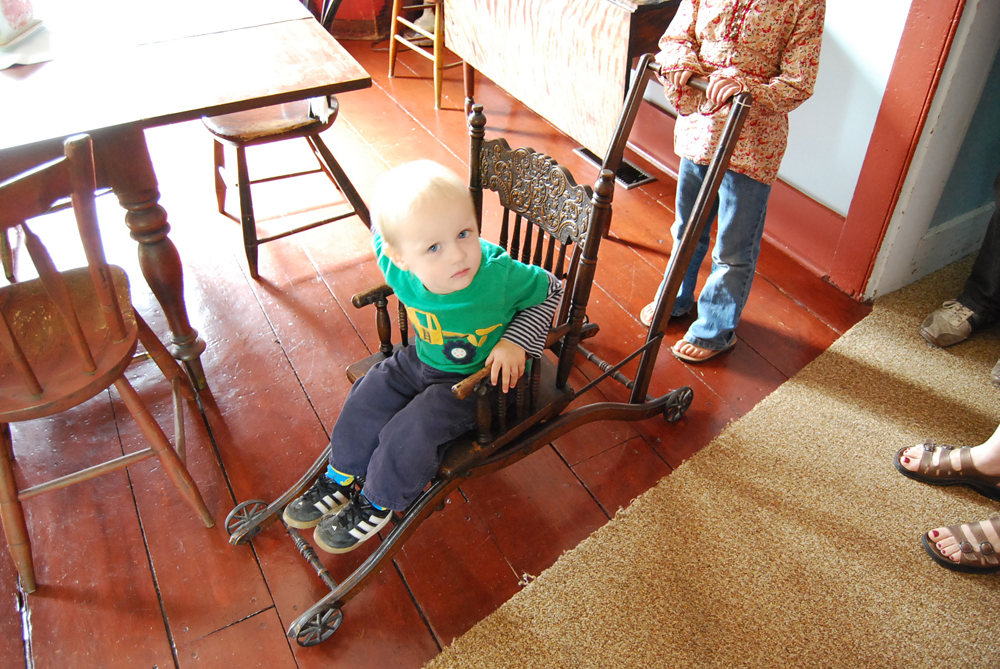
While we were visiting the Keillor House in Dorchester, NB, we saw several fascinating baby items. We always talk about life being simpler "back then." But even 150-200 years ago, there was plenty of baby gear for parents to accumulate.

When I was little, my parents used a Johnny Jump-Up. I have memories of kicking my baby brother while he was sitting in it. These apparently aren't new. Here's a "Jolly Jumper" from the 19th century. It is suspended from the ceiling by a rope.
I loved this multi-function chair. Now it's a high chair...
Now it's a stroller!
Finally, here's a little child-sized potty (missing the bowl underneath)
Read more ...

Monday, June 13, 2011

When they need it, where they want it

A recent press release from the SOGC (Society of Obstetricians & Gynaecologists of Canada) shows support for women's autonomy in childbearing. In honor of the International Day of the Midwife, the SOGC released this document (PDF). Dr. Lalonde upholds pregnant women's autonomy in where and how to give birth:
“The SOGC acknowledges that it is the mother’s decision to decide where she would like to give birth,” stated Dr. André Lalonde, executive vice-president of the SOGC. “Most babies are born without serious complications. As ob/gyns, our specialized training allows us to address the unique requirements of high-risk situations. What matters is that all professions acknowledge each other’s competencies and work together to provide mother and baby with the quality care they need, when they need it, where they want it.”
Read more ...

Sunday, June 12, 2011

What is autonomy?

My earlier question asking if autonomy is just for the natural birth crowd got sidetracked into arguments about the safety of home birth. Yawn. (Is anyone else ready to move on from these worn-out debates?)

Anyway, let's talk about what autonomy is and what it means in a healthcare context. From Wikipedia (emphasis mine):
Autonomy (Ancient Greek: αὐτονομία autonomia from αὐτόνομος autonomos from αὐτο- auto- "self" + νόμος nomos, "law" "one who gives oneself their own law") is a concept found in moral, political, and bioethical philosophy. Within these contexts, it refers to the capacity of a rational individual to make an informed, un-coerced decision. In moral and political philosophy, autonomy is often used as the basis for determining moral responsibility for one's actions. One of the best known philosophical theories of autonomy was developed by Kant. In medicine, respect for the autonomy of patients is an important goal as deontology, though it can conflict with a competing ethical principle, namely beneficence. Autonomy is also used to refer to the self-government of the people.
Let's take a look at the Patients' Bill of Rights adopted by the Association of American Physicians and Surgeons (emphasis mine):
All patients should be guaranteed the following freedoms:
To seek consultation with the physician(s) of their choice;
To contract with their physician(s) on mutually agreeable terms;
To be treated confidentially, with access to their records limited to those involved in their care or designated by the patient;
To use their own resources to purchase the care of their choice;
To refuse medical treatment even if it is recommended by their physician(s);
To be informed about their medical condition, the risks and benefits of treatment and appropriate alternatives;

To refuse third-party interference in their medical care, and to be confident that their actions in seeking or declining medical care will not result in third-party-imposed penalties for patients or physicians;
To receive full disclosure of their insurance plan in plain language...

In a healthcare context, autonomy means being informed about the full range of risks, benefits, and alternatives of a proposed treatment (informed consent), and having the ability to accept or reject the treatment (right to refuse). Or for you math geeks:
autonomy = informed consent + right to refuse
While patients have the right to refuse treatment, they do not necessarily have the right to demand medically unnecessary treatments. For example, if your leg is injured and your physician recommends amputation, you have the right to refuse. However, you do not have the right to demand an amputation of a healthy limb. 

In maternity care, the right to refuse and inability to demand are not always consistently applied. Women are often not allowed to refuse certain treatments, such as repeat cesarean section or IV therapy. On the other hand, many women are able to demand medically unnecessary treatments, such as elective primary cesarean or elective induction. This inconsistent application of autonomy and patients' rights has emerged from cultural beliefs in the inherent risk of labor and inherent safety of medical intervention and from concerns about litigation and liability. 

So I ask again: is the desire for autonomy really a frivolous, selfish concern at best, and a potentially dangerous doctrine at worst, as implied by more than one commenter? 
Read more ...

Saturday, June 11, 2011

Home Birth Summit

I've been hearing buzz about a Home Birth Summit coming some time this fall. I recently received a message from Geradine Simkins via a midwifery list I belong to with more details about the summit participants. This might assuage some concerns, such as the ones articulated at The Trial of Labor, about who is attending and how they were chosen.

Below is the letter from Geradine Simkins, president of MANA.

~~~~~

Dear Friends,

I’d like to address some of the comments about the upcoming Homebirth Summit. First of all, this is an idea that has been brewing for at least two years, some might say for two decades. No one really “owns” the idea of putting together a gathering of multiple stakeholders to have a frank and productive conversation about how to best support and care for women who chose homebirth. But after lots of conversation—the decisive one being at the ACNM Homebirth Section meeting two years ago—we decided to pursue this “project” in earnest.

Many of you may be familiar with the type of process we chose. It is not unlike what Childbirth Connection chose to use when they initiated the process for creating their seminal work, “Transforming Maternity Care: A Blueprint for Action”. They convened a Vision Team of experts in the fields of maternity care and health systems, worked in specific stakeholder groups, and developed concrete solutions to some of the most pressing issues facing the U.S. maternity care system. The result is a group of actionable strategies to improve maternity care quality and value.

It was not a conference; it was an invited work team. The Homebirth Summit will also not be a conference. Here are some details about the process and the participants:


  • In order to get representatives to the table who are in any way involved with homebirth, 72-80 delegates have been identified to be evenly balanced across 9 stakeholder groups (listed below).
  • The invitation selection process has been an iterative process with many rounds of vetting, internally and externally.
  • Short lists were created by subcommittees chaired by those who knew those stakeholders.
  • Each subcommittee of the MULTIDISCIPLINARY planning group went through a detailed vetting and weighing process and considered the balance of perspectives, ethnicities, gender, age, geography, and other factors.
  • After serious consideration, we hired consultants from Future Search because of their success with consensus building among groups with very disparate (and often conflicting) ideas, values and principles.
  • We are using Future Search Methodology, which prioritizes including participants who had authority, information, expertise, need, and resources.
  • We also prioritized those who were likely to respect the process by fully engaging in the Future Search methodology and open-minded dialogue.
  • The stakeholders are NOT ANY ORGANIZATION but rather are individuals who are defined as belonging in these nine stakeholder groups:
    • Consumers (from a variety of perspectives)
    • Consumer advocates (doulas, childbirth educators, childbirth and women’s healthcare activist)
    • Home Birth midwives (CPM, CNM, LM, Amish, traditional, whatever)
    • Obstetricians and OB family practice
    • Collaborating MCH providers (nursing: L&D, neonatal, pediatrics; CNMs who provide backup)
    • Health insurers and liability insurers
    • Health policy, legislators, legal, ethics
    • Research and education: Public Health, epidemiology
    • Health models, systems, administrators


In this way, the WHOLE SYSTEM is at the table. Otherwise, we will not be able to seriously come to consensus.

The point is not to debate the “right or wrongness” of homebirth, or even the safety. The goal is to establish what the whole system can do to support those who choose homebirth, and provide the care, safety net, consultation, collaboration and referral necessary to make homebirth the safest and most positive experience for all involved—moms, babies, families, communities, health care workers, hospital personnel, administrators, payors, and so on.

We have been meticulous and intentional about our process. Nonetheless, not everyone will agree with our process. With only 72-81 spots to make this a functional process, not everyone will be happy with those that are selected, and specifically, if they were not selected.

I would ask you to consider that we are working very hard and with the firm intention of making the process, the event and the outcome as optimal for mothers and infants as possible, and for the benefit of midwives serving homebirth clients.

In solidarity,
Geradine

--
Geradine Simkins, CNM, MSN
President & Interim Executive Director
Midwives Alliance of North America
president@mana.org
executivedirector@mana.org
geradines@gmail.com
275 Cemetery Rd.
Maple City, MI 49664
231.228.5857
Read more ...

Thursday, June 09, 2011

Is autonomy just for the natural birth crowd?

In response to the post about autonomy, beneficence, and non-maleficance, someone left this comment:
And, you know, if random women didn't declare their consent invalid after something *did* go wrong, docs just might be more willing to go along with your riskier ideas. One of the more annoying parts of your "trust birth" idiocy is that you want to refuse all the stuff that might let you know something is going wrong, show up at the hospital with you and the baby in distress, and then bitch blue murder about the evil docs who couldn't pull one more rabbit out of the hat and save your ass, your baby and your uterus.

Does it not cross your mind that docs don't like losing babies, and don't like being sued---because in order to be sued, there has to be a bad outcome? And a bad outcome is a dead or injured baby? Midwives have no insurance, little training and less accountability.
There are gross generalizations, false accusations, and other logical fallacies in this comment. Leaving those aside for a moment, this comment implies that only those of a certain ideological persuasion care about autonomy, and that the desire for autonomy is essentially selfish and misguided.

So what do you think? Is autonomy just for homebirthers (or those who use midwives or want a "natural" birth)? Do more "mainstream" women really not care about, or not benefit from, autonomy in their maternity care?
Read more ...

Wednesday, June 08, 2011

I'm still here, eh?

We're busy getting to know New Brunswick, so I haven't been on the computer much. Here are a few pictures...

For those of you wanting to see how to fit 3 carseats in the back of a VW Golf.
We live right next to a cemetery (complete with Eric's ancestors!), so it's turned into a favorite place to go for walks.
The kids shriek "spit bubbles! spit bubbles!" whenever Inga does this
I can't stop kissing her chubby cheeks
Our first night in Moncton we made fiddlehead ferns (blanch for 1 minute in boiling water, then sautee in olive oil) and salmon en papillotte (made with what we had on hand: caramelized onions, mushrooms, carrots & sour cream). Zari keeps asking for more ferns.
Today we ate lobster from the Bay of Fundy and the kids ran around the house playing with the empty claws. I've never seen such huge lobsters before. Several of the live ones were close to 10 pounds! But the woman at the shop said, "We don't say they're big until they weigh at least 15 pounds." The rest of the lobster will turn into this pasta recipe tomorrow. Mmmmm.
Read more ...

Sunday, June 05, 2011

1,511 miles, 3 children, and 1 small car

We made the 1,500 mile (2,432 km) drive out to New Brunswick in our VW Golf. (Yes, you can fit 3 carseats in the back of a Golf, to the amazement of my SUV- and minivan-driving friends!) We broke the drive into three days: 6 hours to Eric's sister, 15 hours, and 6 hours. The second day was rough. It's hard for little kids to sit still all day. At the end of the second day, we erected a cardboard barrier between Dio and Inga to protect her from kicks and pinches.

A portable DVD player borrowed from Eric's sister helped the last two days go more smoothly. Eric was really opposed to the DVD player. "I don't want our kids to be plugged in," he said. But I insisted we at least bring it with us and use it when/if the kids became too restless. We put on movies about half the time, taking breaks until the kids started become very irritable and bored (meaning they started to hurt Inga, poor thing).

The second night, we stayed at a hotel with an indoor pool and hot tub. We swam in the morning until the kids got all their energy out. Definitely a must-do on the way home.

When we weren't watching movies, we ate snacks, sang songs, played "I spy", told stories, and listened to NPR. And somehow we survived the drive.

Our Golf performed beautifully, getting close to 50 mpg. I love my diesel VW!

Now if the weather would just warm up...it's been unseasonably cold and I didn't pack enough warm clothing.
Read more ...

Thursday, June 02, 2011

3 month pictures

We finished day 1 of driving out to New Brunswick. 2 more days to go. We are officially crazy to do this long of a road trip. Anyone live in or near Moncton? We'll be there for the month of June.

Meanwhile, some "now & then" pictures of Inga, who is 3 months old today:
2 days old
3 months old
1 week old
3 months old
2 weeks old
3 months old
Read more ...

Tuesday, May 31, 2011

Autonomy, beneficence, and non-maleficance

Big words, big issues, and a fantastic post at Birth Sense putting them all together. The blogger at Birth Sense summarized Dr. Andrew Kotaska's recent presentation at the annual ACNM meeting. Dr. Kotaska helped author the new SOGC breech guidelines and is a passionate advocate of maternal autonomy and true informed consent (i.e., informed consent + the ability to make real choices).

Some excerpts from his presentation, via Birth Sense:
Dr. Kotaska posed the question, how does a physician or midwife stay with a patient when she declines your recommendations? ...

Dr. Kotaska argues that we need to promote the policies that systems like those Britain and Ontario, Canada have adopted. The Royal College of Midwives' policy is "If a woman rejects your advice, you must continue to give the best care you possibly can, seeking support from other members of the health care team as necessary." Midwives in these areas do not have to remove themselves from their patients’ care (effectively abandoning them), but are expected to continue to support and care for the woman even if she refuses to follow the midwife’s advice.

Dr. Kotaska urges providers to "explicitly state your commitment to her [the woman's] autonomy over your idea of beneficence." He emphasizes that each provider should embrace these three points:
  • Your job, as a provider, is to inform your patient
  • She is free to decline your recommendations
  • She will not lose your support if she declines your recommendation
What is the result of a provider maintaining this type of attitude with their patient? Dr. Kotaska asserts that women trust these providers because they have not threatened the therapeutic alliance. He also stated that "informed consent" is not truly an informed consent if the woman will not be supported in her choices. For example, giving a woman informed consent about the risks and benefits of a trial of labor after cesarean, while telling her that your hospital does not allow VBACs, is not truly giving her an informed consent because she has only one option.

When asked how a woman should respond when she is refused a trial of labor, Dr. Kotaska replied that a woman should create her own "informed consent" form that she asks the provider to sign. It should state that:
  • she does not want a repeat cesarean section
  • she is aware of the potential risks of a repeat c-section, including placenta accreta, hemorrhage, increased risk of stillbirth, infection, increased risk of maternal death, and four-fold increases in neonatal respiratory distress
  • she is not being offered a choice of how she will give birth
  • if she experiences any complications as a result of being forced to have a c-section, she will be pursuing legal action against the provider who would not support her in a trial of labor.
With this proposal, Dr. Kotaska received a standing ovation from the midwives attending his presentation. What was clear to me is that midwives and mothers are fed up with the status quo in modern obstetric care today, and if change will only happen through women creating an informed consent form they ask their provider to sign, so be it. It’s time for a birth revolution, and it has to start with midwives, mothers, and a few progressive physicians who are not afraid to challenge the status quo.
Read the rest here.
Read more ...

Saturday, May 28, 2011

Breech workshop in the UK

For my blog readers across the pond, there is a Breech Workshop with Mary Cronk and Joy Horner in Totnes, Devon on September 24th.Wish I could join in the fun!
Read more ...

Thursday, May 26, 2011

Special discount for upright breech workshop

We are offering a special discount for non-medical professionals* as part of the Vaginal Breech Skills Workshop. For just $100, you can attend Betty-Anne Daviss' day-long session on upright breech birth. Her workshop takes place on Sunday, July 17th from 8 am - 5 pm at Butler University in Indianapolis.

The workshop will use a combination of lecture, discussion, videos, handouts, demonstrations on doll and pelvis and mannequin, and hands-on acting out of vaginal breech maneuvers. At the end of the session, participants should be able to:
  • Describe why in the past breech birth practitioners delivering vaginally reverted to having the mother on her back.
  • Discuss and critique the Hannah Term Breech Trial, its impact on breech birth, and subsequent research on vaginal breech birth
  • Release one’s fear of vaginal breech birth through an understanding of why the RCT was not the absolute answer to calculating the risks of cesarean vs. vaginal birth, observational research is a respectable form of research and such European research demonstrates both safety and new answers to old questions about how to conduct vaginal breech birth.
  • Develop trust and respect for the ability of the mother and baby to negotiate the baby’s descent after the practitioner has watched videos of babies literally fall out of the mother in the hands and knees position.
  • Describe why the vaginal breech birth in the upright and hands and knees position is more physiologically sound than requiring the mother to be on her back. Demonstrate the cardinal movements of the vaginal breech birth.
  • Demonstrate the skills of receiving the breech and trouble-shooting impediments to the descent of the breech, including what not to do.
  • Identify when breech birth becomes dangerous—whether by cesarean or vaginally.
  • Understand the future of vaginal breech birth and how it can be preserved

If you can't attend the day-long workshop, please mark your calenders for Betty-Anne's free public lecture on upright breech birth on Saturday, July 16th at 7 pm.


* I.e., anyone who is NOT a nurse, midwife, or physician. Doulas, childbirth educators, & lactation consultants are eligible for the discount.
Read more ...

Thursday, May 19, 2011

U-Suck

Our big move is on Saturday (hence the blog silence) and I am beyond frustrated with U-Haul. They were the only company with a rental office in town, so I reserved a truck with them. I just got a call today that they have no trucks available--despite my having reserved one. I now have to drive to another location to pick up and return the truck. It's going to cost a bundle to pay for the gas, not to mention the three hours of additional driving time on an already busy day.

I was not very friendly with the customer service person. I did not say oh thank you for not fulfilling your part of the contract. Oh thank you for making me drive way out of town to pick up my "in-town" truck.

U-Haul, U-Suck.
Read more ...

Sunday, May 15, 2011

Home renovations with small children

We move into our new house next Saturday. We had planned on just moving in, but then we thought...while the house is empty, why don't we refinish the wood floors? The first floor is 1800 square feet. About 1/3 of that space (kitchen & dining room) needed a full sand down to bare wood. The rest (living room, entry hall, library, and half bathroom) needed just a buff & recoat.

With three small children, doing home renovations isn't easy. With the help of friends to watch the older two and a very cooperative baby (floor sanders are the BEST white noise machines ever!), we were able to keep up a decent pace. We even had a few sleepovers in our empty house so that we could both work at night while the children slept.

We pulled out the old carpet in the dining room. The floors underneath had the original shellac and were in decent condition. There was one section with old termite damage that had been patched up with plywood. We tore that out, repaired and reinforced the subfloor, and laid new flooring. In the picture below, you can see the patch on the left and the first pass with the floor sander to the right.

After going over the floors once with the drum sander & edger, they looked like this.

Who would ever paint a room the exact color of baby poop? Ugh. I'm definitely changing the color ASAP.

We did a total of four passes with the drum sander (50-60-60-100 grits). Usually it would take less, but there were a lot of uneven areas. We then did two passes with a buffer using 80 & 180 grit sanding screens. Finally, we hand-sanded and scraped in the corners and edges as needed.

Yesterday we buffed the entire main floor, vacuumed, and laid the first coat of polyurethane. For this, we had to tag-team since we couldn't have any children underfoot. Eric did the first two tasks and I applied the poly. It was messy, stinky work and I had to wear a respirator. But the floors look wonderful. We'll lay two more coats of polyurethane tomorrow and Tuesday, buffing between coats.
Read more ...

Saturday, May 14, 2011

Random man talks homebirth & homeschool

Remember Random Man? Well, we ended up hiring him to make storm windows for our new house (the old-fashioned wood kind with a modern twist--they have interchangeable glass & screen panels that you can change from the inside, so you don't have to carry the storms up & down a ladder twice a year). We signed the contract today and...guess what...

All five of his children were born at home.

And he homeschooled all his children.

He held Inga while we talked windows and home birth and home school. And things like how much did our children weigh when they were born (his smallest was a hair under 10 lbs, and the largest was something like 11!). His wife runs the local homeschooling association, so he said he'd put me in touch with her. (For the record, I have no idea if I will homeschool or public school; I'm keeping both options open at this point.)

He also showed me a very awesome tool, a Rockwell Sonicrafter. How did we ever survive without it?
Read more ...

Wednesday, May 11, 2011

The wedding

My older sister, the oldest of us five children, got married last weekend in Washington, DC. We had a great time seeing relatives and of course seeing my sister so happy to finally be joined with her husband.

The Spencer sisters & their spouses, plus my little brother (the bearded "mountain man" on the right)
My family
Lots of sling wearing. The wedding slings were made of a pink & green iridescent silk dupioni
 
I love this one of Zari
Dio & my mom
Candid camera
 
 
Read more ...

Tuesday, May 10, 2011

3 surveys--please participate!

I've received word from several researchers wanting people to complete surveys. If you are eligible, please participate!

~~~~~

Survey #1: Baby Food Survey

This is a research study about infant feeding practices. This study is conducted by Amy Bentley, Ph.D.,Department of Nutrition, Food Studies and Public Health, Steinhardt School of Culture, Education and Human Development, New York University.

Who can participate: anyone who has had one or more children. This asks questions about how and when you introduced your baby to solid foods.

~~~~~

Survey #2: Coping and the Unplanned Cesarean Section: Examining how women cope with the need for an unplanned cesarean section

More about the survey from the researcher Nedra Goldman:
My name is Nedra Goldman and I am a graduate student at DePaul University. I am currently conducting a research project titled “Coping and the Unplanned Cesarean Section: Examining how women cope with the need for an unplanned cesarean section” as a requirement to obtain my Master’s Degree. The purposes of this study are to examine the coping mechanisms/strategies utilized by women age 21-39 during the labor and delivery process when an unplanned cesarean section is indicated and to describe the self-efficacy of the women. I am seeking out women who are willing to participate in my study. Inclusion criteria for this study include a) women, b) who were between the ages of 21-39 when they delivered, c) had emergency cesarean section, d)normal pregnancy, e) speak and understand English sufficiently enough to complete survey. If you or someone you know meet these requirements and are willing to participate in my study please click on the link below which will lead you to an information sheet and the study. There is no need to respond directly to this email if you are interested.

For privacy and confidentiality purposes no identifying information such as name, address, or insurance information will be collected, I will be the only person who has access to the survey responses for analysis purposes, and all responses will be coded.

~~~~~

Survey #3: Parenting Perceptions & Attitudes About Mothering

More about the survey from researcher Miriam Liss, PhD, Associate Professor of Psychology at the University of Mary Washington:
I am researching attitudes about mothering with some of my colleagues at the University of Mary Washington and our students. We are collecting data from people over the age of 18. We are looking for parents and non-parents but are especially interested in the views of attachment parents.
Read more ...

Wednesday, May 04, 2011

2 months old and off to her first wedding

Inga is nestled in the corner of my chair, drifting off to sleep. We're leaving tomorrow morning for my older sister's wedding in Washington D.C. Zari is super excited to wear her new "wedding dress," as she calls it. She and Inga and all of her girl cousins have matching dresses--cute ones that you can actually wear in places besides a wedding.

Inga is such a fun, smiley, zen baby. She does fuss occasionally, but as long as she's tended to (either nursed, diaper changed, played with, or put down for a nap) she's really content. Her latest fascination is staring at the ceiling fan as it turns around. She also loves being talked to. If you take your eyes off her, she gets upset and starts squawking. But as soon as you face her again and start talking (or cooing, or making random noises) she smiles and babbles right back. She stores most of her fat on her chin and cheeks. So cute! Her new hair is growing in, and I'm curious to see what color it will be. Her original hair is a reddish auburn. Like my other children, she has a widow's peak, but hers is off-center. I love these little quirks of genetics.

I hope my poison ivy rash calms down. It's all over my arms, ankles, backs of my knees, on my neck, behind my ear, and even on both breasts. Believe me, I definitely did not garden in the nude--I had long pants on, in fact--so don't ask me how poison ivy got there. Itchy itchy itchy...

Oh, and what would a wedding be without wedding slings? All of the bridesmaids with babies (which is 4 of us) have matching silk dupioni slings. I made three and my youngest sister made the fourth. Pictures coming when I get back home!

Off to get both of us to bed. I'm so excited for this weekend!
Read more ...
Related Posts Plugin for WordPress, Blogger...