Showing posts with label cloth diapering and toilet paper. Show all posts

Tuesday, August 11, 2015

Cloth diapers for sale

Note: cloth diapers are sold

Ivy is done with diapers (yay! wait...sniff...but yay!).

Anyone want to buy my handmade cloth diapers? I have 23 size newborn and 23 size small. (I gave away the size M diapers in France--sorry!) I will also throw in 2 small wetbags and 8 assorted diapers (some name-brand) sizes S & M.

Dio sporting a NB size diaper

I made the NB and S diapers with the Chloe Toes AIO diaper pattern using FOE and diaper-grade hook & loop.

The diapers are all loop, so no diaper chain when you do the wash! (They close with double-sided hook tabs.) They're cut high in the back and low in the front for a perfect fit.


The absorbent insides are made of hemp fleece, hemp terry, and cotton terry. The soaker is stitched in on just one side, allowing it to wash & dry more easily. It can be folded over for extra absorbency.


Half of the diapers have appliqued Canadian maple leaves.

NB fits until 6 weeks (for the chunky babies) up to 3 months (for the skinny ones).

S fits until 6 months (chunky babies) up to a year (skinny babies).

The 8 other diapers are an assortment of name brands and a few homemade ones that have lost their elastic.


Please email me if you're interested! I can ship within the US.
Read more ...

Monday, May 25, 2015

I'm selling my cloth diapers...anyone interested?

Ivy has been in underwear for 2 months and I am ready to sell my largest (size M) cloth diapers.

(When I get home from France, I will sell my NB & S diapers...so if you're dying to have some of those adorable Canadian diapers, you can still get your hands on some!)

sniff...

Before I list them on leboncoin.fr, are there any takers in the Alpes-Maritimes region of France?

Except for one name-brand diapers, these are all handmade Chloe Toes pocket diapers with FOE & snaps. The inside layer is a stay-dry wicking fleece. These will fit babies starting around 4-6 months until they are potty trained.

Disclaimer: I've used these on all four children, so the elastic isn't as tight as it used to be when I first made them 8 years ago. Most of the diapers are in decent-to-good shape, with 2 or 3 showing some wear/rips around the snaps.

The soakers are a combination of hemp fleece, microfiber, cotton, and other absorbent fabrics. Some soakers are commercially made, although I sewed most of them myself. Some fold into 2-3 layers, others are already sewn together into layers. Again, these have been used for 8 years straight so they are starting to show wear. However, they are still functional.

Here are the specifics of the 14 diapers for sale:
  • 1 white Canada diaper with red FOE
  • 3 red Canada diapers with white FOE (well, over 4 kids the white elastic has grayed somewhat...)
  • 3 green w/ white polka dots, white FOE
  • 1 purple w/ white FOE
  • 1 blue/green w/ white FOE
  • 2 carnival print w/ black FOE (one is starting to rip near the snaps)
  • 2 sun/moon print w/ black FOE
  • 1 yellow Fuzzibunz size small
  • 2 small zippered wetbags
Price: ??? 

Make me a reasonable offer and they are yours! I'm also open to bartering/trades.


All but 2 of the diapers come with soakers (1 full and 1 small soaker in each, which I found to be the best combination).


Read more ...

Sunday, July 03, 2011

Bright Star diapers

I love the huge variety of cloth diapers available to parents nowadays: prefolds, flatfolds, All-In-Ones, All-In-Twos, pockets, and wool covers. You can wrap your baby in bamboo and hemp, cotton and wool, even in silk! Cloth diapers are stylish as well as functional. I know a lot of parents who love their cute cloth diapers so much that they rarely put pants or skirts on their babies.

I had the opportunity to test-drive a Bright Star Ultimate Trim Fit All in One Diaper, thanks to Abby Flores of Itsy Bitsy Bums. Mine came in Horizon, a pale sky blue.
 

So what is a Bright Star diaper?
The maker of Fishnoodles diapers has created a new diaper line called Bright Star. The diapers are advertised as All-In-Ones, but actually I'd call them a hybrid diaper. It combines the elements of an AIO and a coaker/cover system. The inside soaker pad snaps into the diaper at the back. You normally leave it snapped in during washing and drying, but you can remove it for additional cleaning.

The outer part of the diaper is made of PUL and lined with a thin layer of fabric. I tried re-using the cover with a new soaker, but the inner layer of fabric does get damp enough after one use that you have to change both parts each time (which makes it more of an AIO).

The soaker pad is cleverly engineered with 7 total layers. However, it dries quickly because the layers are serged together in groups of two and only joined where they snap into the outer diaper. I like this combination of high water retention and efficient washing & drying.
Photo taken right after washing & drying...soaker is spread out to show layers
The diaper uses a side-snap closure (the front snaps over the wings). There are four sets of double snaps on each side, giving each diaper a good range of sizes.

What are Bright Star diapers made of?
The outer layer is PUL, like most modern cloth diapers. The soaker is made of bamboo and organic cotton fleece.

I love the range of colors and patterns! I'm drooling over the limited edition prints...Skully, Black Butterfly, Aloha, and Dalmatians are some of my favorites.

How do the diapers fit?
Bright Star diapers come in 3 sizes: 0, 1, and 2. Dio (2 years old, about 25 lbs) fits very comfortably into the second set of buttons on a size 2 (24-32 lbs). He probably could still fit into the last set of snaps in a size 1 (12-28 lbs). In fact, you could probably diaper your baby almost entirely in size 1s, as long as you had something else for the first few weeks.

Bright Star diapers have a very trim, smooth fit. The front goes under the belly, while the back rises to keep the diaper snugly on the waist. The back waistline of the diaper is serged, rather than bound or turned, making it even trimmer.

I've washed and worn my Bright Star diaper 20+ times. It has held up well, no staining or pilling or fraying. The only complaint I have is that the outer diaper scrunches up after it's first washed (totally normal for a diaper bound with elastic). When you lay the soaker on top of the diaper, the soaker overlaps the crotch sides. You have to put your hand on the soaker and tug the four corners with the other hand until all the soaker edges are tucked in. Not a huge deal, but definitely a design element I'd suggest changing.

For a super-detailed review of the Bright Star diaper, and a comparison to the retired Fishnoodles diaper, visit Bitsy Buzz.
$21.50 for solids, $22.50 for prints. Volume discounts available.
Read more ...

Thursday, January 06, 2011

BumGenuis conversion: velcro to snaps

A good friend of mine, Nutrition Momma, uses bumGenius one-size pocket diapers for her daughter. They look like this:
After a good 18+ months of use, the velcro had worn out and would no longer grip. She asked me if I could convert the diapers to snap closures.

The bumGenuis diapers are well-made in general. I just would never recommend any kind of diaper with hook & loop (velcro) closures. Hook & loop becomes ratty, snags in the wash, and inevitably fails. I see that bumGenuis now makes the 4.0 diaper with snap closures--a wise move, in my opinion.

So here's how to convert a bumGenius hook & loop diaper to snaps:

1. Remove the loop tape from the front of the diaper. It's much easier to apply snaps without the thick piece of loop tape in the way.

2. Remove as much of the hook tape from the two side tabs without disturbing the stitching. I carefully cut a slit in the hook side with a seam ripper, then used small embroidery scissors to cut right next to the stitching. (If you have lots of time, you could always remove the hook & loop tab entirely and make a new tab.) Why do this? You want to get rid of as much hook tape as possible, to eliminate snagging. It's also really hard to put snaps through two layers of velcro.


3. Mark the spacing for your snaps. I put 10 snaps across the front and 2 on each tab. My snaps were just under 1" apart along the front.
On the first diaper I converted (orange diaper pictured below), I put the tab snaps far enough apart to skip a snap in the middle. But I found that the outer snap was too close to the edge of the tab to grip well.
So I decided to space the rest of the tab snaps closer together, so they didn't skip a snap in between. In other words, I made the tab snaps 1" apart, rather than 2" apart (see blue tab pictured below). This gives you more tab to grab onto when you're removing the diaper, plus more snap positions to choose from.

4. Apply snaps with a snap press. The front 10 snaps (which use a socket fitting) can be inserted inside the diaper, so you don't have to put the snap all the way through the entire diaper. The tab snaps use a stud fitting, shown in the above picture. You'll need 14 caps, 10 sockets, and 4 studs for each diaper. I bought my polyacetal snaps and snap press from The Snap Store.

You're done!
Read more ...

Wednesday, November 24, 2010

Sprout Change cloth diaper review

A month ago, I contacted the Willow Store to see if I could review their Sprout Change diapers. I first heard about them at Baby Makin(g) Machine and was intrigued. A fluffy package soon arrived in the mail!

So what exactly is a Sprout Change cloth diaper? I've heard it called an all-in-two system or a hybrid diaper combining the best of AIOs, pockets, and covers. I would describe it as a cover + absorbent inside...but unlike any other cover system.

One of my favorite features of the Sprout Change diaper is that the cover or "shell" is fully reversible. You get two colors for the price of one! My diaper was a BlueBerry: medium blue on one side and aqua on the other. There are 12 different color combinations, from chili pepper (fiery red/olive green) to sweet corn (sage green/pale yellow) to grapefruit (lavender/pale pink). As with all diaper covers, you can re-use them multiple times and just change the wet insert. Once the diaper is soiled, you change both the cover and insert.

The diaper shell is made of 2 layers of PUL (polyurethane laminate, the waterproof, breathable fabric used in most cloth diapers). To keep the diaper from trapping water between the two layers during a wash cycle, there is a small opening left unstitched in the front. This allows excess water to exit the diaper when the washing machine begins to spin.

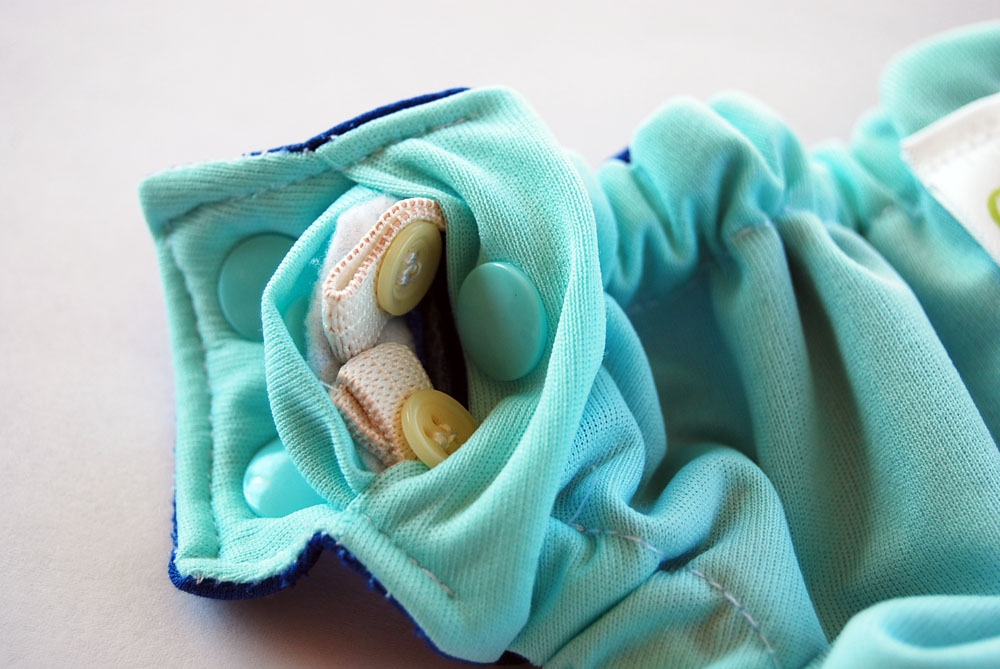
Another great feature is that the Sprout Change system is one-size-fits-all, from 5-40 lbs. How does this work? The legs and waist both have buttonhole elastic that cinches as tight or as loose as you need it. At the edge of each snap tab, there's a small access pocket. You simply open it up, pull the elastic to the right length, and fasten it to the hidden button. Tuck the extra elastic back inside and you're done! You'll probably need to adjust the diaper 3-4 times from your baby's birth until she is potty trained.

I wasn't able to try out the diaper on a real newborn; I'll have to wait for a few more months for that! But it fit Dio quite well right out of the package.

So now onto the inside of the diaper. You can buy a huge variety of absorbent insides: one-size serged inserts, one-size organic hemp "insides" that fold either horizontally or vertically to fit any size baby, traditional organic hemp sized prefolds, and more. You can also buy Soft Sleeves that you insert other absorbent insides into--great for re-using really worn, but still functional, prefolds.

My Sprout Change Shell v2 came with an organic cotton fleece Super Saver insert: several layers or organic cotton/hemp fleece, topped with a layer of organic cotton fleece. It's really absorbent--great for holding lots of moisture, but definitely the longest to dry in my entire diaper stash. For faster drying, you could choose the microfiber/microfleece Super Saver insert. This insert mimics the feel & function of a stay-dry pocket diaper, since the microfleece wicks moisture away into the microfiber layer.

You can also buy just the shells and use your own inserts or prefolds.

My only critique is that the diaper is sewn with white thread, rather than matching thread on each side. This reveals even the slightest imperfections in stitching.

I lent the diaper to a friend who has cloth diapered her 18-month-old since birth. She has used a wide range of diaper brands and systems. She really liked the Sprout Change as well. Her only suggestion for improvement would be adding snap-in liners; she's used to those and almost tossed the insert into the toilet when she was shaking off the soiled diaper!

I also tested the Sprout Change shell and insert several times (plus more of my own inserts, since you can re-use the shell several times until it gets soiled). I had no problems with any leaks, even when I double stuffed and put it on for overnight. The shell dries very quickly while, as I mentioned earlier, the organic insert takes a while to dry. Using a foldable insert (either the one-size inside or the prefold) would cut down on drying time.

Because the Sprout Change shell fits any size baby or toddler, you only need to buy 6-8 shells, plus 24-36 insides, for a lifetime of cloth diapering. The upfront cost of cloth diapering can turn many parents away, especially if they have to buy 24 diapers in 3 or more sizes. With the Sprout Change system, your initial investment is much more modest, and there's nothing else to buy as your baby grows. If you bought 8 shells and 24 Super Saver inserts, it would cost $270. If you bought just the shells ($16.95 each) and used your own inserts or prefolds, it would cost $136. And because the shells are reversible, buying 8 shells gives you 16 different colors to choose from.

Want to a Sprout Change diaper for yourself? Stay tuned for a Sprout Change Giveaway!
Read more ...

Saturday, October 16, 2010

Birth Educator Cloth Diaper Kit

One of my favorite exhibitors at the Lamaze Conference was the Real Diaper Industry Association. It is a non-profit organization dedicated to making "reusable cloth diapers the primary choice for babies’ parents and caregivers while emphasizing responsibility and sustainability through a focus on people, planet, and profit."

If you are a childbirth educator, the RDIA has a fantastic offer to help you educate your clients about cloth diapering options. For only $25 (shipping included to the US or Canada), you can receive a Consider Cloth Diaper Demo Kit. Worth well over $100, this kit allows your class attendees to see and touch all of the basic types of cloth diapering systems (AIO, Pocket, Fitted, Flat, Contour, Wool or PUL Diaper Cover, and Wet Bag, all donated by manufacturers). 
To give you an idea of what your kit may contain, here is what came in my kit:
This is an amazing offer. If you're a childbirth educator, be sure to order a kit before supplies run out. The RDIA has also offered these kits to qualified, registered doulas, childbirth educators, midwives, birthing center directors, and lactation educators; inquire to see if you are eligible to purchase one.
Read more ...

Wednesday, May 05, 2010

Your baby the tyrant


A blog reader alerted me to a bestselling book from French philosopher and feminist Elisabeth Badinter, Le Conflit, La Femme et La Mère (The Conflict, The Woman and The Mother).I haven't yet read the book, but I did read an article about Badinter's new book in The Times. Among other things, Badinter claims that babies have become women's new tyrants, and that cloth diapers, homemade baby food, and breastfeeding are major culprits in the oppression--even modern-day slavery--of women. "It may seem derisory but powdered milk, jars of baby food and disposable nappies were all stages in the liberation of women," she comments. 

I then took an amusing romp through the comments. Is it just me, or does Badinter's argument, and many of the ensuing comments, just seem so old and worn out? Is there a way to talk about these issues without lobbing personal attacks against Badinter or simply rejecting everything she says outright ("if you're too selfish to lay off cigarettes and alcohol for a few months, then frankly you're too selfish to be a mother")?

My take on this whole weary debate:
  • "Choosing" not to breastfeed (and in lesser part, choosing disposables and processed baby food) and thus being obligated to purchase expensive, commercially manufactured products for a number of months and/or years does not feel very liberating to me. 
  • For me, breastfeeding isn't just about getting food into the baby's body, but about relationship. How can you quantify something so complex as love or attachment or comfort?
  • The women I've met who cloth diaper, me included, do it because they really enjoy using cloth, not out of a sense of grudging obligation to some unspoken ideal of motherhood.
  • Speaking of washing diapers, is it really that much work to put diapers in a washing machine and hit a button? If we're talking about a new form of slavery, turning on a machine and spending...what?...30 seconds at a time doesn't seem all that terribly demanding to me. Now, cloth diapering would be a whole different story if I had to wash everything by hand... 
  • I've never used either homemade or purchased baby food, and this particular example seems especially trivial. Children have to eat one way or the other. I don't see how buying small jars of prepared foods will somehow liberate women from an otherwise bleak life of slavery. 
  • Badinter is coming from a position of wealth and privilege. She has the means to outsource many aspects of mothering, from feeding to childcare. What irks me are her grand, sweeping generalizations that all women ought to abandon the day-to-day tasks of mothering because she found them oppressive--as if economics and personal value systems played no role whatsoever in the various ways women choose to mother their children.
  • I'm trying hard not to reject everything she says outright, but it's proving difficult. Especially her devaluation of children--they ruin your lives, just ship them off so you can do "important" things with "real" people, etc. Children are human beings, albeit small and often quite helpless, and they deserve an extra measure of compassion and care, not abandonment (however you might personally define it) to surrogates so their parents can "get on with their lives."
  • I'm not buying her argument that French women are happier than German women because they are more successful at separating their motherhood from their womanhood. No room for nuance or personal preference. 
  • Overall, Badinter speaks of breastfeeding, cloth diapering and stay-at-home parenting as if they were predominant practices that very few women dare break from. In reality, most women formula feed and buy disposables and send their children to day care. So I guess I am left wondering why she's getting herself so wound up over a non-existent "problem," as it were.
  • I acknowledge that I am responding to someone else's summary of her ideas, since I haven't yet read the actual book. Great big caveat.
  • I do think that modern-day, industrialized, nuclear family life can be isolating. I don't think humans were really meant to live in isolated, nuclear families where the father leaves to go to "work" and the mother "stays at home." I think it's a tragedy that most of us in the developed world have lost our extended kin networks. We no longer have sisters who can breastfeed our babies if we are away, or cousins next door to tend to our little ones, or grandparents who can be a daily part of their grandchildren's lives. We live in a culture in which work and family life occur in strictly separated spheres. Can we imagine new ways of combining the need to earn a living and raise a family, outside of todays' either/or options (working mom or SAHM? Paid out-of-the-home employment or unpaid stay-at-home parent?)
I had to laugh at this comment: "I don't understand why washable nappies and breastfeeding should ruin your sex life? It sounds all in the mind to me, oh no darling not tonight I've got to wash some nappies!!??"

Please read the article and the comments (and be warned, some of them get really off-topic), and then come back and discuss!
Read more ...

Thursday, March 04, 2010

Writing contest sponsor: Monkey Muffin Creations

We have another sponsor for the Writing Contest: Monkey Muffin Creations! Monkey Muffin offers knit soakers, hand-dyed and upcycled yarns, and quilts.
After having a difficult time finding affordable wool soakers, Monkey Muffins Creations decided to create their own. Monkey Muffin soakers are knit with babies—and mama!—in mind. The soakers feature soft yarn, secure waist and legs, and plenty of room for fluffy bottoms. Monkey Muffins has many styles of soakers--shorts, pants, even skirts with built-in legs! Check them out at www.MonkeyMuffin.etsy.com
Monkey Muffin is honored to offer a soaker of your choice (up to $35 value) to one of the writing contest winners.

If you aren’t entering the contest (or don’t think you’ll win!), don’t despair. Free shipping on any order from Monkey Muffin through May 1st--just mention that you read Stand and Deliver!
Read more ...

Friday, February 26, 2010

10 months old!

I was looking back through pictures of Zari when she was 10 months old, and it's fun to see the contrast between the two children. Zari's hair was so much thicker. Dio still has that fine dandelion fluff. She was into grinding her teeth together at that age too.

When he's concentrating on something, he sticks his tongue out.
 
He had a major blow-out today, but it had been several weeks since he had a poopy diaper. I can usually anticipate when he needs to go. 

He's been sleeping terribly much of this last month. We're lucky if he only wakes up every 3 hours at night, but sometimes it's every hour and a half or every two hours. And naptime is sometimes just as bad: 30 or 40 minutes and then he wakes up and is exhausted but I can't get him back to sleep. And to top it all off, he's started waking up at 6:30 am, instead of his usual 7:30 or 8 am. What's up? I don't know if there's anything different I can do to help him sleep better. At night, he starts out in a separate room. He's bundled up to stay warm (but has one arm free so he won't struggle). There's a fan running for white noise. But he seems to wake up just as frequently when he's in a separate room as he does once I bring him in with us (around 1 am, or whenever he wakes up to nurse after I've gone to bed).

Dio can crawl quite quickly now. He's started pulling himself up on the furniture all by himself. He hasn't figured out how to get back down, though, so I have to come to the rescue.

He loves to stand up in his crib, hold onto the bars, and bite the rail. This comes in handy for when I need to get dressed or fold laundry or dry my hair. Zari climbs in to join in the fun, and the two of them bounce around and laugh together.
Read more ...

Monday, November 16, 2009

Extreme makeover: diaper edition

He was done with his newborn size diapers (6-13 lbs) by about 6 weeks and was starting to bust out of the smalls (10-20 lbs) by about 5 months old. I just put Dio into the size medium diapers (18-36 lbs). Zari didn't go into the mediums until after she was a year old!

These size mediums are boring, though. White PUL, white hook & loop, white elastic, off-white bamboo velour.


I decided to give one of the diapers a makeover. I recently bought a snap press (why didn't I get one earlier???) and some new PUL prints and solids. I took apart the old diaper and, using the bamboo velour inner layer, made this:


I also liked my FuzziBunz so much that I made some of my own pocket diapers. First I made a pattern using the Fuzzibunz diapers. The green dotted one is a One Size knockoff, identical except I made snap elastic because I couldn't find buttonhole elastic in the right width. The sun & stars diaper is basically a Perfect Size knockoff, except I trimmed the seam allowances and put on FOE (fold-over-elastic) on as an experiment.


I bought microfleece for the wicking layer from a diaper supply store, but was very disappointed to find that it doesn't wick--it repels! So these pocket diapers I made have been leaking like crazy. They still repel water even with repeated washings. I'm giving up on microfleece and will switch to a high-tech atheltic wicking fabric like powerdry or procool for the wicking layer. For now, I'm using the pockets as a cover and just laying the absorbent soaker pad inside, rather than tucked underneath the microfleece.


I also made a stack of organic bamboo velour soaker pads for my new pocket diapers. They're 13x13", two layers thick, and fold into thirds with snaps. They really didn't need snaps, but I was having too much fun with my snap press.

And finally I made myself a new wet bag. My old ones are plain white and starting to come unstitched. This one's a lot more fun. The zipper is recycled from a bag I bought at a thrift store.

When I was expecting Zari, I made 24 newborn, 24 small, and 18 medium all-in-one diapers with hook & loop closure and FOE binding. Then I helped my sister make 48 of the same kind for her own stache. Now that I've made a variety of cloth diapers, I'd definitely do a one-size adjustable pocket diaper with snap closures if I were starting over again. I'd probably buy one stack of 36 prefolds for the soaker pads, rather than sewing my own. I like pocket diapers because they wash and dry really quickly, especially if your soaker pad unfolds into thinner layers. They keep your baby feeling dry because of the top wicking layer. And snaps don't wear out, wick moisture (which is a problem where I've sewn on my loop tape on the front of the diapers) snag up the diapers, or make a diaper chain in the wash. I like FOE because it's quick to apply, but it does wick moisture around to the outside of the diaper and, if your diapers have hook & loop closure, it starts looking ratty. So I'm leaning more towards a turned-and-topstitched style. And, if you use buttonhole elastic, you can make one-size adjustable diapers--which means you only need to make one set, not three or four!
Read more ...

Wednesday, November 11, 2009

FuzziBunz giveaway winner & One Size Rewards Program

Jill of Peestick Chronicles is the giveaway winner! Send me your mailing address and the type & color of diaper you'd like.

Thanks to everyone for your comments, questions, and advice!

I wanted to let all of you know about the FuzziBunz One Size Rewards Program, which lasts through the end of this year. If you purchase 9 One Size diapers, you get $40 worth of FuzziBunz products! Rewards Program products include XS diapers, Daisy Print Perfect Size diapers, Changing Pads, Menstrual Pads, Diaper Totes, Burp Cloths, diaper pails, and extra inserts.
Read more ...

Saturday, November 07, 2009

FuzziBunz giveaway!


I am exited to be able to sponsor a FuzziBunz giveaway! One reader will win their choice of a Perfect Size or One Size Fuzzibunz diaper.

How to enter:
Leave a comment with your favorite cloth diapering tip. Or, if you're new to cloth diapering, a question for the rest of us to answer! 

For additional entries (new comment for each entry, please):


 Giveaway ends Wednesday, November 11, 2009 at 5 pm EST.
Read more ...

Friday, November 06, 2009

FuzziBunz cloth diaper review

A few weeks ago, a fluffy package arrived in the mail: two FuzziBunz diapers to review! FuzziBunz sent me a yellow One Size Diaper and an apple green Perfect Size Diaper in size medium. Now that I've used, washed, and dried both diapers several times, here is my detailed review of these cloth diapers.


First off, let me explain more about how FuzziBunz diapers are made and how they work. They are pocket diapers, which means there's an insert that you stuff inside the diaper and take out when you do laundry. The main diaper is made of two layers:
  • outer layer: PUL (polyurethane laminate): a common breathable, waterproof outer layer used in many cloth diaper systems)
  • inner layer: polyester microfleece, which wicks moisture away from the baby and onto the insert
The absorbent inserts are made of several layers of polyester microfiber serged together into a rectangle. I received one short and two long inserts. After the diaper is wet or soiled, you shake the insert out and toss both pieces into the diaper pail. The diapers are turned and topstitched with elastic along each leg opening and along the back waistband.

One nice thing about pocket diapers is that they dry more quickly than all-in-ones (AIOs). The FuzziBunz inserts are thick, probably at least four layers of microfiber terry serged together. If you used a folded insert instead of a layered, serged one, you could line dry these diapers in no time at all. 

Most cloth diaper systems use either hook & loop (velcro) or snaps for closure. FuzziBunz diapers fasten with snaps. Both the one-size and the perfect fit diapers have multiple snap settings so you can adjust the diaper to fit as your baby grows. Hook & loop is hands-down the easiest to fasten, especially at night when you don't want to turn the lights out, but it also wears out, snags in the wash, and attracts lint. (I know this from experience, because my own diapers have hook & loop. So far, the H&L has stood up well, but eventually I'll have to replace it.) The snaps take a little more manual dexterity, but you soon get the feel of which snap goes where.
 
FuzziBunz diapers come in a rainbow of colors and prints. I especially love the green daisy diaper. Mmmmmm....

Whenever a diaper claims to be "one size", I am curious to see how it's made. How can one diaper adjust to fit a tiny 7-pound newborn, then a chunky 20-lb baby (Dio's current size), then a 30+ pound toddler (Zari's size)?

FuzziBunz one-size diapers do it with 1) adjustable buttonhole elastic and 2) multiple snap settings. The back waistband and each leg hole have narrow buttonhole elastic that fastens onto hidden buttons. Each diaper has 6 buttons for the adjustable elastic: 2 on each leg and 2 on the waist. You can create 8+ different size settings on the legs and 4 on the waist. This picture shows the yellow One Size diaper with the elastics pulled tight (but not all the way to the smallest settings) and snapped up all the way, and then with the elastics let out and the snaps at the largest setting.

In the picture below, I have pulled the buttonhole elastic out from its "hide away hole" on the right side.

The elastics have numbers next to each hole, so you know that you have pulled the elastic the same distance on each side. There's a chart on the FuzziBunz website that gives suggestions for where to set the elastics, depending on your baby's size.

If your adjustable elastic wears out, you can get replacement pieces for a minimal fee. I called FuzziBunz to find out how this works. You can obtain replacement elastics if you bought the diapers new and can show proof of purchased from an authorized FuzziBunz retailer. If you bought them used, you're out of luck. (I tried searching the net for 3/8" wide buttonhole elastic and had no luck; it seems to only come in 3/4" and 1" widths). The elastic is easy to replace: simply hook the new piece to one end of the old piece with a safety pin and pull the new piece through.

Changing the snap configuration further adjusts the diaper's fit to your growing baby. Now, any one-size diaper will be quite bulky on your tiny newborn. But if you're willing to put up with extra fluff at first, the diaper will soon fit normally.

I tried both diapers on both of my kids. The yellow one size FuzziBunz actually have a trimmer fit at this point than the apple green Medium Perfect Fit diaper. The Perfect Fit diapers are about the same shape and size as the One Size, but they have sewn-in permanent elastic and slightly different snap configurations.

Zari has been wearing underwear for the past 6 months, but she was more than happy to model these for me. She especially loves stuffing the inserts in the diapers. (And how crazy is it that Dio's torso., bum, and thighs are as big as Zari's?!?)

I first tested the FuzziBunz diapers on Dio during the day, and I was pleasantly surprised at how I couldn't tell when he had peed or not. The microfleece wicking layer really kept him feeling dry, even when the insert was wet. But I was really curious to see how the FuzziBunz performed at night. Dio goes to bed around 8 pm and wakes up several times to nurse, usually every 2-3 hours. He wakes up between 7 or 8 am. When I am using my home-made AIOs (all-in-one cloth diapers made of hemp or bamboo fabric with PUL on the outside), I have to change diapers and/or potty him every time he wakes up. He doesn't like having a wet diaper, and at night this translates into extra night waking or restless sleep. So I put the FuzziBunz to the test. I stuffed each diaper with 2 inserts and tried several nights of no diaper changes.

Nighttime verdict: You *can* go 11-12 hours with a double-stuffed FuzziBunz, but by the end of the night it's really, really saturated and even the wicking layer can't keep a baby feeling dry with that much pee. Dio started getting rashes from having so much moisture against his skin all night. So I adjusted my routine and now change diapers and/or potty him when I go to bed (around 11 pm, which is when he wakes up for the first time) and maybe the next time he wakes up to nurse around 1 or 2 am. Then, with a fresh FuzziBunz on, Dio gets to spend the rest of the night without having to be disturbed by diaper changes. And me too!

Conventional cloth diapers have absorbent fabric right against the baby's skin, which feels wet as soon as the baby pees. (I don't mind this during the day, but it does pose a problem at night when you want your baby to sleep!) FuzziBunz , however, feel dry even when they're wet. You probably should change your FuzziBunz diapers once during the night if your baby is nursing as often as Dio is. By his age, though, many babies are sleeping longer stretches and nursing less, and you could probably get away with just one double-stuffed FuzziBunz at night.

Cloth diapers are a big financial investment up front, but they save a lot of money over the long-run. One Size diapers are a great solution to the initial cost of cloth diapers, since they will fit from the newborn stage until your child has potty trained. I suggest a minimum of 24 diapers and up to 36 if you have some generous family members who want to help out with baby expenses. I have 24 of each size of my home-made AIOs, and I wash every other day. You might be able to get away with fewer than 24, since FuzziBunz feel dry even when your baby has peed. FuzziBunz are available both online and in select stores. You can also find used FuzziBunz at Diaper Swappers.

Read more ...
Related Posts Plugin for WordPress, Blogger...