Tuesday, October 31, 2006

She is here!

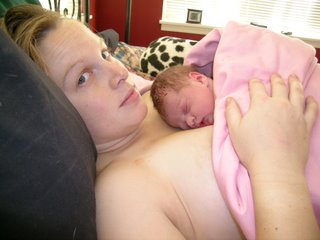
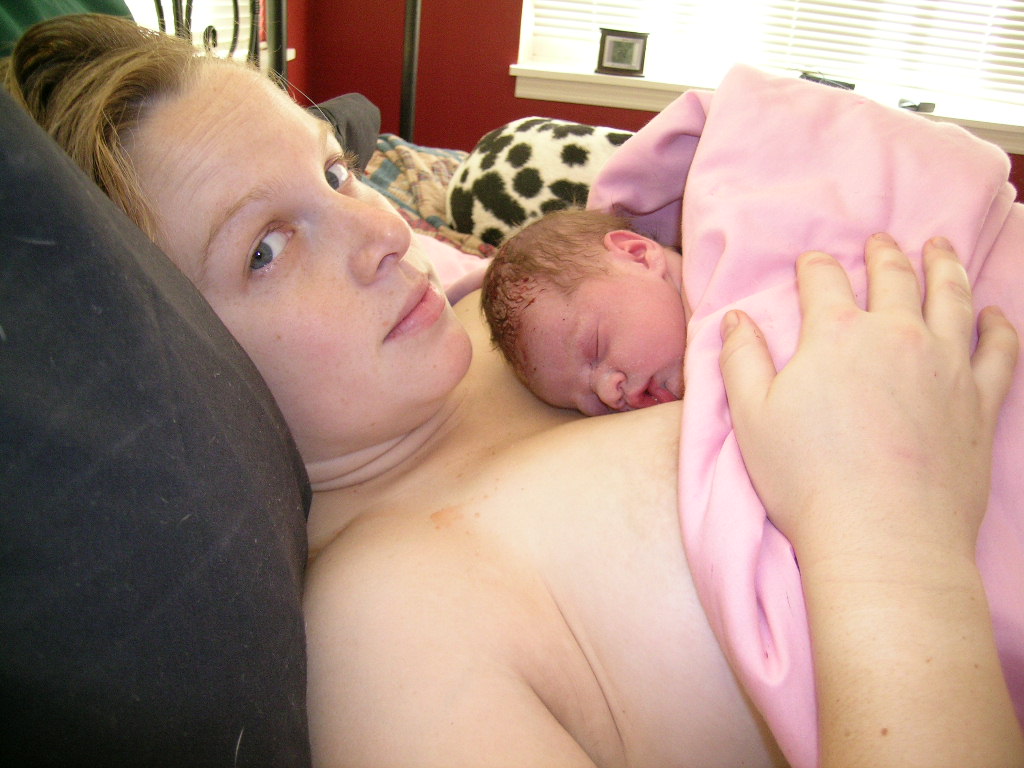
I gave birth to a girl this morning at 11:23!! We weren't expecting her so early (she is 38 weeks on the nose) but we are thrilled. She weighs just shy of 7 lbs.

Labor lasted 10 hours. It was intense, challenging, and very fulfilling. She was born into my own hands in our master bathroom. Eric was a great help. Basically I labored on my own in another room and hollered if I needed anything. He respected my need for doing this without feeling watched. It was just what I wanted.

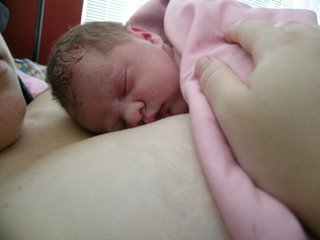
She's been nursing like a pro and cuddling up skin to skin the rest of the time. She has never left her parent's arms from the minute she was born.

Here she is less than 1 minute old:


Read more ...

Monday, October 30, 2006

Wiped out

Today I can claim to be a miserable pregnant woman (although my complaint probably has nothing to do with pregnancy). Last night I slept a grand total of about 6 minutes. Every time I would start to fall asleep, I would suddenly wake up to the sound of a very loud snorting/gagging sound. How did such a ladylike sound come out of my own mouth? Then I would lie in bed for a half hour or so until my heart stopped racing and try to get to sleep again. Then the whole snorting/gagging thing would start up again as soon as I fell back asleep.

It was really weird. I've never had anything like that happen before.

I went downstairs from 1:30-3:30 am thinking that lying on the couch would help. It didn't. So I went back upstairs until 5:30 am, when I finally gave up and went back downstairs to waste some time on the internet.

It was as if I had stopped breathing each time, or had a really congested airway. Only I am not congested...what is up?

I have been able to get about an hour of sleep total today, thanks to my Hypnobirthing CDs. They put me out like a light. Let's just hope that there is no more snorting tonight, because I don't know if I can take another night of no sleep. I am okay with waking up 5-6 times a night to pee--I've been doing that since month 1. But no sleep at all? NOT GOOD.
Read more ...

Saturday, October 28, 2006

35 weeks gestation


Read more ...

Wednesday, October 25, 2006

Preparing for Labor

A woman on one of my internet birth groups recently posted these thoughts about how she prepared for labor:
When we decided to have a homebirth with a midwife, I (being an intellectual) bought as many books as I could, went to my childbirth class very early, read the corresponding book to the class, went to homebirth meetups, watched every video I could, including the ones on TV with hospital births. I wanted every possible tool in my bag for when the time came, uncertain which method would ultimately prove beneficial once in labor.

The last video I watched was at my childbirth class. It was, yet again, another South American video. I was disappointed with this after so many videos, because I couldn't understand what was being said in labor. I knew everything I felt I needed to know about the actual birth by then, but I wanted to know more about a natural LABOR at that point.

Well, as was typical in the Latin videos, the woman had her family there with her, both in and out of the tub, and she QUIETLY gave birth to her baby while her children watched her normal, natural birth. Then suddenly the video switched to an American home birth in a blow-up pool in the family's living room. The woman moaned and cried and wailed and had that typical wild-eyed, American labor look of "Who Is Going to Rescue Me Now????"

The stark contrast was what helped me know that every tool in my bag was completely unnecessary and useless. I was looking to trust everything but my baby and my body. I threw away my bag of birthing tricks. I understood then that we Americans are heavily convinced that birth is super difficult and have been indoctrinated into the mindset of we weak women need to be saved by the knight in shining armor. I was NOT going to be that. I believed thoroughly in the natural process of birth. I believed that my body was made to give birth. And, most importantly, I believed that just as my baby and body knew when it was time for my body to labor, my baby knew how to be born.

I was very quiet during the three days I was in labor. My midwife did not even come over until late the third morning. By then I was finally in active labor. I was quiet throughout the entire day until transition. After an hour of transition, during the last 30 minutes of transition I began to ask if I could really do this. My husband and my midwife's apprentice talked to me after every contraction and reminded me that I could and to stick with just one contraction at a time. (The transition contractions were the worst for me, because I thought I would throw up. What they didn't know was that I would rather have contractions any ole day than be forced to vomit. Just a personal preference thing.)

All at once I felt a wave start from my head and flow through my body and out of my vagina, and my body pushed with it. It did it again on the next contraction, and I felt the ring of fire. I jumped up out of the bed and headed for the tub. My midwife reminded me that I didn't have to have a waterbirth just because that was what I had planned, but I didn't even listen for a second. I KNEW the water was where I needed to be.

The water eased the contractions remarkably. My friend, husband, midwife, and midwife's apprentice were all in the bathroom talking to each other while I was in the tub with my head at one end and my feet touching the other end. Absolutely NO ONE knew I was pushing (actually not even I knew). I asked for a rag that I instinctively held with my hand between my legs.

Suddenly I felt a "pop" and asked my midwife what it was. She turned around and looked down at me and said, "Oh! The head is out!!" She insisted that I pull my legs up then (my knees were still together when the head was pushed out), and Ania was born a few seconds after.

My point is that I turned into myself. I listened to my body. Found the position that worked for my body. Walked when my body knew I needed to walk.

It was the closest I've ever been to God. The world went quiet and faded away. I was in touch only with each breath of each second of each contraction. Two months of third trimester discomfort and swearing I would never ever never have a baby again had me wanting another almost immediately because of the childbirth.

Was it painful? Yes, in all honesty it was painful during that 1-1/2 of transition. Was it my mindset that got me through it? Absolutely. I welcomed the pain, knew it was natural, knew it was not permanent, knew labor pains would not be listed as the cause of my death. I just fell into labor, didn't fight it, didn't question it, didn't question the process. I trusted birth. THAT is the only real tool you need.

Posted with permission from M. Morrow.
Read more ...

Monday, October 23, 2006

A beautiful poem

Silence (Ciúnas) by Biddy Jenkinson
Tranlated by Pádraigín Riggs


How I welcome you, little salmon
who leapt the womb, impatient to commence life.
I undertake to be a river to you
as you follow your course from the haven of
my belly to far distant seas.

Let yourself go, and drink up your fill.
Suck sleep from me. By the terms of the breast-contract
I'll suck back from your puckered lips
love, with which I'll suckle another time, and for that
I'm grateful.

How I welcome you, salmon of sleep
who made a tranquil pool in my life-stream.
In the rhythm of your heartbeat
I hear the music of the Heavens,
and it guides my way.

Born in 1949, Biddy Jenkinson (pen name) is an Irish poet and dramatist.
Read more ...

Tuesday, October 17, 2006

My hospital rant

Last week I visited a hospital with a friend who is 7 months pregnant. She had an okay birth with an OB a few years ago, but during this pregnancy has realized that she wants—and deserves—so much more. I’ve been providing her with information about all of her options, from unassisted birth to hospital birth with a CNM. I loaned her two of my favorite books, Ina May’s Guide to Childbirth and The Thinking Woman’s Guide to a Better Birth, and several birth DVDs. She is most interested in homebirth but, like me, has had trouble finding an available midwife. So we took a trip to visit this hospital’s maternity wing and to chat with a CNM who comes highly recommended.

This hospital is one of two certified Baby Friendly facilities in the entire state, and its cesarean rate is half the national average. One of the on-call OB’s has a cesarean rate of 10%. (The other OB’s rates are around the national average of 30%.) If I had to go to a hospital, this is the one I would choose.

Still, what I saw was so disappointing. Not because I was expecting anything better—I am familiar enough with hospital birth rooms and routines—but because a hospital could easily offer an entirely different birth experience if they truly understood the physiology of birth. Michel Odent’s book Birth Reborn gives us a glimpse into what a hospital birth experience should be like, if a laboring women’s needs for privacy, security, warmth, darkness, and lack of feeling observed were truly understood and respected.

At this hospital was the standard high, narrow birth bed with stirrups and foot rests. Because women *still* give birth on their backs even though we know it’s a terrible position. There was the high-intensity spot light built into the ceiling so your perineum gets center stage (because of course you will be in bed on your back for the birth). Electronic fetal monitor—check. Never mind that every study done on fetal monitors has shown that they do NOT improve fetal outcomes at all. Their only documented effect is to dramatically raise the cesarean rate. Uncomfortable couch for the father—check. Lots of other medical equipment half-heartedly hidden by pastel wallpaper—check.

I asked the nurses what the standard admittance routine was: electronic fetal monitor strip, blood pressure, temperature, and IV. The nurses have NEVER seen a woman labor at this hospital without an IV or heplock. Never.

On the upside, they do have gigantic Jacuzzi tubs for laboring. I’d say they are even bigger than mine. They are actually so big and high that I don’t know how a pregnant woman would actually be able to climb in...

Like I mentioned, the hospital is Baby Friendly certified, which means it meets these 10 requirements as outlined by the WHO-UNICEF:
• Have a written breastfeeding policy that is routinely communicated to all health care staff;
• Train all health care staff in skills necessary to implement this policy;
• Inform all pregnant women about the benefits and management of breastfeeding;
• Help mothers initiate breastfeeding within a half-hour of birth;
• Show mothers how to breast feed and how to maintain lactation even if they should be separated from their infants;
• Give newborn infants no food or drink other than breast milk unless medically indicated;
• Practice rooming in: allow mothers and infants to remain together 24 hours a day;
• Encourage breastfeeding on demand;
• Give no artificial teat or pacifiers (also called dummies or soothers) to breastfeeding infants;
• Foster the establishment of breastfeeding support groups and refer mothers to them on discharge from hospitals or clinics.

The sad thing is that only two hospitals in the entire state meet these fairly minimal requirements. Every hospital should automatically do these things!

Even more dismal is the tiny number of hospitals nationwide that meet the Mother-Friendly Childbirth Initiative, as outlined by the Coalition for Improving Maternity Services. Here are the basic requirements to be certified as Mother-Friendly:

1. Offers all birthing mothers: unrestricted access to the birth companions of her choice, including fathers, partners, children, family members, and friends; unrestricted access to continuous emotional and physical support from a skilled woman-for example, a doula or labor-support professional; access to professional midwifery care.
2. Provides accurate descriptive and statistical information to the public about its practices and procedures for birth care, including measures of interventions and outcomes.
3. Provides culturally competent care -- that is, care that is sensitive and responsive to the specific beliefs, values, and customs of the mother's ethnicity and religion.
4. Provides the birthing woman with the freedom to walk, move about, and assume the positions of her choice during labor and birth (unless restriction is specifically required to correct a complication), and discourages the use of the lithotomy (flat on back with legs elevated) position.
5. Has clearly defined policies and procedures for collaborating and consulting throughout the perinatal period with other maternity services, including communicating with the original caregiver when transfer from one birth site to another is necessary; linking the mother and baby to appropriate community resources, including prenatal and post-discharge follow-up and breastfeeding support.
6. Does not routinely employ practices and procedures that are unsupported by scientific evidence, including but not limited to the following: shaving, enemas, IVs, withholding nourishment, early rupture of membranes, electronic fetal monitoring.
Other interventions are limited as follows: induction rate of 10% or less; episiotomy rate of 20% or less, with a goal of 5% or less; total cesarean rate of 10% or less in community hospitals, and 15% or less in tertiary care (high-risk) hospitals; VBAC (vaginal birth after cesarean) rate of 60% or more with a goal of 75% or more.
7. Educates staff in non-drug methods of pain relief and does not promote the use of analgesic or anesthetic drugs not specifically required to correct a complication.
8. Encourages all mothers and families, including those with sick or premature newborns or infants with congenital problems, to touch, hold, breastfeed, and care for their babies to the extent compatible with their conditions.
9. Discourages non-religious circumcision of the newborn.
10. Strives to achieve the WHO-UNICEF "Ten Steps of the Baby-Friendly Hospital Initiative" to promote successful breastfeeding.

These elements should be a given in any hospital service! The hospital I visited, which is by far the least interventive in the entire area, fails miserably in at least 4 of the 10 requirements (#2, 4, 6 & 7). This is my best choice??

The final irony is the brochure the nurse gave me at the end of the tour. The front page proclaims in big letters: "Just Right In Every Way."

Read more ...

Monday, October 16, 2006

The Nerve

Yesterday when I was at church an older woman asked to speak to me after the meeting. She had asked me last week to play my violin in church, so I assumed she wanted to talk more about what music I had picked out. Although I’ve been attending this congregation for a little over a year and know most of the people, I have never spoken with this particular woman until last week. I don’t even know her name.

After church she brought me into an empty classroom, sat me down, and said, “You probably have no idea why I wanted to talk to you.” Nope. She looked at me and said, “I want you to tell me why you are not seeing a doctor or going to a hospital for your birth.” She then proceeded to tell me several horror stories about things going wrong at the last minute during birth. Her daughter bled a lot after having her baby and “had to be sedated” because she started panicking when she saw all the people in the room and asked what was going on. (This daughter also had one kidney and "half a uterus," whatever that means). She knows of another woman who bled to death after giving birth in the hospital. Yeah—great advertisement for hospital birth! She told me that she’s been worried sick about me ever since she learned that I am not planning on seeing a doctor or going to a hospital, and that I should really reconsider my plans.

I calmly explained my choices to her (statistics of home vs. hospital birth for healthy women, the importance of not disturbing a natural process, and how many routine hospital procedures can often cause complications to occur). I talked about how I’ve been researching birth for close to 4 years now, and that I’ve made this decision with a lot of thought and prayer. I then told her: “Frankly, you should never say those kind of things to a pregnant woman, especially to someone so close to giving birth.”

The whole conversation took about half an hour, most of it with her talking.

On the way home from church, I told my husband about this strange experience. He became very upset that a woman I don’t even know had the nerve to pry into my life and tell me what to do. He said “you are the one who has done years of research into birth, not her!”

The more I have thought about this conversation, the more it bothers me. It’s one thing for a close friend to ask me what my birth plans are, because they care for me and want to know what I will be doing. But for a virtual stranger to demand that I justify a very personal decision to her and then to try and scare me into doing what SHE feels more comfortable with—that is completely unacceptable.

I wish I had known what she was about to ask when she sat me down. I should have ended the conversation right then by saying, “This is a very personal decision between me, my husband, and God. And it is none of your business.”

Thanks Ellen for the pep talk last night! I felt much better afterwards.
Read more ...

Saturday, October 14, 2006

33 weeks gestation

If you look closely at my hip, you will see 3 red marks. No, I was not stabbed by a giant fork! I think these are stretch marks. I have identical marks on the opposite hip. I also have these same "stab marks" very low on my abdomen. Weird, eh?

Read more ...

Monday, October 09, 2006

Pushed and Pulled

I’ve been following a recent discussion thread on MDC (Mothering Dot Commune) about unassisted birth. One of the posters wrote:

“It's one thing to be motivated by a desire to NOT have something happen. It's another to be motivated by a desire to HAVE something happen.

See the difference?
Pain pushes.
Vision pulls.”

Embracing what we DO want, rather than just avoiding what we DON'T, has really resonated with me. I've been thinking a lot about the term "unassisted birth." It's interesting that so many of the words we use for birth focus on what is absent:
un-assisted
un-medicated
un-hindered
un-inhibited

These words are important because they help identify what is wrong with our current birth culture. A great deal of my motivation to birth at home is to avoid unnecessary and harmful hospital procedures. I don’t want an IV, electronic fetal monitoring, artificial rupture of membranes, vaginal exams, Pitocin, epidural, narcotics, time limits on labor, forceps, vacuum extraction, cesarean section, immediate cord clamping, cord traction, sepatation from baby for bathing or measuring, bright lights, narrow hospital beds.... The list goes on.

I have a healthy fear of birthing in a hospital. Just a quick comparison of cesarean rates in healthy women planning home or hospital births is enough to keep me securely at home. In the year 2000, roughly 19% of healthy (or “low risk” in medicalese) women planning hospital births had cesarean sections. Cesarean rates among women planning home births are consistently between 1-4%.

But birthing at home merely to avoid the hospital is only part of the picture. I love words that focus on what we're gaining, not just what we're leaving behind, when we reject the rituals and confinements of institutional birth:
freebirth
empowered birth
ecstatic birth
autonomous birth (see Linda Hessel’s blog for an excellent discussion of this term, especially her posts titled “Laura Shanley” and “Terminology”)

Early books about unassisted childbirth often use the term “Do-It-Yourself childbirth.” I like that term--I'm a big DIY girl myself. Over the past several years I've learned how to do plumbing, electricity, framing, plastering, drywall, roofing, tiling.... Almost anything you can do to a house, my husband and I have done it! A DIY-er isn't afraid to get dirty, to make mistakes, to make a mess at times. I trust myself to do the job right, whereas when I hire someone (which I've done twice, once for a big job and once for a little job) I'm always fretting about whether or not it's good enough. Plus there's something so satisfying about accomplishing a big task and having professionals come over and admire the quality of your work! Or when people ask you which contractor you hired, seeing the look on their face when you say, "oh, I did it all myself. Piece of cake."

Home repair manuals are filled with dire warnings about leaving certain jobs up to professionals—anything from refinishing wood floors to electrical work. And yes, there are certain things that I will hire out, such as working on gas lines. I’m sure that I could figure it out if I wanted to, but it’s not worth the hassle. But most of these things we have done ourselves, and the results were fantastic.

On the other hand, DIY also conjures up images of Bob Vila and middle-aged men wearing toolbelts and red plaid shirts. It’s probably why the term “DIY childbirth” fell out of vogue.

But enough talk of home repairs. I think freebirth speaks to me the most. Because there's nothing attached to it. There is no "right" way to freebirth. Just you and the baby and the freedom to do whatever is necessary to have that baby.

I don’t have any one particular vision of how this birth should unfold. Perhaps I will labor at night in our fireplace nook, warmed and lit by a fire. Maybe I will give birth by candlelight in our oversized Jacuzzi tub. I might push the baby out kneeling on our bed, at mid-day, with sunlight streaming in from the seventeen windows in our bedroom. (Can I say that our house has good birthing vibes?? So many nice places to labor in.) I may have a “wham, bam, thank you ma’am” labor that leaves me feeling somewhat stunned. Or labor could be long and slow. The point of freebirth is that there is no script I have to follow, no rules for what is right or wrong. In the end, what I really want is to be able to experience birth on my own terms, on my own power. I want my baby to emerge in an atmosphere of love and peace, and to know only the warmth of his parent’s arms. I want to come away feeling exhilarated and to be able to say "Don't mess with me. I can do anything now!"
Read more ...

Thursday, October 05, 2006

Belly Heaving


This is a fantastic timelapse collection of babies moving around in utero. I don't have a video camera of my own, but my baby does similar acrobatics all the time. I love it!
Read more ...

Monday, October 02, 2006

Naming My Fears

These are my biggest fears. I am going to list them no matter how silly they might seem on paper. Instead of pretending they don’t exist, I am going to broadcast them to whoever wants to read them.

In no particular order:

1. Having a cesarean section. Even if it was truly “necessary.” (I would be skeptical of that diagnosis for anything but a very small number of reasons, including: complete placenta previa, cord prolapse, shoulder/transverse presentation that doesn’t resolve with labor, or massive placental abruption.)

2. Having an operative delivery (forceps or vacuum extraction).

3. Transferring to a hospital and having to fight for what I want.

4. “Losing it” during labor and transferring to a hospital and later regretting it.

5. Taking pain medications and then having people smirk and say “I told you so.” Obviously I would have to be in a hospital for that.

6. Making the wrong decision about where to birth, and whom to invite. I honestly cannot say I know 100% that planning to birth unassisted is the right choice. I’d say it’s more like 90%. I cannot think of any more appealing alternatives though. I do have a good midwife friend who might be able to come, but it’s not certain. She also lives 3 hours away so I cannot plan on having her there on time.

7. Wanting a certain kind of birth so much that I will ignore what is really best for me. Maybe I would have a better experience with a “low profile midwife” (I love Michel Odent’s term!!). Or maybe I invite a midwife for the birth, but I would have been better off by myself.

8. My husband freaking out when I am in labor and disrupting me. Let’s face it—adrenaline is not a good thing for laboring women to be around.

9. Losing the baby and having people blame me for it. My husband especially.

Those are my biggest fears. Now what to do about them...comments or suggestions appreciated!
Read more ...

Wednesday, September 27, 2006

30 weeks gestation

My belly is growing rapidly. The skin feels so streeeeeetched sometimes!


Read more ...

Tuesday, September 26, 2006

What does a pregnancy cost?

I was recently going over my finances and asked myself "what has this pregnancy cost me?" Here's the breakdown:

Medications & supplements:
$60 for Crinone progesterone gel copays (I had some low progesterone concerns early in the pregnancy)
$100 for prenatal vitamins, vitamin B6, fish oil supplements, etc

Maternity clothes

$300

Books & DVDs
$200
(These were also for my dissertation research)

Chiropractic care
$60 for 6 visits (my copays are about $10 now that I have met my annual deductible)

Fetoscope
$20

Doctor or midwife visits
$0
(Okay, technically I spent $20 to see my family doctor about getting my Hemoglobin levels checked and getting a prescription for a postpartum Rhogam shot if needed. However, she refused to help me with those things. Luckily the midwife I work with recently checked my Hg for free, and said she'd help me with the Rhogram prescription.)

Birth Supplies
I already had most things at home. Here are the costs for things I had to actually go out and purchase:
$20 for anti-hemorrhagic tinctures
$7 for afterbirth herbal bath
I'll probably spend a little more money on things like extra secondhand towels, hydrogen peroxide (takes out blood like a charm), and disposable mesh panties for the first few days postpartum.
Read more ...

Monday, September 25, 2006

Birth supplies

Here are some supplies I have gathered in preparation for the birth. To be completely honest, I don't really "need" most of them. I think the most important birth supply is lots & lots of towels.

Towels
Chux pads (rectangular absorbent pads, aka incontinence pads or puppy training pads)
Placenta Out tincture (for bleeding before placenta releases)
HemHalt & Wombstringe tinctures (for post-placenta bleeding)
Afterease Tincture (for relieving afterbirth pains)
Herbal afterbirth bath: great for healing tears & sore bottoms
Placenta bowl (aka a large, shallow stainless steel mixing bowl)
Emergen-C (a powder you add to water, to make a fizzy, energizing drink)
Bendy straws
Various massage tools
Microwaveable rice packs
Electric heating pad (for keeping towels warm)

Things I have but will probably never use:
Plastic cord clamps (I plan on tying off the cord with shoelaces or braided embroidery floss--much more comfortable for the baby)
Bulb syringe
Nonsterile latex gloves (mostly for when I am at someone else's birth and examining the placenta)
Sterile 4x4 gauze pads

I plan to put all of my birth supplies in a basket that I can grab and bring anywhere in the house. I will layer the supplies with things I will need first towards the top, and afterbirth/baby items towards the bottom.
Read more ...

Wednesday, September 20, 2006

Looking more pregnant

I'd say I definitely started looking pregnant about 2 weeks ago. All of a sudden, random people started commenting on my pregnancy. Even just 4 weeks ago, people at church still came up to me hesitantly, giving me that I-don't-know-if-I-should-ask look. Some didn't notice until I told them.

And my appetite--wow! Just this last week I have become ravenous nearly all of the time. Even though I've had to eat more often during this pregnancy, I didn't necessarily eat more overall until this week. I'm even waking up at night hungry, so I've started bringing snacks upstairs when I go bed.

Here's what I ate yesterday:
- milk & cereal (for breakfast, and as a snack mid-day)
- 2 scrambled eggs with cheddar cheese
- spaghetti squash
- apple
- banana
- milk (probably 2 glasses)
- rice with cheese
- salad: arugula, New Zealand spinach, some "mystery greens", & hard boiled egg
- Tilapia fillet with Malabar spinach
- glass of grape juice
- square of very dark chocolate, a small chocolate cookie, and a few spoonfuls of ice cream
Read more ...

Friday, September 15, 2006

Better Is Not Good Enough

People have asked me why I don’t just choose a CNM in a hospital. After all, there are hospital birth centers now with comfortable (ha!) beds and Jacuzzi tubs. You don’t even feel like you’re in a hospital; it’s more like an upscale hotel. And the nurse midwives will even let you walk around and go into the tub!

That setting is certainly better than a typical hospital birth attended by an OB. Or rather, unattended by an OB, since most doctors generally have the nursing staff manage and monitor labor. Once the woman is pushing and the head is showing, the doctor is called in to take over. But I digress...

But better isn’t good enough for me. I refuse to labor in an environment where I will be “allowed” to do things. My recent attempt at IVF reminded me why being on my own turf is crucial. I went to the fertility clinic in January for the embryo transfer, the culmination of two months of drugs, shots, vaginal ultrasounds, blood tests, and minor surgical procedures. The staff led me to a room and had me undress and place my legs in THE HIGHEST stirrups I have ever seen. They left, and I waited. The four cups of water they had asked me to drink (so the ultrasound would work properly) came back with a vengeance.

There was a bathroom right across the hallway. I have never had to pee so badly in my entire life. I was a grown woman with advanced college degrees, yet I was nearly in tears because they had told me sternly that I was not allowed to go to the bathroom. I finally took my legs out of those stirrups, wrapped myself in a sheet, and sneaked across the hallway. I felt like James Bond. Even after I had locked myself in the bathroom, I was so worried about getting in trouble that I only let the smallest amount out. I sneaked back to the room and waited again. I made another evasive trip to the bathroom. I still was on the verge of exploding, just somewhat less so than before.

When the procedure started, I told the staff that I really had to pee. I mean REALLY. They said, “You’ll have to wait until we’re done and use the bedpan.” I was lying totally exposed, like an omega female on her back with a pack of alphas standing above her. I started crying because the discomfort was so incredible. The nurse dug around on my abdomen with the ultrasound probe for a few minutes. Finally, she said, “I guess you can go—you have a retroverted uterus and I can’t see it with your bladder in the way.” Peeing never felt so good.

My friends know that I’m not a wishy-washy Nice Girl by any means. I stand up for what I believe in. I speak up in class and disagree with my professors. Yet I found myself begging virtual strangers for permission to engage in a bodily function. On that day I understood complete humiliation.

I refuse to ask permission to walk around. I refuse to be “allowed” to drink clear fluids. No one will tell me that I cannot push, or that I have to get out of the tub, or that I have to lie on my back. If I want a steak, I will eat one. If I want to crawl in circles around my living room and bellow like a cow, no one will try to stop me. (My dog will probably think it’s great fun though).

Better is not good enough. I want fantastic. I want euphoric. I want incredibly challenging and painful and exhilarating.

And most of all, I want an empty bladder.
Read more ...

Thursday, September 14, 2006

Good laugh

This is completely unrelated to pregnancy or birth, but I thought it was pretty funny. These are TV and radio ads for Utah's 2005 State Fair, done by Napoleon Dynamite.

Horses
Duels
Sweet Rides

Ninjas
Cakes
Sesquicentennial
Dear Diary

Pedro's Song
Read more ...

Tuesday, September 12, 2006

Prenatal care

One question that I often hear when people learn I am giving birth at home is "but are you seeing a doctor or a midwife for your pregnancy?" The short answer is no. This post is the longer answer about what prenatal care means when you're not seeing a professional.

First, true prenatal care is NOT going to a doctor once a month to be weighed, measured, and examined. Prenatal care is how well you take care of yourself in between those visits. This includes eating an excellent diet, exercising, getting enough sleep, eliminating stress, and taking the initiative to remain healthy.

So, what do I do to take care of myself?

1. I try to eat a whole foods diet, focusing on adequate protein, calories, whole grains, fruits and vegetables, fluids, and salt. We rarely eat processed foods or sweets (except very dark chocolate, which is actually good for you! My favorite is 86% cocoa, although 70% is quite good as well).

2. I exercise regularly. I walk at least 2-3 miles per day, thanks to my lovely Dalmatian Zeke. We go down to the bike path every morning for a brisk 2 mile walk. He runs off leash, chases ducks and deer, and splashes in the creek. I usually go on a shorter walk or two with him in the afternoon or evening. I also swim 3/4 mile (24 laps) three times a week.

3. I take good quality prenatal vitamins and some supplements. I don't feel this is truly necessary, but it's a good idea unless you can eat all organic, free-range foods. I use Rainbow Light's Complete Prenatal System. They're big, green, and smell like grass. Mmmmm. I also take fish oil capsules because we don't have access to good seafood here in the Midwest. (Read Michel Odent's fascinating article on the role of fatty acids from seafood.) I took vitamin B6 supplements during my first trimester. I didn't really get sick at all--just a few weeks of feeling blah and "off." Was it the B6? Who knows...

4. I keep track of my uterus' growth by measuring fundal height. I note how my fundus is growing in respect to certain landmarks--3 fingers above the belly button, etc. I also get out my handy dressmaker's measuring tape and measure in centimeters from the pubic bone to the top of the fundus.

5. I listen to the baby's heartbeat and placenta with a fetoscope. I bought the cheapest model I could find for $13 and was able to locate the heartbeat around 16 weeks. I usually count the heartrate when I listen. So far it's been consistently in the 150s. It's fun to locate the placenta; it makes a swooshing/rushing noise in synch with my own heartbeat. Last I checked, mine was on my left side about waist high.

6. I weigh myself occasionally. So far I have gained about 18 lbs (as of 28 weeks gestation). Most of the weight gain occurred while I was in France over the summer.

7. I pay attention to the baby's movements and enjoy the acrobatics. As the pregnancy advances, I've noticed more distinct kinds of movements: kicks, punches, rolls, stretches. This baby likes to move its hands on my lower left side, and kick on my upper right.

8. I checked my hemoglobin level 2 weeks ago. It had fallen from 13.6 pre-pregnancy to 12.9. A stable or rising Hg level is the earliest indication of an inadequate blood volume expansion (due usually to inadequate nutrition), which if unresolved can lead to metabolic toxemia. I was reassured that my blood volume had expanded, although I am still vigilant about my nutrition.

9. I sleep as much as my body needs. I can usually get enough at night, despite waking up several times to go the bathroom, but I take naps if I feel the need.

10. I check my blood pressure occasionally, perhaps twice so far. I haven't checked it since I went to France, so I might again out of curiosity. Blood pressure can fluctuate tremendously depending on a woman's environment and stress level, so it's not something I am terribly concerned about monitoring.

11. I read, read, read. I love my textbooks by Anne Frye (Holistic Midwifery vols 1-2 and Understanding Diagnostic Tests). I talk to my midwife friends if I have questions. I search the internet. Most of all, I enjoy my pregnancy and the sense of discovery that comes when you take care of yourself, rather than waiting for someone else to tell you if you're healthy or not.

12. I keep track of these things, and more, on these nifty "Moon Charts" that I made. They're loosely based on fertility charts from the book Taking Charge of Your Fertility, but with lots of extra columns added for pregnancy stuff. I just started my 8th moon chart (they are 4 weeks each).
Read more ...

Sunday, September 10, 2006

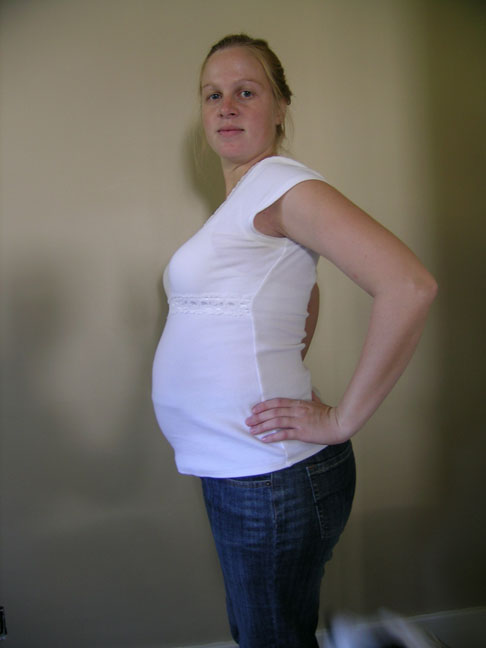
28 weeks gestation

On the bottom is a random belly shot that Eric took. The watermelon belly is starting to appear. Nicer than a lumpy-sack-of-potatoes belly. The best is watching my belly heave and distort when the baby moves around. Sometimes we'll just lie around and watch the acrobatics. We are so easily amused.

Read more ...

25 weeks gestation

And I even have clothes on in one picture!

Read more ...
Related Posts Plugin for WordPress, Blogger...