
Friday, August 27, 2010

Bernina 930: The last sewing machine I will ever buy

I just purchased a Bernina Record 930 and am so excited that I can hardly think of anything else.

Until yesterday, I'd been sewing on a computerized Brother cs-6000 that I bought new (reconditioned) 3 years ago for $140. The Brother was okay for lightweight fabrics, but could not handle anything remotely heavy duty. It struggled with medium-weight linen and deerskin and cotton twill. Denim or cowhide were unthinkable. It often was unable to sew through the layers of pleats in the ring slings that I make. I've had to use my 1940s-era White Rotary machine when my Brother failed. The White is a powerhouse (I found it for $13 at an antique store, and it came with all the original accessories and carrying case), but it only does a straight stitch.
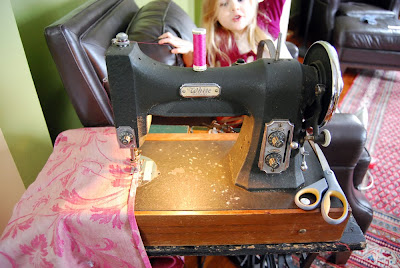
My Brother has seized up inexplicably several times over the past three years. Then yesterday, it refused to sew at all. After just one stitch the thread would snarl and tangle and the machine would shut down, refusing to move another stitch. I cleaned the machine and could see nothing at all obstructing the gears, yet the machine would not sew. I took it to our local sewing machine repair shop, only to find that the starting fee for a tuneup was $60. I didn't want to spend lots of money repairing a mediocre machine, so I decided to look for a new machine.

I wanted something mechanical and all metal. No computerization or complicated electronics. Something that could do, at minimum, straight stitch, zigzag, and a few decorative stitches. I wanted a machine that could handle heavy cowhide or denim without a hiccup. I wanted a machine that people raved about and that they were using decades years later without a single problem. I browsed two furniture consignment stores in town. Both had old sewing machines with cabinets for around $50, but one only did a straight stitch and the other only straight and zigzag.

I hopped on Craigslist and found numerous old Singers, starting at $10 and up. Then I saw an estate sale listing a Bernina Record 930 and my rader started beeping. I read several reviews of the 930 and became convinced that this was the machine meant for me. I inquired about the price and blinked a few times at the response. Let's just say that it cost the equivalent of what I earn sewing 20 slings. That's a lot of sewing.

Okay, so I guess I'll let you know the price: $500. Yikes! For a machine that was made from 1982-89, they still command a very high price. I did a nationwide search on Craigslist and found that the Bernina 930 usually sells between $600-1,000. And that's just for the machine and basic accessories. The one I was looking at had the machine, all original accessories, original owner's manual, Bernina sewing guide, a walking foot, a cut & edge foot, carrying case, wood sewing cabinet with lifting mechanism, and (unknown to me until I purchased it) at least $100 of sewing supplies. The only thing missing was the knee lift mechanism, which allows you to raise and lower the presser foot hands-free.

I headed out as soon as Eric was done with work and made the hour-long drive, hoping that no one else had bought it yet. Luck was with me. It was an estate sale for a woman who'd died. Judging from her house and belongings and sewing room in particular, she was meticulous and had very good taste. I almost bought some of her stylish 1940s-era hats and furs and nightgowns, but resisted the temptation...except for 2 pairs of cotton gloves that I just couldn't pass up.

It sews beautifully and has all the features I could ever need. Yet it's all mechanical, which means that (unlikely) repairs will be simple and easy. It purrs along like a...like a...well I don't know cars well, but if I did, I'd compare it to some high-performance sports car that is less about show and more about the essentials: craftsmanship, durability, extreme precision, and above all, power.

So here she is, in all of her vintage 1980s glory.
 The machine folds down into the cabinet, and the tops fold up over the hole.
 Walking foot and Cut 'n Sew foot (precursor to a serger)
Original manual and book showing advanced sewing techniques with a Bernina
All the presser feet, plus cleaning & maintenance tools
A lifetime worth of sewing machine needles, bobbins, and Olfa blades.
Drawers full of thimbles, tailor's chalk, marking pencils, pins & pincushions, rulers, seam rippers, and various other handy sewing notions. I even found a pair of Gingher featherweight thread snips that I can wear around my neck when I'm sewing! No more searching for my scissors (which are usually on the other side of the room) when I need to snip threads.
More quilting, embroidery, upholstery, and hand sewing needles than I could ever hope to use.
Sewing Susan needles: pure vintage.
Read more ...

Thursday, August 26, 2010

16 months old!

Dio is 16 months and racing towards becoming a little boy. People who haven't seem him over the summer will remark on how different he looks, how they wouldn't have known it was him if I hadn't been there. I think he looks the same, but that's because I'm around every day. It's strange, and a bit bittersweet, to look at pictures of my children when they were little babies. They look like strangers to me now--Zari especially--even though I was sure I had memorized every feature.

You know, these kind of moments.
Illustration by Heather Cushman-Dowdee of Mama-Is. 

Here's a rundown of our day--it gives you a good idea of what Zari and Dio are up to.
  • 6:30 am: Dio wakes up. I go in and nurse him, in the hopes that he'll go back to sleep. Doesn't work, so we get out of bed at 7:15. Potty and then breakfast. 
  • 7:30 am: Zari wakes up and joins us for breakfast. Dio eats a bowl of cereal and then homemade yogurt. He wants to do it himself, so I give him the bowl and spoon and let him have at it. He's very happy and very messy. Eric gets ready for his 8am class (first day of school!). He teaches all 3 classes on Tues & Thurs. Zari and Dio play in a big cardboard box and help me hang up laundry on the clothesline.
  • Dio goes in the shower with me, since he's a walking yogurt bomb. Well, technically he takes a bath in a small rubbermaid bin that sits in the shower--we don't have any bathtubs in our house. Zari hops in too. We get dressed, brush teeth and hair (Zari hasn't had a hair brushing freakout for at least a week, thank goodness), put shoes on, and pack a few snacks for the morning's excursion.
  • I load both kids in the 1-passenger stroller and head out on a gorgeous, sunny day. First we go to library story time. On the way home we stop by a sewing machine store and a few furniture consignment stores. I give the kids cheese and crackers to keep them content during all this errand-running. When the food runs out, Dio starts trying to climb out of the stroller. We have a few freakout moments, especially when I tell Zari she has to walk the rest of the way and she melts into a crying puddle on the sidewalk. I cheer her up and she decides that walking isn't so bad after all. But then Dio wants OUT. Eventually I undo his buckles and let him stand up in the stroller and hold on for dear life. He thinks this is pretty cool and decides to stop screaming.
  • Lunch (eggplant parmesan and wickelkraut from last night, plus cherries and plums and grapes). Naptime for Dio. Then Zari comes into my lap and falls asleep too! Eric comes home and sees both kids sleeping, so we head off to the bedroom for some talking and snuggling and you know...
  • Both kids wake up at 3:30 pm. I was able to read for a while (fun page-turner called The Terror--great for going to the gym, because it makes the time go by quickly). We go outside and hang up diapers on the clothesline, play on the swingset, water & pull weeds in the garden, and pick raspberries. Eric comes home briefly to change clothes, then heads back up to campus to play Ultimate frisbee. 
  • 5:30 pm: I fetch Eric from his frisbee game because I need to make a last-minute trip to a town an hour away to buy a sewing machine. He takes the kids and I hurry off, hoping no one else has bought the machine. They haven't. It is awesome. More about it later. I get back at 8:30 pm. Dio is already in bed. Zari helps us set up the new sewing machine and finds lots of treasures in the new sewing desk: antique thimbles, a wooden pencil case with scroll-top lid, and a magnifying glass. I tell her that if she goes to bed and sleep all night long, she can play with her treasures first thing tomorrow morning. We snuggle and talk and finally I tell her that I need to go downstairs. She reluctantly lets me go. Most nights we end up snuggling with her until she falls asleep, but she was a bit too wired tonight.
Today was very good in terms of Zari-Dio conflict (or lack thereof). Some days Dio shrieks almost constantly, usually because Zari is taking away his toys or pushing him over. But if we keep busy enough, the kids have too much fun to get frustrated with each other. I still can't believe that I'm having another baby. I've thought about this pregnancy for probably a grand total of 5 minutes! Once I feel the baby moving and listen to the heartbeat on my fetoscope--haven't tried yet, but it should be audible soon--it will feel more real. I also have my first prenatal visit next week.

Now some pictures...
 Zari's first time horseback riding, at my aunt's house in Cache Valley.
With their great-grandparents at Third Dam in Logan, UT
Read more ...

Tuesday, August 24, 2010

Pregnancy Brain / Placenta Brain

I've often heard women talk about having "pregnancy brain" or "placenta brain"--those momentary (or lengthy) bouts of forgetfulness or absentmindedness due, supposedly, to being pregnant. Just tonight, in fact, I was asking an acquaintance of mine to remind me to pick her up for a playgroup tomorrow, if I didn't show up on time. "I have a pretty bad memory," I said.

"Oh, especially right now," another friend of mine said knowingly, meaning because I was pregnant.

"No, not because of being pregnant--just because I have a bad memory for appointments!" I said.

Both women were very surprised to hear that I'd never experienced pregnancy-induced forgetfulness. Never anything of the sort. My brain functions just as well when I'm pregnant as when I'm not. But I've heard so many women talk about placenta brain and pregnancy brain...and I'm wondering: is there any sort of information on this phenomenon, besides anecdotal experiences? Does pregnancy brain really exist, or is it just a convenience excuse for normal memory lapses that happen to occur during pregnancy?
Read more ...

Sunday, August 22, 2010

High-res images (updated)

Below are several high-resolution images of the 1871 LDS Sacrament Meeting I posted about a few days ago. The last two come from the original illustration and explanatory text in Harper's Weekly, Sep 30, 1871.
Read more ...

Saturday, August 21, 2010

Breastfeeding history moment: LDS Sacrament Meeting, 1871

My sister-in-law (remember her from her birth story Failure to Progress or Failure to be Patient?) took this picture for me at the LDS Church History Museum. It's an illustration from Harper's Weekly of an 1871 Sacrament Meeting in the Mormon Tabernacle in Salt Lake City, Utah.

The Harper's Weekly text reads:
The double-page illustration which we give this week shows the administration of the "Sacrament," large pewter vessels, of which several may be seen in front of the pulpit, being used for the purpose. All present, men, women, children, and babies in arms, partake.
On the left side, you can see two women breastfeeding. (Click on images for a high-res version.)

From this illustration I learned several things about the culture and practice of breastfeeding at this time (late 1800s), place (Utah), and culture (Mormon):

1) Public breastfeeding was accepted as normal in mixed company and during worship services.
2) LDS women breastfed in public without a cover or blanket.
3) The norms of dress at the time meant women unbuttoned their dresses at the chest area to nurse. In the closeups below, you'll see dress opened, exposing the nursing breast.

The illustrator seems familiar with the techniques of breastfeeding (or was just good at reproducing what he/she saw). Notice the woman supporting her breast while her baby nurses, something I often do myself.
The engraving originally appeared in Harper's Weekly.Text describing the illustration is on the upper left column.
Other posts about nursing & LDS culture:
Breastfeeding History Moment: Mormon Handcart Pioneers
Breastfeeding in Church

Other people's posts on this topic:
Breastfeeding at church: now and then at Life Inspired
Breastfeeding and LDS Church at Improves With Age
Several posts from TopHat: Modesty and Breastfeeding, Sacrament Meeting 1871,  & Inquisition Monday
Read more ...

Friday, August 20, 2010

My garden

Two years ago, the back of our yard was a gravel parking area. It was the best place for a garden--full sun, no trees nearby to shade it--but the gravel meant I had to build up with raised beds, rather than dig down into the soil. I got a huge pile of free wood chips from a tree removal company, so those are spread as mulch between the raised beds. Here's what my garden looks like today:
Top beds: 1) beets and some mystery squash/melons, 2) herbs
Middle beds: 1) carrots, 2) tomatoes (mostly Cherokee Purple), shallots, garlic
Bottom bed in the retaining wall: raspberries & strawberries
Top beds (notice the last few fence panels that need to go up): 1) strawberries 2) compost pile/brown matter/compost tumbler
Middle beds: 1) Masai variety bush beans 2) edamame & more bush beans
Bed alongside the garage: blackberries, asparagus, and (harvested) onion patch
Fruit bed that wraps around the swingset: 2 honeyberries, 3 red currants, 3 gooseberries, 3 juneberries.
You can see my shadow--I'm standing on the top of the play house to take the picture.
We also have a 4x10 bed right outside our kitchen door, with tomatoes, potatoes, & herbs.
And lots of mystery melons and squashes in our compost pile & in the jungle behind our garage. I spotted an acorn squash plant but the rest I don't recognize.

Things have been growing vigorously this season, but it seems I've harvested surprisingly little. Other gardener friends of my have made the same remark. My onions & beets were disappointingly small. My carrots, on the other hand, are long and straight and lovely. The beans & herbs have done well, while tomatoes and potatoes got the blight again. I saved most of the tomato plants with a copper spray, but the potatoes finally gave up the ghost. I need to harvest several of the beds and plant beets, kale, salad greens, spinach, and whatever else will grow quickly enough for a fall harvest.
This last picture is a homage to Craiglist--$150 for the whole swingset, including delivery! There's an I-beam for a tire swing on the other side of the playhouse.
Read more ...

Thursday, August 19, 2010

Mexican sleeper terrorist anchor babies?

My husband was watching something online and laughing out loud every few minutes. He called me over and said, "You have to see this. Hey, you should blog about it!" So here goes:

What is the newest threat to our nation's security and freedom? Babies! Anchor babies! Mexican sleeper terror babies! Watch the (wickedly funny) Daily Show episode and roll your eyes over the following real-life quotes from the episode:

Unnamed lawyer: "I know it's babies we're talking about, and it's hard to be tough on babies, but let's remember--we're talking about illegal aliens coming to this country for the purpose of birthing a child. Not because they love the kid, but because they want that child to provide them with the benefits of US citizenship."
~~~~~
TV reporter asks Congressman Louie Gohmert: "Your theory is that Al-Qaeda will send a pregnant woman over here to have a baby and then start to train these babies to be terrorists? Is that right?"

Congressman Gohmert: "Well it's not just a theory..."
~~~~~
Senator Lindsey Graham (R-SC): "Birthright citizenship, I think, is a mistake. We should change our constitution and say that if you come here illegally and have a child, that child's automatically not a citizen. They come here to drop a child. It's called 'drop and leave.' "
Read more ...

Wednesday, August 18, 2010

Selfish and reckless...what next?

Every so often I come across an article that's so over-the-top that I can't not blog about it. This just in from Britain's Daily Mail: Planning a home birth? Sorry, but you're just selfish and reckless. It's a mother's argument about why women shouldn't give birth at home, based on her personal experiences giving birth. Nothing entirely new or even unreasonable in itself, but the author Liz Fraser takes a huge leap from explaining why home birth isn't the right choice for her to condemning and judging all women who choose home birth as reckless and selfish. And lots of other things.

What really irks me about this woman's piece isn't her personal choice to birth in a hospital setting, and not even her conclusion that home birth, to her, seems too risky. It's the blatant lack of research and the self-righteous tone that make her piece particularly insufferable.

Let's turn to the short piece of research she cites to back her claim that there is a tiny but increased risk to the baby at a home birth: the Wax meta analysis on home birth that's been making my Google alert on "home birth" go haywire for the past month. On the surface, this meta analysis seems fairly impressing: over 500,000 births in their data set and the news-grabbing conclusion that home birth "associated with a tripling of the neonatal mortality rate." The author obviously read no further than the news headlines, because a closer look at the Wax meta analysis reveals something else entirely. To come to the conclusion that home birth results in a 3x higher neonatal mortality rate, the study's authors eliminated around 95% of their data set, looking at only 9,811 home births--not hundreds of thousands. In addition, the 2002 Pang study contributed significantly to those numbers on neonatal mortality ("12 of the 18 neonatal deaths in normally formed newborns," according to Amy Romano of Science & Sensibility). The Pang study was based on birth certificate data and included unplanned home births in its data.

Now let's take a look at Fraser's tone. I understand why some women really prefer being in a hospital setting and truly feel safer there. And I don't try to talk them out of it, or convince them they're misguided, even though I might make very different choices. But Fraser's article isn't really about her--it's about you and me. About everyone who makes different choices from her. And it isn't at all understanding or supportive or even somewhat self-reflexive. Read a few of her sentences and you'll see what I mean:
Home is the perfect environment for many things, but there's one thing it's definitely not right for - and that's giving birth. For that, there are things called 'hospitals' and they are full of lovely people called 'doctors'....

We're talking about the life of two people here - and, by association, the lives of everyone they know - and I value that ever so slightly above the need for comforting personal effects and my favourite CD on the stereo. And to me, anyone who doesn't is being not only very foolhardy, but also incredibly selfish. As well as having written three books on parenting, I have given birth three times, and never considered having my baby on the Ikea rug in my living room....

[I]t's vital for mothers to maintain a sense of self, to keep meeting their needs and to teach their children that they are not the most important things in the universe. I wish more overindulging parents would try this. But where childbirth is concerned, I firmly believe we need to put our self-centred wishes aside, and be in the safest possible place just in case things go unexpectedly wrong....

Those in favour of home birth speak of it as being a ' positive' choice. Of the journey into hospital being 'unpleasant'. Of hospitals being 'uncomfortable' And for whom? For the mother - not for the baby. Now, I dislike strip lighting, the clinical smell and not being able to drink a cup of tea out of my favourite mug as much as the next woman trying to get a human out of her body. But these discomforts seem shamefully insignificant compared with the importance of having a safe, healthy delivery - even if the risk is tiny. And at least if I get myself to the hospital from the start, I know there's no chance I'll end up rushing there in an emergency, thus putting my baby's life at risk....
And one of the best ever--having a baby at home is selfish because the midwife gives you one-on-one attention for the duration of your labor!
And I only have to look to all the doctors I know who have chosen to give birth in hospital to know it's the safest place to be. The other selfish aspect of a home birth is that it requires a fully-trained midwife to leave the hospital and give one woman her undivided attention for the duration of her labour, which can be 24 hours or even much longer....There is no mention of all the other women in hospital who might need the midwife's care during that time. Thought is given only to the right of the woman to choose to give birth wherever she likes.
Never mind that one-on-one, uninterrupted care during labor is probably the safest kind available. And thus, in Fraser's reasoning, this should earn a mother gold stars for her concern about the baby's safety.

Let's leave behind the talk of selfishness, or the mythological notion that home birthers care more about "The experience" than their babies' welfare. The author condemns home birth (which she clearly knows little about in any breadth or depth) with a flourish of her sarcastic, snarky pen. That smacks of both shoddy journalism and a constricted worldview.
Read more ...

Monday, August 16, 2010

Website launch

I'm thrilled to announce the launch of my new Second Womb Slings website: www.secondwomb.com! I've been working on the site with the help of my graphic designer cousin and a web developer who traded her programming skills for a silk and batik Ergo-style carrier. I've added lots of fabrics and a few new products, including DIY sling kits and gift certificates.

Come on over for a visit!

Read more ...

Sunday, August 15, 2010

Lots of good news

We're finally back home for good, after being away almost all summer! We actually got home a day later than planned. Our flight home was overbooked, so we volunteered to be bumped. In addition to flight vouchers, we got to spend an extra night & day in downtown Salt Lake City, paid for by Delta Airlines.

Tomorrow evening I'm giving a presentation about natural birth for C.H.O.I.C.E.S. Come join me at 5:30 pm at the West Lafayette Public Library!

Other good news: yesterday was our 12th wedding anniversary! We didn't do much, since we were recovering from jet lag and two very busy weeks of visiting family. But earlier this summer we celebrated with dinner at Ze Kitchen Galerie in Paris. The food was really, really, really good...but I've actually had just as good of food for a much better price in other places in France. Such as the Restaurant du Golf near Royan. Mmmmm....

And finally, Zari has a secret that she wants to share with you:
Read more ...

Monday, August 02, 2010

American Gothic, or what we did last week


90+ degree heat, high humidity, and swarms of bugs did not deter us from installing 200 feet of privacy fence before we left for a family reunion last Thursday. Here we are mid-project. One of the days had a heat advisory and a heat index of over 100. Around 3 pm we were positively wilting and wondering "What's wrong with us? Why can we hardly move?" Then we figured out how hot it was and called it a day.

Anyway, I'm taking a blogging break until I get back from the reunion late next week. Later...
Read more ...

Thursday, July 29, 2010

Guest Post: Summer Reading on Maternal Care

The following is a guest post by Christine H. Morton, PhD, Research Sociologist and List owner of ReproNetwork.org. You can reach her at christine@christinemorton.com.

Summer Reading on Maternal Care:
Mis-Steps and Steps Forward….

As a medical sociologist interested in childbirth practices, I’ve got a library of fiction and nonfiction that has grown exponentially over the years. I’ve read all the usual suspects but recently have come across some compelling gems that somehow I missed over the past few years.

Now that I’m working with the California Maternal Quality Care Collaborative on the issue of maternal mortality and morbidity, I’ve been drawn into the world of quality improvement, patient safety and that bogyman of defensive obstetrics, ‘liability and malpractice.’ So imagine my delight when I discovered What do I say?: Communicating Intended or Unanticipated Outcomes in Obstetrics by James R Woods and Fay A Rozovsky — an obstetrician and a lawyer, respectively.  Their book (Jossey-Bass 2003) is designed to help obstetricians improve communication about bad outcomes while avoiding liability. It’s an interesting, if ultimately unsatisfying, book because it is very narrowly construed along those lines. While it fulfills its own goals admirably, for me it doesn’t take the issues further by examining the lack of communications and teamwork skills in medical school curricula or the real patient safety issues that emerge with some standard obstetric practices that are not evidence based. The case examples are very interesting though. How does an obstetrician who fought with a nurse about the appropriate course of action in the hearing of the laboring woman, discuss the adverse outcome with the new mother afterwards? I think I snagged the last used copy at a reasonable price off Amazon but perhaps your local library can get you a copy; it’s worth a read.

The next book I read followed as a perfect complement: the story of an obstetrician and her journey through self-discovery and healing after she is sued in the course of her work. Delivering Doctor Amelia The Story of a Gifted Young Obstetrician's Error and the Psychologist Who Helped Her (Vintage 2004, and many cheap used copies online). Dr. Amelia Sorvino is a well liked obstetrician who has been in practice a few years when, in order to respect her patient’s desires for a vaginal birth, delays a cesarean section. Subsequently, her patient’s baby is diagnosed with cerebral palsy; she loses her nerve, stops practicing and faces a lawsuit. The narrative structure centers around the therapy sessions with the author Dan Shapiro and Dr. Amelia, and the story is told through the psychologists’ lens. So many issues emerge that struck me as very illuminating in terms of how current medical training gets in the way of self-knowledge and personal growth of these young, hard working men/women. It fails to help them see the larger structures of politics/law/medicine, etc., affect their work (ok, the sociology of it all...). It’s a gripping read. I feel like we are missing the sense that doctors, yes, even obstetricians, are people, not perfect clinicians all the time, and our health care (and liability) systems are not set up to allow authentic engagement on a number of levels.

There is also a good novel about a Seattle anesthesiologist who gets sued, and her experience: Oxygen, A Novel by Carol Cassella, if you can bear to expand your reading beyond birth topics!.

The issue of ‘trauma’ among obstetric clinicians regarding their experience and fear of lawsuits is an interesting counterpoint to the ‘trauma’ experienced by birthing women — see this nice piece by an Australian journalist, Hard Labour, which really captured some of these issues.

I’m starting now to read Safe Patients, Smart Hospitals: How One Doctor's Checklist Can Help Us Change Health Care from the Inside Out (Hudson Street Press, 2010) by Peter Pronovost and Eric Vohr, a book about patient safety initiatives that were started at Johns Hopkins after poor communication, inflexible hierarchy, lack of appreciation for team perspectives and medical egos resulted in the preventable death of 18 month old Josie King. Not about maternal quality care or obstetric patient safety per se, but I see plenty of parallels in terms of the practices engaged in maternity care systems that put everyone at risk. Probably the only reason more pregnant women aren’t harmed by some of these practices is that they, unlike most hospital patients, are relatively healthy to begin with. The big insight for Pronovost is that hospitals, and the units within them, have their own culture, and this affects how patients are cared for. This isn’t news to medical sociologists and anthropologists (or doulas), but physicians are discovering it for themselves. It’s also a clear ‘news’ item in the quality improvement literature.... interesting.

Next on my list, where it’s been for some time, is medical anthropologist Elisa J Sobo’s excellent foray into this literature, Culture and Meaning in Health Services Research (Left Coast Press, 2009). All this to gear me up for thinking about the book in my brain after years of research on maternity care advocates – the doulas, childbirth educators, midwives, and now at CMQCC, obstetric and neonatal clinicians who want to make birth better for women and their babies.
Read more ...

Monday, July 26, 2010

15 months old!

I'm still adjusting to the fact that I have two children. It seems like Dio's birth just happened. But then I see this little boy running around. He's losing his baby fat and his face and limbs are getting longer and leaner.

After spending a few weeks with his cousins, he's started to interact more with other children. He wants to be in the middle of the action at all times.
Like me, Dio's default look is serious and a bit somber. But as I tell people, "If he's not crying, he's happy. Even if he doesn't look like it."
We still get big smiles out of him sometimes.
Dio has 7 teeth and 3 more halfway in. He can walk and climb and throw balls and say or sign lots of words. I'm so glad that we do sign language--nothing hardcore, just a few Signing Time videos--because his words are fairly indistinguishable. But he usually signs at the same time he's speaking, so we usually know exactly what he's trying to say. We've been working on signing "please" because his usual way of asking for something is with a deafening shriek. Now he shrieks, then signs "milk, please" or "nurse, please." I'd like to keep track of all the words he knows or says, but it's getting to the point that I probably couldn't get caught up. Every day it seems there's a new word or phrase that he understands. Like the other day, I told Zari to sit down, and he plopped down right away and looked at me expectantly.

EC: He's doing pretty well going pee in the toilet or on the grass, if we're outside. He usually stands on the toilet seat, facing the bowl. Poops have been more elusive, since he gives very little advanced warning. And he poops all the time, at least twice a day and sometimes 5-6 times! He is really fascinated with pee and poop and loves to watch it be flushed away.

Sleep: Dio naps once in the early afternoon. He sleeps from 8pm-6:45am and rarely wakes up at night. If he does, he fusses for a minute or two and then goes back to sleep. He nurses before he goes to sleep, although he usually isn't totally out when I lay him down. He loves snuggling with his sock monkey. I'm glad I introduced it to him as a sleep aid. He hugs and cuddles it whenever he sees it during the day, and I imagine in the future it will help him bridge going to sleep without me (for example, when we have another baby and I can't always be the one putting him down for naps or bedtime). Now if I could just get Zari to sleep that well...she's been on a long streak of waking up 1-2 times a night and needing us to come into her room and help her back to sleep.

Siblings: Dio and Zari have good times together. Like blowing on each others' stomachs. He also likes to nuzzle his head between my breasts and blow bubbles. (Or farts? What are they called anyway?)

Don't get me wrong--life isn't always giggles and smiles. More often than not Zari is tormenting Dio and he is shrieking to be let go. She likes to tackle him and pin him to the ground. She will walk up to him out of the blue and push him over, and then watch him cry. She takes things away from him just because. And I get the feeling that she's doing these things on purpose to get a reaction from Dio--and from me. It drives me a bit crazy, because Dio is miserable and I feel like a broken record explaining that we don't hit people and Dio doesn't like that-- it makes him sad and please be nice to your brother. Sometimes I just have to remover her from the situation. We call it "taking a break." It entails sitting in a separate room--usually a nearby bedroom--until a) a few minutes have elapsed or b) she can show me that she's ready to get out and play nicely. I'm not sure of a better way to deal with deliberately mean behavior towards a sibling. She's 3, after all, and so I don't want to be making a huge issue out of normal 3-year-old behavior. In any case, I'm open to suggestions...

Vive le Canadian swim diaper. 
Read more ...

Sunday, July 25, 2010

Zari

Just because--some pictures of Zari this month.

Today we were in the garden and she adorned herself as a "forest fairy" with maple tree seedlings and basil.
Ice cream face. 
Jumping on the trampoline at grandma's house.
Cooling off at grandma's.
Read more ...

Friday, July 23, 2010

Bryce Dallas Howard of "Twilight" on postpartum depression

Actress Bryce Dallas Howard recently shared her experience of postpartum depression in Gwyneth Paltrow's Goop newsletter. It's haunting and vivid and so well-written. Here are a few excerpts.
I recently saw an interview I did on TV while promoting a film. In it, I was asked about my experience with post-partum depression and as I watched, I cringed. I said things like “It was a nightmare,” or “I felt like I was in a black hole.” But I couldn’t even begin to express my true feelings. On screen, I had seemed so together, so okay, as if I had everything under control. As I watched, it dawned on me. If I had been able to truthfully convey my ordeal with post-partum depression under the glare of those lights, I most likely would have said no words at all. I simply would have stared at the interviewer with an expression of deep, deep loss....

It is strange for me to recall what I was like at that time. I seemed to be suffering emotional amnesia. I couldn’t genuinely cry, or laugh, or be moved by anything. For the sake of those around me, including my son, I pretended, but when I began showering again in the second week, I let loose in the privacy of the bathroom, water flowing over me as I heaved uncontrollable sobs....

Post-partum depression is hard to describe—the way the body and mind and spirit fracture and crumble in the wake of what most believe should be a celebratory time. I cringed when I watched my interview on television because of my inability to share authentically what I was going through, what so many women go through. I fear more often than not, for this reason alone, we choose silence. And the danger of being silent means only that others will suffer in silence and may never be able to feel whole because of it.

Read the rest of her story here. Be sure to read the entire newsletter, which has other stories and articles about PPD.
Read more ...

Wednesday, July 21, 2010

ACOG issues less restrictive VBAC guidelines

We just got back from a 10-hour road trip and all I want to do is go to sleep...but then I saw that ACOG just issued more liberal VBAC guidelines! This likely occurred in response to the NIH Consensus Conference on VBAC this year. Please visit the following links for more information.

First, read ACOG's press release about the new VBAC guidelines.

Then, read about the significance of the new guidelines at VBAC Facts.
Read more ...

Tuesday, July 20, 2010

DIY Medicine: From Blogger to YouTube

A few years ago, I mentioned an article from the Ottawa Citizen called Barbarians in Blogistan, which discussed the new do-it-yourself movement spreading via blogs. Today, the newest repository of self-help medical knowledge--to be shunned if you have any common sense, the article implies--is YouTube. In DIY Medicine, Dakshana Bascaramurty of the Globe and Mail argues that the new frontier is no longer online medical diagnosis--it's YouTube.
Before, doctors worried about patients who self-diagnosed after doing Internet research on questionable medical websites. But the social Web has given birth to a new beast: users who document their DIY medical procedures on camera and share the videos on YouTube.
Among the procedures mentioned in the article are toenail removals, cyst excisions, boil lancing, cast removal, suture or staple removals, abscess drainage and tattoo removals. And, of course, unassisted birth. Most of the article's examples contain some grisly language describing people pulling out their own toenails, or removing surgical staples in the backyard after a couple of beers. But unassisted birth has, by far, the strongest cautionary tale. The author mentions a 14-year-old girl who gave birth unassisted to a baby who died shortly after birth and threw the baby in a dumpster. Here's an excerpt:
Particularly troubling to Richard Musto, a public health physician with Alberta Health Services in Calgary, are the videos that depict unassisted home births, some of which have garnered millions of hits and several comments from expectant mothers eager to learn about the procedure.

Last month, a 14-year-old girl in Texas was charged in relation to the death of her newborn boy, whom she left in a dumpster. The baby died minutes after he was born and investigators suggest it may have been because the afterbirth blocked his airway. The girl and her younger sister learned how to deliver the baby at home after watching videos on YouTube.

“You can understand it’s a natural thing, but things go wrong in childbirth and that’s why you need to have someone that’s properly trained to manage that,” Dr. Musto says.
I get tired of childbirth being lumped together with medical procedures--from brain surgery to cyst removal to dental surgery. I also find the example of the teenager who throws her baby in a dumpster incredibly insulting to the vast majority of women who prepare extensively for an unassisted birth. Sure, I do worry about someone giving birth unassisted after watching a few videos and reading a some online articles. But that is not reflective of most UCers' level of preparation.

For example, before I gave birth the first time, I became certified in neonatal resuscitation and had first-hand experience resuscitating a newborn. (Short version of the story: precipitous birth, terrible Midwest blizzard, midwife driving as fast as she could. Baby came out limp and unresponsive to stimulation. Midwife was on the phone, advised mouth-to-mouth. The baby perked up after a few minutes of M2M. Midwife arrived a few minutes after the birth, by which time baby was stable and crying. I had vernix all over my face and glasses and clothes. It was quite the sight.)

I'm not saying unassisted birth is perfectly safe, just think happy thoughts and nothing will ever go wrong, la la la. But condemning all unassisted birth--childbirth, after all, is a normal, inevitable physiological event, not a medical procedure--because of one tragic "dumpster baby" is way off the mark.

I'm not calling this one Code Mec yet. But it definitely merits an emphatic eye roll.
Read more ...

Monday, July 19, 2010

Lamaze/ICEA 50th Anniversary Mega Conference

I'll be speaking at the joint Lamaze/ICEA Future of Birth Conference this fall in Milwaukee. I had a blast attending last year's Lamaze Conference in Orlando. I expect that this one will be just as good, if not better!

I've been browsing through the conference program, trying to decide which sessions to attend. I'm especially intrigued by the presentation on More OB. I am excited for the keynote address about the ii\mpact of birthing practices on breastfeeding. And Wendy Budin's presentation on Historical, Sociocultural, Political and Biomedical Views of the Breast. And lots more!

Any of you coming?
Read more ...

Saturday, July 17, 2010

Controls needed for HG study

Last year, I participated as a friend control in a study on Hyperemesis Gravidarum. The researchers have recruited close to their goal of 1,000 participants (women who had HG) but need many more friend controls. One of the researchers explains (emphasis mine):
We currently have almost
 1,000 eligible participants for the HG study, but we have less than 500 friend controls. I'm writing to beg you to refer extra CONTROLS to
 participate in the study. A control is someone who has had at least 2
 pregnancies and has not had any weight loss or treatment for nausea in pregnancy. The controls cannot be blood relatives. Please have any willing friend controls email me at nvpstudy@usc.edu and reference your name or ID number.

We are getting there but I need your help!!!


Thank you for helping me find the cause and cure for HG!


Marlena S. Fejzo, PhD

If you participated in the HG study, please help by referring extra controls (ie, women who did NOT have weight loss or treatment for nausea during pregnancy).
Read more ...

Thursday, July 15, 2010

Wisconsin

We're up in northern Wisconsin for our annual family gathering at my parent's cabin on Lac Court d'Oreilles. Somehow I managed not to take any pictures of us actually at the cabin. You can see some from 3 years ago here, when Zari was just 7 months old.

Two days ago, we took a day trip up to Madeline Island on Lake Superior. Lake Superior is usually ice cold, but a brisk wind was blowing the warmer surface water towards the shore, so the water was swimmable. Cool, but not at all cold. I played in the waves for about an hour. Eric snorkeled, but all he saw was sand.

Waiting for the ferry.
On the ferry.
Sand + sun + water = heaven for little kids
At the end of the afternoon, Dio took a nap under a giant pine tree.
Wisconsin is also the land of hokey oversized objects. It stormed all day yesterday, so we finally went to the Fishing Hall of Fame in Hayward to give the kids something to do. We have driven by it for 20 years but never went in until this year. It was about as chinzy as I expected.
Giant musky that you can walk inside.
Lots of oversized fish on the grounds.
There was even a little children's play area, all fish-themed: fish swings, fish climbing tunnel, fish teeter-totter.
Read more ...

Sunday, July 11, 2010

Conversation with my midwife

A few months ago, the midwife I used for Dio’s birth invited me to come to her office and meet a CNM she was thinking of adding to her practice. (Having a solo home birth practice is very demanding. Adding a second midwife would allow her to actually take vacations more than once every few years, to do more well-woman care, and to have more time for breastfeeding support as an IBCLC). Here are some recaps from our conversation.

My midwife Penny and the prospective midwife Holly talked about their backgrounds and how they came to both midwifery and home birth. Both worked as OB nurses for many years before they even thought of midwifery or home birth. Both eventually pursued a CNM degree with the intention of opening a home birth practice. Penny worked for several years in a large university hospital. It was the end-of-the-line for obstetrical cases, where you’d go if a high-risk situation arose in a smaller, less-equipped hospital; if you needed care for a 26-weeker; if you had an extremely complicated obstetrical history. Penny’s time working at Large University Hospital (LUH) taught her the limits of what medicine could do. Sometimes they could save lives and improve women’s and babies’ health. But other times—all too often—all they could do was offer compassion and support, unable to save every life or prevent all bad outcomes. And this was at the most tertiary of tertiary centers.

Penny said that working in such a high-tech, high-intervention setting gave her much more confidence to pursue a second career as a home birth midwife. She knew first-hand what the most advanced medical care could and could not do. There was no mystery or mystique about what a hospital could offer—something she sees as a great advantage, compared to many home birth midwives who have never worked intensely in a hospital environment.

During her years as a nurse at LUH, Penny loved taking care of home birth transfers. She was able to offer excellent care for the specific medical issues that needed addressing, while otherwise supporting and facilitating the woman’s desire for a gentle, unmedicated birth. I remember her telling me the story of catching one woman’s baby in the bathroom and putting the baby immediately on the mother’s chest—something she thought entirely commonsense, but something she got a lot of flack for from her co-workers. It was these experiences that pushed her to become a midwife.

Penny highly values the knowledge and skills she acquired as an OB nurse in a high-risk setting. She is totally fluent in inserting IVs, administering medications, intubating, resuscitating, etc. Now, she hardly ever uses these skills as a home birth midwife, because they are rarely, if ever, needed. (In fact, one skill she says is becoming rustier than she’d like is suturing, because women in her practice hardly tear, and if they do it’s rare that the tears need stitches—something she attribute to her hands-off approach. Dads or moms usually catch their babies; she steps in only if they do not want to catch or if neither parent is in a good position to do so.) But if/when her medical skills are needed, she is really, really good at them.

While we were chatting with Holly, Penny said to me, “you know Rixa, because of your background with unassisted birth, you hired me for different reasons than many women typically hire a home birth midwife. You didn’t need me so much for labor support or guidance. You really hired me for that 5% chance of needing really skilled medical assistance, something that I can do really well.” I thought about that and realized that I agreed with her. I am really independent and pretty much labor and birth all on my own. I don’t rely on my husband or female companions for labor support or encouragement. In fact, I prefer to do things on my own for the most part. So I wanted a midwife not for the 95% of stuff that she does during labor—now, that 95% is quite valuable and many women love the support and guidance their midwife offers during labor—but for the small chance that I’d need some kind of additional intervention or emergency skills.

Which brings me to another point I want to make—the more exposure I have to midwives, the more I realize how credentials and background do NOT translate into a certain style of practice. I have a lot of experience interacting with “lay” midwives, direct-entry midwives (CPMs), and home birth nurse-midwives. A CNM degree does not mean that a midwife will have a more “medicalized” style of practice (although it is true that most nurse-midwifery programs are geared towards preparing midwives to practice in a hospital setting).

Now, I am sure some people reading this are thinking, “Oh, Penny is such a MEDwife!” But nothing could be farther from the truth. She is very professional and very highly skilled. Very respectful of women’s desires at birth. She had such a quiet presence at my birth that I hardly noticed she was there; she honored all of my requests and wishes that we had talked about prenatally. She was especially adamant about not disturbing the immediate postpartum period. She doesn’t care about liability and has deliberately chosen to forego malpractice insurance and go “bare.” She is willing to go beyond the “standard of care,” to borrow a phrase from Dr. Denise Punger. Her attitude is “you need to prove to me why you shouldn’t have a home birth.”
Read more ...

Saturday, July 10, 2010

Open thread, birth story style

I'm up in northern Wisconsin with my parents, siblings, nieces, and nephews. So today's post will be a group effort. Please share your favorite birth stories--your own or links to someone else's. Talk about the role birth stories played as you prepared to give birth. Anything and everything related to birth stories is fair game!

To get things started, here's the birth story I want to share: a breech home birth at Musings of a Redhead, complete with lovely pictures.
Read more ...

Wednesday, July 07, 2010

All that matters...

And all that matters is that you have a healthy and safe delivery... no matter how it's done.

All that matter is a healthy baby and healthy mommy.

Whatever happens, what matters most is a healthy baby girl and a happy mama and daddy.

In the end, all that matters is bringing a healthy baby into this world, by whatever means necessary.

These are all real statements I came across one day last week.
 
I find these statements both tyrannical and tautological. Tyrannical because it leads to a restriction of choices in the name of safety. Tautological because *of course* mothers want their babies to be born healthy and want themselves to come out of the process unharmed.

The "healthy mom/healthy baby" rhetoric, if followed to its logical end, leads down several ridiculous and contradictory paths.

First, it allows widespread abuse and manipulation of birthing women by negating anything that happened in the course of the birth, as long as the mom and baby survived. (Because in this context, "healthy" is a euphemism for made it out alive, not necessarily thriving and vibrant and injury-free.) It excuses any and all deviations from principles of evidence-based medicine and informed consent. And ironically, it often leads to greater net harm. Why? Because the "healthy mom/healthy baby" rhetoric is usually used to justify increased medical intervention. Pressured to have a c-section you didn't want or need? Encouraged to have an induction for dubious reasons? Given an episiotomy even though you clearly said you would rather tear? You should be grateful, because all that matters is that you have a healthy and safe delivery... no matter how it's done.


Second, it creates a false dichotomy between Good Moms who do the Right Things (like doing whatever their care provider says without asking questions) and Bad Moms who care more about The Experience than their own and their baby's wellbeing. You know, the hedonistic, selfish, narcissistic moms who'd rather listen to Enya and labor in an Aquadoula than have a living baby.

Third, it creates an artificial hierarchy of women's wants and needs, in which the mother's--and especially the baby's--health cannot coexist equally with other goals. Goals such as feeling respected and honored and joyful during the birth process, being able to make decisions about their care, and emerging from the birth feeling powerful and confident.

Fourth, the healthy mom/healthy baby idea opens the door for dictatorial top-down decisions. Because if the most important thing is a healthy mother and a healthy baby, then logically anything that adds additional risk to mother or baby should not be allowed. Let's follow this logic down its slippery slope to the final, authoritarian end:
  • No epidurals or pain medications except for surgical births, because they add medical risk with no medical benefit (no one has ever died from the sensations of labor, but there are a host of risks--from minor to deadly--from epidural anesthesia and IV narcotics).
  • No elective inductions.
  • No elective cesareans.
  • No home births (if you believe there is increased risk to the baby).
  • No hospital births for low-risk women (if you believe there is increased risk to the mother and/or baby from standard hospital and obstetrical practices).
  • No VBACs because they have a slightly increased risk to the baby.
  • But no repeat cesareans because they are riskier for the the mother and sometimes the baby as well...So if you have a cesarean, you are not allowed to have any more children, since both VBAC and ERCS carry risks, and risk to either mother or baby is not acceptable. After all, the most important thing is a healthy mom and healthy baby.
See how ridiculous this is becoming?

I'm not saying that I don't value a healthy mother and healthy baby. On the contrary. It's just that the "healthy mom/healthy baby" rhetoric serves as a smokescreen. I'm thinking back to a comment by a family physician whom I am honored to know. She attends births as part of her family practice and has four children of her own:
I know as a mother that I would do anything to have my children whole and healthy (and I'm so blessed that they are!). I would have 10 cesareans, I would take any intervention, I would walk on hot coals. But it doesn't mean that we should require everyone to have every intervention known - or even that that would be the safest for everyone. I would take any intervention to have a healthy baby if it was needed, but that doesn't mean I should have every intervention no matter what.
Read more ...

Blog updates

First I want to say a huge thank-you to everyone who commented on my existential blogging crisis. It means so much to me to hear from you, and I wish I had time to respond to everyone individually. And don't worry--I have no plans to stop blogging any time soon. I really love doing this blog and I can't imagine how isolated I would feel without it.

Now for some housekeeping: I finally was able to log onto Facebook and created a fan page. All my blog posts will automatically be updated there, making it easier for you to read & share my posts. I've also linked the page to my Twitter account, so you can receive updates about new posts via Twitter.
Read more ...

Tuesday, July 06, 2010

Delivery room wrestling match

In an article in the Omaha World-Herald about using alternative positions for labor and birth--aptly titled Stand and Deliver--one physician literally wrested an ambulating woman onto the delivery bed. Dr. Maureen Fleming is director of general obstetrics and gynecology at the Creighton University School of Medicine. Here's the story:
As for obstetricians preferring a more convenient position, Fleming said they, like midwives, are accustomed to strange positions and situations. She recalled a woman in so much pain that she angrily started to walk out of the hospital room. Fleming had to wrestle her back. “I almost fell on the bed with her because I had to throw her on the bed.”
The midwives interviewed for this article tended to be more supportive of alternate birth positions, including kneeling, standing, and squatting.
Alternative positions are by no means sweeping maternity units. The majority of births are done with epidural injections, which numb the lower body and make it virtually impossible for the woman to stand or squat. Nevertheless, some midwives and other delivery experts suggest that expectant mothers are more frequently considering delivering from some position other than the back. “I recommend women get out of bed all the time,” said Heather Ramsey, a certified nurse midwife at the Med Center.

Ramsey and other proponents of alternative positions say the benefits can include decreased pain, better blood circulation for the mother and baby and easier downward descent for the baby. Pain medications, they say, can make the mother and baby drowsy, which may impede the infant's ability to immediately breast-feed.
The two physicians interviewed for the article, on the other hand, viewed analgesics and epidural anesthesia as overwhelmingly positive:
Fleming and Pankratz, a board member with the Nebraska Medical Association, said pain medication and epidurals are fine. “We don't believe there's anything unnatural about alleviating pain in labor,” Fleming said. “My philosophy,” Pankratz said, “is technology is present to make our lives better.”
The article began with a woman who gave birth in a hospital standing up, one knee propped up on the bed. Rosalina Romero tried several different positions, finally finding one that alleviated the intensity:
Finally, she stood with her fists on the bed. The horrible pain dissipated and became more of a burning sensation, far more tolerable. “It's just what felt natural,” she said. She lifted one leg and her husband, Brent Vignery, held the leg up. The baby's head began to come out. She put a knee on the bed and kept one foot on the ground. Their baby, Dexter, emerged. “Gravity helped a lot,” she said.
In contrast, Dr. Fleming expressed her doubts that gravity helps the birth process:
Fleming said she doubted gravity played a role in delivery, as some proponents of standing or squatting believe. The opening of the cervix, or cervical os, holds the baby in, she said. “Babies don't just fall out,” she said.
My commentary:
Delivery room wrestling match = assault and battery
Does gravity cease to exist if you don't "believe" in it?
Read more ...

Friday, July 02, 2010

Existential blogging crisis

Sometimes I wonder why I blog and whether I should keep going. This boils down to a few questions:

Is my blog too birthy? Or is it too filled with the mundane and the everyday? I feel like I haven't posted much about family life because it seems so...quotidian. But then I start feeling boxed when the blog becomes more and more about birth and pregnancy and less about anything else. I've thought about starting another blog just for personal/family life stuff. I even have a great blog title and address called Two Frozen Doctors. However, I hardly have the time to do one blog, let alone two. So for now, I'm sticking to one.

I love the discussions we have here, but I do wonder: does any of this make a difference? As much as it's nice to talk with people whose views you already share, to feel a sense of commonality and community, I wonder if anyone else is even reading. Let alone examining their own viewpoints and experiences in light of what gets talked about here.

And then there's the whole "am I wasting my time when I could be doing *real* things in the *real* world?" question.

I'd love your feedback on these questions. I'd also like to hear about which kind of posts you want more of. Some of the things I do on this blog include: research updates and analysis, guest posts, my own meditations on birth and mothering, academic essays, critiques of North American obstetric practices, links to blogs and news articles, birth stories & videos, and book/film/product reviews, and updates and pictures of my family.
Read more ...

Thursday, July 01, 2010

New York State passes Midwifery Modernization Act

Read more about it here.
Read more ...

A physician speaks about doulas and birth plans

This comment just came in from Kingsdale Gynecologic Associates: Doula Ban and Birth Plan.
So I am actually a physician. Doula's may be beneficial in some situations, but you all must remember that the role of a physician is to provide good medical knowledge and advice based on evidence. Where Doula's may be thought of as positive most have zero training and often times may give inaccurate medical advice which is out of their scope of practice. If people want Doula's there should be a government agency licensing those individuals. As you wouldn't want just any person playing your doctor the same gaves for those helping. If they obstruct what we are trying to do they are not beneficial and can ultimately hurt you. Further, they do not have any medical liability. If you want a Doula they should accept medical liability for the 18 years that OB gyns do. In regards to birth plans. They are all nonsense. When it comes to the delivery room most if not all mean nothing. Your in pain you said I don't want drugs you change your mind you get drugs. Happens everywhere all the time. Look the most important thing is not extra personnel in the delivery room. The important thing is a safe and healthy delivery for both the infant and mother. Any mother or father for that matter that thinks anything else is more important should not have children till they get their priorities straight.
Let's discuss this comment from multiple angles--research evidence for/against doulas, personal experience as a doula/birthing woman/nurse/physician/midwife, role and usefulness of birth plans, desirability of licensing and malpractice insurance for doulas, etc.

Here are a few links to get the discussion started:
Have at it.
Read more ...
Related Posts Plugin for WordPress, Blogger...